
Walk into any electronics aisle or scroll through budget monitor listings and you’ll hit the same fork in the road: a 144Hz IPS panel or a 165Hz VA panel, often within a few dollars of each other. The refresh rate difference looks meaningful on paper, but the panel technology underneath it shapes far more of your daily experience—colors, contrast, viewing angles, and how the screen behaves when you’re not gaming at all. This guide breaks down what each option actually delivers at the sub-$120 price point, so you can spend your money on the right trade-offs for your home rather than chasing a number on a spec sheet.
Top 3 picks at a glance
Quick Verdict
For most budget gamers who also use their monitor for everyday computing, a 144Hz IPS display is the safer, more versatile pick. IPS panels offer wider viewing angles, more consistent colors, and faster perceived response, which matters in competitive shooters. A 165Hz VA panel wins if you mostly play single-player games with dark, atmospheric scenes—the deeper blacks and higher contrast (typically 3,000:1 versus roughly 1,000:1 on IPS) make those games look genuinely richer. If raw frame rate is your priority and you don’t mind some smearing in dark scenes, VA at 165Hz delivers. If image quality and versatility matter more, 144Hz IPS is the better long-term roommate.
As an Amazon Associate we earn from qualifying purchases at no extra cost to you. Product prices and availability are accurate as of the date shown and are subject to change.


Side by Side
| Factor | 144Hz IPS | 165Hz VA |
|---|---|---|
| Color accuracy | Strong out of the box; typical coverage near 99% sRGB at this price | Decent but often oversaturated or slightly shifted; usually 90–100% sRGB |
| Contrast ratio | Around 1,000:1; blacks look grayish in dark rooms | Around 3,000:1; noticeably deeper blacks |
| Viewing angles | 178° horizontal and vertical; minimal color shift | Roughly 178° on paper but colors wash out and gamma shifts off-center |
| Motion response | Fast pixel transitions; less ghosting in fast games | Prone to dark-level smearing (“black smearing”) in fast dark scenes despite the higher refresh rate |
| Comfort for mixed use | Excellent for web, documents, and side-by-side windows thanks to consistent color at angles | Fine head-on; text and color shift when you lean or share the screen |
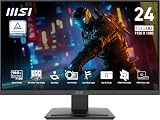
| Price range | Roughly $85–$110 (e.g., the Dell SE2426H and MSI PRO MP243L both sit at $89.99) | Roughly $80–$110 (e.g., the Sceptre E248B-FW165T at $83.97) |
| Maintenance | Identical: dust the panel, avoid pressure on the screen; neither needs calibration to enjoy | Same routine; no meaningful durability difference between the panel types |
| Space needed | 24-inch class panels are nearly identical: about 21 x 16 inches with stand, 7–9 pounds | Same footprint class; VESA 100mm mounting is common on both |
| Resale value | IPS carries broader appeal on the used market; slightly easier to sell | Sells fine but attracts a narrower buyer |
| Best for | Competitive play, mixed gaming-and-work use, shared rooms | Movie nights, atmospheric single-player games, dim rooms |
Where 144hz Ips Wins
Competitive and fast-paced games. The real bottleneck at this price isn’t refresh rate—it’s pixel response. Budget VA panels commonly show dark smearing when a fast object crosses a dark background, which is exactly what happens in most shooters. IPS panels transition faster and more consistently, so 144Hz on IPS often feels smoother in motion than 165Hz on VA.
Mixed use and shared screens. If you answer email, edit photos casually, or watch videos with someone sitting beside you, IPS keeps colors and brightness consistent across its 178° viewing angles. VA panels lose contrast and gamma the moment you’re off-axis.
Daytime, bright-room gaming. IPS panels at this tier typically hit 250–300 nits with solid anti-glare coatings, holding up better against windows and lamps. VA contrast advantages disappear entirely in a lit room.
Value. The 144Hz IPS category is brutally competitive. Options like the Dell SE2426H and MSI PRO MP243L at $89.99 each include 1ms-rated responses, FreeSync, and dual HDMI inputs—features that cost noticeably more just a couple of years ago.
Where 165hz Va for Budget Gaming Monitors Wins
Dark, cinematic games. Horror titles, space sims, and story-driven games with lots of shadow detail benefit enormously from VA’s ~3,000:1 contrast. Blacks actually look black instead of dark gray, and subtle lighting in a cave or night scene reads with far more depth.
Movies and streaming. The same contrast advantage makes VA the better panel for film nights in a controlled-light room. If your monitor doubles as your TV, VA is the more home-theater-friendly technology.
A modest frame-rate edge. 165Hz is about 15% more frames per second than 144Hz. If your PC pushes 150+ fps in esports titles and your GPU matches the panel, you get a slightly smoother experience—assuming the VA panel’s response can keep up, which varies by model.
Price. VA remains the cheapest way to hit high refresh rates. The Sceptre 24-inch at $83.97 with dual DisplayPort and dual HDMI inputs plus built-in speakers undercuts most 144Hz IPS options while adding connectivity many competitors lack.
Cost Over 5 Years
Budget gaming monitors are cheap to own once purchased. Expect either panel type to draw 20–35 watts in typical use. At the U.S. average electricity rate of roughly $0.17 per kWh, five years of six-hours-per-day use costs about $28–$46 total—identical for both technologies.
Panel longevity is also a wash: both IPS and VA are rated in the tens of thousands of hours (30,000+ hours puts you near 13 years at that usage). Real-world replacement drivers are accidental damage and obsolescence, not panel failure.
Where costs diverge slightly is resale and upgrade friction. A used 144Hz IPS 24-inch typically fetches $40–$60 on the secondhand market; comparable VA units often sell for $10–$15 less because demand is narrower. If you replace your monitor within the five-year window, IPS claws back a little of the difference. Buy the Sceptre at $83.97 and you start $6 ahead of either $89.99 IPS option anyway—enough to offset most resale gaps.
Budget a one-time $15–$25 for a decent DisplayPort or HDMI 2.0 cable if one isn’t included, since 165Hz at 1080p generally requires DisplayPort or a high-bandwidth HDMI port.
Which One for Your Home
Small Apartment or Dorm
Space and versatility rule. A 24-inch IPS at 144Hz handles gaming, video calls, and coursework from every angle on a small desk, and its brighter, glare-resistant panel forgives a setup near a window. The MSI PRO MP243L’s 4-side slim bezel and VESA mountability make it easy to wall-mount or pair on a dual-arm if your desk real estate shrinks. Look at the $85–$95 IPS tier first.
Family with Kids or Pets
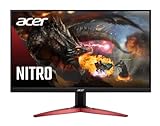
Prioritize sturdiness and brightness over contrast. Kids and daytime lighting flatten VA’s contrast advantage anyway, and IPS holds up better when someone games with curtains open. Tilt-only stands are fine at this weight (7–9 pounds), but check that the stand base is deep enough—16–18 inches—to resist a bump. Both the Dell SE2426H and Acer Nitro KG241Y Sbiip (a 180Hz IPS option at $109.99 if you want headroom) fit this profile well.
Rental or Temporary Setup
Buy cheap, stay flexible. VA’s lower price point and the Sceptre’s built-in speakers mean one less peripheral to move, and dual DisplayPort plus dual HDMI inputs let it hop between a console, a laptop, and a desktop without a switch. If you might leave the monitor behind or sell it in a year, the $80–$90 VA tier minimizes your downside.
Long-Term Home
If this monitor will anchor your desk for five-plus years and double as your media screen, think hard about what you do outside games. Heavy movie and atmospheric-game use tilts toward VA’s contrast; everything else tilts toward IPS’s color consistency and resale value. Many long-term buyers land on a 144Hz IPS model and never regret it—by the time you want more, panel standards will have moved again.
FAQ
Is 165Hz really faster than 144Hz in practice?
Only slightly. The 21 extra frames per second amount to about a 15% difference, which most people can’t perceive. Panel response time usually matters more; a fast 144Hz IPS panel often feels smoother than a slower 165Hz VA one, especially in dark scenes.
Do VA panels still suffer from ghosting at this price?
Some do. Budget VA panels commonly show “black smearing”—a dark trail behind fast objects on dark backgrounds. It varies by model, so read panel-specific feedback on any VA monitor you’re considering rather than assuming the higher refresh rate solves it.
Are these monitors good for console gaming?
A PS5 or Xbox Series X targets 4K/120Hz, so a 1080p 144Hz or 165Hz monitor won’t take full advantage, but it still delivers a sharp 1080p picture at 60fps and accepts the signal fine. Check that the monitor has HDMI 2.0 or newer; both the Dell SE2426H and Sceptre E248B-FW165T meet that bar.
Should I pay more for 180Hz IPS instead?
Only if your PC actually pushes those frames and your budget stretches to around $110. The Acer Nitro KG241Y Sbiip offers 180Hz on an IPS panel for $109.99, which splits the difference nicely—but the practical jump from 144Hz is small, and the money might serve you better in a better GPU or peripherals.


