
Shopping for a gaming monitor usually starts with one question: how high should the refresh rate be? It’s easy to assume that bigger numbers are always better, so many buyers chase 240Hz or higher without checking whether their PC, the games they play, or even their eyes will benefit. The result is overspending on speed you can’t use, or underspending on the panel quality and ergonomics that affect you every single day.
When you are figuring out how to choose gaming monitor refresh rate for value, the smartest approach is not to pick the highest number on the spec sheet. It’s to match refresh rate to your hardware, your competitive needs, and your total budget. A well-balanced 180Hz monitor with a good IPS panel and solid stand will feel better long-term than a cheap 240Hz display that cuts corners on color, brightness, and build. This guide breaks down exactly what to prioritize so you pay for performance you will actually notice.
As an Amazon Associate we earn from qualifying purchases at no extra cost to you. Product prices and availability are accurate as of the date shown and are subject to change.



Top 3 picks at a glance
Decide These 3 Things First
Before you compare Hertz, lock in these three decisions. They determine which refresh rate actually makes sense for you.
1. What can your PC or console consistently push? Check the frame rates you get today in the games you play most. If your GPU averages 90-120 frames per second in competitive shooters at 1080p, a 240Hz monitor will sit half idle. If you average 180+ fps in Valorant, Fortnite, or Apex Legends, you can use 180Hz to 240Hz. For most single-player or story-driven games capped at 60-75 fps, anything above 144Hz is headroom, not value.
2. What do you play to win vs. play to enjoy? Competitive FPS and fighting game players gain the most from 180Hz to 240Hz because every millisecond of motion clarity matters. Casual, RPG, and strategy players benefit more from better color, contrast, and screen size than from the jump from 144Hz to 240Hz.
3. What is your total monitor budget including ergonomics? Decide on a firm range. In 2026, value 1080p gaming monitors cluster from $99 to $185. If your ceiling is $110, a quality 180Hz IPS display is better value than a stripped-down 240Hz TN panel at the same price. If you have $150 to $180, 240Hz IPS with FreeSync Premium becomes the sweet spot.
Size and Resolution: Don’t Outrun Your GPU
For value shoppers, 24-inch to 27-inch at 1920×1080 (FHD) remains the best balance of sharpness, speed, and price. At this resolution, even mid-range GPUs can hit high frame rates without upscaling tricks.
A 23.8-inch to 24-inch panel viewed at 22 to 28 inches away fills your central vision without forcing large head movements, which helps in competitive play. It also keeps pixel density at about 91-92 pixels per inch, sharp enough for text and UI without needing Windows scaling. These models typically weigh 6.5 to 9.5 pounds without the stand and 8 to 13 pounds with the stand, and use 18 to 28 watts during gaming.
A 27-inch FHD panel offers more immersion and is easier on the eyes for long sessions, but the same 1080p resolution drops to about 81 pixels per inch, so text looks slightly softer up close. A 32-inch FHD display, like curved 240Hz options around $179.99, maximizes immersion and fills peripheral vision at 30 to 36 inches viewing distance. It is compelling for racing and simulators, but competitive players often prefer 24 to 27 inches for faster eye tracking. Weigh the trade: bigger screen for immersion, smaller screen for focus and pixel clarity.
Rule of thumb for value: stay at 1080p if you want high refresh rates under $200. Moving to 1440p usually adds $70 to $130 and requires a significantly stronger GPU to maintain 144Hz+.
Panel Material: IPS vs. VA vs. TN
Panel technology determines color, viewing angles, and motion handling more than refresh rate alone.
IPS (In-Plane Switching) is the value leader for most buyers. Modern IPS gaming panels cover 95% to 110% sRGB and 75% to 90% DCI-P3, offer 178-degree viewing angles, and maintain color accuracy when you lean or swivel. Response times are typically 1ms to 5ms GtG, fast enough that ghosting is minimal at 180Hz to 240Hz. Most $99 to $149 240Hz monitors now use IPS with AMD FreeSync Premium and TUV low blue light certification, which is ideal for mixed gaming, work, and movies.
VA (Vertical Alignment) excels at contrast, often 3000:1 versus 1000:1 for IPS, so blacks look deeper in dark rooms. Curved 32-inch VA models use this to add immersion. The trade-off is narrower viewing angles and sometimes slower dark-to-bright transitions, which can show as slight smearing in fast motion if overdrive is not well tuned.
TN (Twisted Nematic) is rare at budget 240Hz now but still appears under $120. It offers the fastest raw response but with washed-out colors and 160-degree vertical viewing angles. For value in everyday use, IPS is almost always the better buy unless you only play competitive shooters and want the absolute lowest motion blur.
Look for matte anti-glare coating rather than glossy, 250 to 300 nits brightness for a bright bedroom or office, and 8-bit color depth. Avoid HDR400 claims under $180 as a buying factor; at this tier it adds little real dynamic range.
Construction and Ergonomics: The Parts You Touch Daily
A monitor’s stand and ports affect comfort more than an extra 20Hz ever will. Cheap construction creates wobble, eye strain, and cable headaches.
Check the stand first. Value models from $99.99 to $149.99 often include tilt-only stands with -5 to +20 degrees of range. That is usable if your desk and chair are at the correct height, but height adjustment (4 to 5 inches), swivel, and pivot are worth $20 to $30 extra if you share the desk or work long hours. All budget gaming monitors should include a 75x75mm or 100x100mm VESA mount so you can add a $25 to $40 arm later for full ergonomics and desk space savings.
Inspect the chassis. Displays in this class weigh 7 to 12 pounds and use plastic frames with thin bezels (6 to 10mm). That is normal. What matters is stability: the base should be 8 to 10 inches deep and not flex when you adjust tilt. Buttons or a joystick for the on-screen display should be on the bottom or rear edge and easy to reach.
For connectivity, expect 2x HDMI 1.4 or 2.0 and 1x DisplayPort 1.2 or 1.4 on 180Hz to 240Hz FHD models. DisplayPort is required on most models to hit full 240Hz with adaptive sync, while HDMI may cap at 120Hz to 144Hz depending on version. Confirm the cable in the box: many include DisplayPort for 240Hz units and HDMI only for 180Hz units. Also check for a 3.5mm audio out if you use wired headphones through the monitor.
Comfort and Performance: Response Time, Sync, and Eye Care
Refresh rate is only half the motion equation. The other half is how cleanly each frame is drawn.
At 180Hz, a new frame appears every 5.5 milliseconds; at 240Hz, every 4.16 milliseconds. The difference is 1.4 milliseconds, noticeable to serious competitive players but subtle for most casual gamers. Jumping from 60Hz (16.6ms) to 144Hz (6.9ms) is a huge leap in smoothness. The jump from 144Hz to 180Hz is clearly smoother; from 180Hz to 240Hz is incrementally smoother.
Prioritize 1ms MPRT or 3ms to 5ms GtG response with well-tuned overdrive. Poor overdrive causes inverse ghosting (bright halos behind moving objects) that looks worse than a slightly slower response. Adaptive sync is essential for value: AMD FreeSync Premium or G-Sync Compatible prevents tearing when your frame rate dips below max refresh. This matters most in the $109 to $149 range where frame rates fluctuate between 90 and 180 fps.
For comfort, look for flicker-free backlights and low blue light modes certified by TUV Rheinland. During 3 to 6 hour sessions, these reduce eye fatigue more than any extra Hertz. Brightness of 250 nits, contrast around 1000:1, and a stable 178-degree viewing angle keep eyes relaxed without washing out the image.
Price Tiers: Where Value Actually Lives
Use these real-world brackets for 1080p gaming monitors to judge refresh rate value without overpaying.
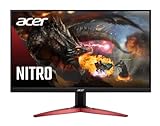
Budget $99 to $119: This is the 180Hz to 240Hz entry tier. The Acer Nitro 23.8-inch 180Hz at $109.99 and the Dell SE2426HG 24-inch 240Hz at $99.99 show how aggressive pricing has become. Expect 1080p IPS, FreeSync Premium, tilt-only stand, and 2x HDMI plus DisplayPort. Best for students, second setups, or anyone whose GPU averages under 150 fps. Here, 180Hz is often the smarter pick if it saves $15 to $25 and gets you a better stand or brighter panel.
Mid Value $130 to $159: The sweet spot for most gamers. The Dell SE2726HG 27-inch 240Hz at $149.99 represents this tier well: larger screen, IPS, FreeSync Premium, and better factory color. You get 240Hz without major sacrifices. Choose this if your PC reliably pushes 160+ fps and you want a do-everything monitor for gaming and work.
Upper Value $165 to $190: Pays for size and immersion, like a 32-inch curved 240Hz panel near $179.99. Ideal if you play sims, sports, or single-player games where immersion outweighs pixel density. Not ideal if you primarily play competitive shooters on a mid-range GPU; the extra screen size does not improve value per Hertz.
Do not pay more than $20 extra just to go from 180Hz to 240Hz at the same size and panel type unless you are competitively ranked and know you can use it. Put that money toward an IPS panel over TN, a height-adjustable stand, or a monitor with DisplayPort 1.4 included.
Warranty and Support: Cheap Insurance
Refresh rate means nothing if the panel fails. Value is not just purchase price but how long the monitor lasts.
Most budget and mid-range gaming monitors include a 1-year manufacturer warranty, with Dell and Acer often offering 3-year limited hardware warranties on select gaming lines. Confirm the term on the product page before buying; a 3-year warranty on a $149.99 monitor effectively costs $33 to $50 per year of coverage versus $99 per year for a 1-year warranty.
Check dead pixel policy, advance exchange options, and whether the warranty covers backlight and ports. Brands with 24-hour phone or chat support and US-based return centers resolve issues faster. Keep your receipt and register the serial number; many warranties require registration within 30 days. If buying from a marketplace seller rather than direct, ensure the warranty is valid and not limited to the original retailer.
Delivery and Assembly: What to Expect in the Box
Most 24-inch to 32-inch gaming monitors ship free within 3 to 7 business days and arrive in a box weighing 11 to 18 pounds and measuring roughly 30 x 18 x 6 inches for 27-inch models. White-glove delivery is unnecessary; these are one-person setups.
Assembly typically takes 5 to 10 minutes with no tools. You attach the base to the stand with a thumbscrew, snap the stand into the back of the panel, and connect power brick (external 45W to 65W) and video cable. Curved 32-inch models may include two-piece stands and require a bit more desk depth: allow 8 to 10 inches for the base plus 22 to 24 inches viewing distance. Plan desk space accordingly: a 27-inch monitor is about 24.2 inches wide and 17 to 19 inches tall with stand, while a 32-inch curved model is about 27.9 inches wide.
Before you buy, measure desk depth and confirm you have a DisplayPort output on your GPU if you want full 240Hz. If you use a laptop, verify it supports 180Hz+ over HDMI or DisplayPort via USB-C; many budget laptops cap external output at 120Hz over HDMI 1.4.
Spec Checklist
| Spec | Budget ($99-$119) | Mid Value ($130-$159) | Premium Value ($165-$190) |
|---|---|---|---|
| Refresh Rate | 180Hz to 240Hz | 240Hz | 240Hz |
| Resolution | 1920×1080 FHD | 1920×1080 FHD | 1920×1080 FHD |
| Panel Type | IPS preferred, TN acceptable | IPS with 95%+ sRGB | IPS or VA curved |
| Response Time | 1ms MPRT / 5ms GtG | 1ms MPRT / 1-4ms GtG | 1ms MPRT / 1-4ms GtG |
| Adaptive Sync | FreeSync / FreeSync Premium | FreeSync Premium, G-Sync Compatible | FreeSync Premium, G-Sync Compatible |
| Brightness / Contrast | 250 nits / 1000:1 | 250-300 nits / 1000:1 | 250-300 nits / 3000:1 on VA |
| Ports | 2x HDMI, 1x DisplayPort 1.2 | 2x HDMI 2.0, 1x DisplayPort 1.4 | 2x HDMI 2.0, 1x DisplayPort 1.4 |
| Ergonomics | Tilt only, 75x75mm VESA | Tilt + height option, 100x100mm VESA | Tilt + height, curved stand |
| Power Use | 18-24W typical | 22-28W typical | 25-35W typical |
Red Flags
Watch for these warning signs that a high refresh rate is masking low overall value.
- 240Hz with no adaptive sync listed: Without FreeSync Premium or G-Sync Compatible, tearing and stutter will erase the smoothness you paid for when frame rates drop.
- HDMI-only connection at 240Hz: Many budget 240Hz panels only reach full refresh over DisplayPort. If the listing shows only HDMI or does not include a DisplayPort cable, you may be capped at 144Hz.
- Vague response time without MPRT or GtG label: Claims like 1ms without specifying method often hide heavy overdrive that causes ghosting. Look for explicit 1ms MPRT or 1-5ms GtG.
- No VESA mount and a tiny fixed stand: A wobbly, non-VESA 240Hz monitor locks you into poor ergonomics. Eye and neck strain over months costs more than saving $10 up front.
- Curved 32-inch 1080p marketed for competitive FPS: Extra size and curvature add immersion but reduce pixel density and increase eye travel for competitive play. For ranked shooters, 24 to 27 inches at 1080p is better value.
- Exaggerated HDR or contrast promises under $180: HDR400 and 4000:1 claims on cheap IPS panels rarely translate to visible improvement. Prioritize sRGB coverage and 250+ nits instead.
FAQ
Is 240Hz worth it over 180Hz for value?
It depends on your frame rate. If your PC consistently delivers 180 to 240 fps in the games you care about and the price difference is under $20 for the same panel size and type, 240Hz is worth it for competitive players. If you average 100 to 150 fps or the 240Hz option forces you to accept a TN panel or tilt-only stand, 180Hz IPS offers better overall value. For casual and single-player gamers, the visual difference between 180Hz and 240Hz is small compared with the jump from 60Hz or 120Hz to 144Hz.
What refresh rate should I choose for a mid-range GPU?
For GPUs that average 90 to 130 fps at 1080p in modern titles, a 144Hz to 180Hz monitor is the value pick. You will use most of the refresh range without paying for unused headroom. Pair it with FreeSync Premium so dips to 70 to 90 fps stay smooth. Only step to 240Hz if you play lighter esports titles where you hit 200+ fps, or plan a GPU upgrade within a year.
Do I need DisplayPort for high refresh rates?
Usually yes for 180Hz to 240Hz at 1080p. Most value monitors require DisplayPort 1.2 or 1.4 to reach full refresh with adaptive sync. HDMI 1.4 often caps at 120Hz, while HDMI 2.0 can do 240Hz at 1080p but some monitors limit HDMI to 144Hz. Check the spec sheet for max refresh per port and use the included DisplayPort cable when possible. If your laptop only has HDMI, confirm it supports 180Hz+ output before buying a 240Hz display.
Can a 32-inch 1080p 240Hz monitor be a good value?
Yes for immersion-focused players. A 32-inch curved 240Hz panel around $179.99 is excellent for racing, sports, and cinematic games where a larger field of view adds enjoyment, and 1080p keeps frame rates high on mid-range hardware. It is less ideal for competitive shooters or desk setups under 22 inches deep, where a 24-inch or 27-inch 240Hz IPS at $99.99 to $149.99 gives sharper text, faster eye tracking, and better desk fit. Choose size based on viewing distance and game genre, not just Hertz.


