
Top 3 picks at a glance
The Short Answer
For most mid range gaming PCs, the right power supply size is 650W to 750W. That wattage sweet spot safely powers a modern mid range GPU and CPU with headroom for transient power spikes, extra drives, and fans, without paying for capacity you will not use. In terms of physical size, nearly all mid range builds use a standard ATX PS2 power supply measuring 5.9 x 3.4 x 5.5 inches (150 x 86 x 140 mm), which fits any standard ATX mid-tower case.
If you are building around an entry-level to lower mid range card like an RTX 4060 or RX 7600 XT, a quality 550W to 650W unit is sufficient. If you are building around a higher mid range card like an RTX 4070, RTX 4070 Super, or RX 7800 XT, or you plan to overclock or upgrade your GPU within a few years, choose 750W. As of 2026, 650W and 750W 80 Plus Gold ATX 3.1 models offer the best balance of price, efficiency, and future compatibility, typically ranging from $49.99 to $89.99 for reputable units.
As an Amazon Associate we earn from qualifying purchases at no extra cost to you. Product prices and availability are accurate as of the date shown and are subject to change.


Quick recommendation by build type:
- 1080p mid range (Ryzen 5 / Core i5 + RTX 4060 / RX 7600): 550W to 650W
- 1440p mid range (Ryzen 5 7600 / Core i5-14400 + RTX 4070 / RX 7800 XT): 650W to 750W
- Compact ITX mid range: Same wattage, but SFX or SFX-L form factor required
- Mid range with upgrade headroom: 750W 80 Plus Gold, ATX 3.1 ready
Standard Sizes
Power supply sizing has two meanings: electrical size (wattage) and physical size (form factor and dimensions). For a mid range gaming PC, you need to get both right. Physically, the case dictates which form factor you can use. Electrically, your components dictate how many watts you need.
This table covers the physical dimensions you will encounter when shopping. All dimensions are width x height x depth.
| Form Factor | Dimensions (inches) | Dimensions (cm) | Typical Wattage Range | Best For |
|---|---|---|---|---|
| ATX PS2 (Standard ATX) | 5.9 x 3.4 x 5.5 | 15.0 x 8.6 x 14.0 | 500W – 1000W | Standard mid-tower and full-tower cases. The default for mid range gaming PCs. |
| ATX PS2 (Extended 160mm) | 5.9 x 3.4 x 6.3 | 15.0 x 8.6 x 16.0 | 750W – 1200W | Larger ATX cases needing higher wattage. Check case depth clearance. |
| ATX PS2 (Extended 180mm) | 5.9 x 3.4 x 7.1 | 15.0 x 8.6 x 18.0 | 850W – 1600W | High-wattage units. Usually unnecessary for mid range builds. |
| SFX | 4.9 x 2.5 x 3.9 | 12.5 x 6.35 x 10.0 | 450W – 750W | Mini-ITX and compact Micro-ATX cases. |
| SFX-L | 4.9 x 2.5 x 5.1 | 12.5 x 6.35 x 13.0 | 550W – 1000W | Compact cases that need more wattage and a 120mm quiet fan. |
| TFX | 3.3 x 2.5 x 6.9 | 8.5 x 6.4 x 17.5 | 300W – 500W | Slim prebuilt and HTPC cases. Not recommended for gaming builds. |
For reference, most mid range ATX units weigh between 3.2 and 4.8 pounds (1.45 to 2.18 kg) and are 5.5 to 6.3 inches deep. Modular and fully modular models do not change the PSU dimensions, but they save 0.75 to 1.25 inches of clearance behind the PSU because you only attach the cables you need.
On the electrical side, the standard wattage sizes for mid range gaming PCs are:
- 500W to 550W: Minimum for entry mid range GPUs. Budget option, limited upgrade room. Example price range: $39.99 to $54.99. The Thermaltake Smart 500W 80+ White Certified PSU at $39.99 is representative of this tier.
- 650W: The value sweet spot for most 1080p and many 1440p mid range builds. Plenty of headroom for a Ryzen 5 or Core i5 paired with an RTX 4060 Ti or RX 7700 XT. Example: ASRock PRO-650G 650W 80 Plus Gold at $49.99.
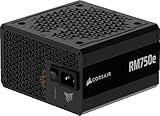
- 750W: Ideal for 1440p mid range and any build where you want comfortable headroom for transient spikes and future GPU upgrades. This is the most recommended size for a new mid range build. Examples: MSI MAG A750GL PCIE5 750W at $89.99 and CORSAIR RM750e 750W at $89.99, both ATX 3.1 and PCIe 5.1 ready with 80 Plus Gold efficiency.
How to Measure Your Space
Before you buy, confirm your case can accommodate the physical size of the power supply and its cables. Use a tape measure or ruler and measure in both inches and centimeters for accuracy.
- Identify your case’s PSU form factor. Check the case manual or spec sheet under PSU Support. If it says ATX, PS2, or ATX PS2, it takes the standard 5.9 x 3.4 x 5.5 inch unit. If it says SFX or SFX-L, you must buy that smaller size or use an SFX-to-ATX adapter bracket.
- Measure the PSU bay depth. Open the side panel and measure from the rear wall where the PSU mounts to the nearest obstruction in front of it, usually a drive cage, shroud wall, or front radiator. Most ATX mid-towers offer 6.7 to 8.5 inches (17 to 21.5 cm) of PSU depth. You want at least 0.5 to 1.0 inch (1.3 to 2.5 cm) of extra space for cables.
- Measure height and width clearance. Standard ATX PSUs are 3.4 inches tall and 5.9 inches wide. Confirm the mounting screw pattern aligns and that the PSU will not block bottom intake fans. In cases with a bottom PSU shroud, also measure the shroud opening.
- Measure cable bend space. For non-modular and semi-modular units, add 1.5 inches (3.8 cm) behind the PSU for the cable bundle. For fully modular 750W units like the MSI MAG A750GL or CORSAIR RM750e, you can reduce this to about 0.75 inches because cables connect flush and you can route only what you need.
- Check mounting orientation and ventilation. Note whether the fan faces up or down. Bottom-mounted PSUs should have a filtered vent beneath the case. Ensure at least 0.6 inches (1.5 cm) of clearance under the case feet for airflow.
- Confirm cable length. In standard ATX mid-towers 16 to 18 inches tall, you need a 24-pin ATX cable of at least 23.6 inches (60 cm) and an 8-pin EPS CPU cable of at least 25.6 inches (65 cm). Compact or wide cases may need longer cables.
- Estimate your wattage need. Add CPU TDP plus GPU power, then add 100W to 150W for motherboard, RAM, storage, fans, and USB devices. Multiply that total by 1.25 to leave 20 to 25 percent headroom. Example: A Core i5-14400 (65W base, ~148W peak) + RTX 4070 (200W) + 120W for other components = 468W. 468W x 1.25 = 585W, so a 650W unit is the minimum, 750W is more comfortable.
By Room or Use Case
Where and how you use your PC affects the ideal power supply size more than you might think. Consider noise, space, and thermals for each scenario.
Standard ATX Mid-Tower in a Bedroom or Living Room – 650W to 750W ATX
This is the most common mid range setup. A standard ATX PS2 unit 5.5 inches deep fits easily and leaves room for cable management. Choose a 650W unit for a 1080p build that will stay as-is, or 750W for a 1440p build. Look for a 120mm fluid dynamic bearing fan and 80 Plus Gold efficiency for quiet operation. At idle or light gaming loads, the fan on many Gold units will not spin at all, which matters in a quiet room. A fully modular 750W ATX 3.1 model in this space makes building and cleaning easier and improves airflow around the PSU shroud.
Small Apartment or Dorm Desk – SFX or SFX-L 650W to 750W
If your case is a compact Micro-ATX or Mini-ITX model under 16 inches tall, physical size is the constraint. You need an SFX unit at 3.9 inches deep or SFX-L at 5.1 inches deep. Electrically the same rules apply: 650W for lower mid range GPUs, 750W for higher mid range GPUs. SFX units often cost $20 to $40 more than equivalent ATX units and run slightly louder under load due to smaller fans, so only choose SFX if your case requires it. Always verify your small case’s maximum PSU depth, as some compact cases limit you to 5.1 inches or less.
1440p Gaming and Streaming Setup – 750W ATX 3.1 Fully Modular
A PC that simultaneously games at 1440p, streams, and powers multiple monitors, capture cards, and USB devices draws more sustained and peak power. The CPU will often run at its turbo power for long periods, and transient spikes from the GPU are higher. A 750W ATX 3.1 and PCIe 5.1 ready unit with a native 12V-2×6 cable is the safest choice. This standard handles modern GPU power excursions better than older ATX 2.x designs. The typical ATX 3.1 750W unit measures 5.9 x 3.4 x 5.5 to 6.3 inches and includes over-voltage, under-voltage, short-circuit, and over-temperature protection. Prioritize a 10-year warranty model if you plan to keep the PC for 4 or more years.
Office or Family Room Shared PC – 550W to 650W Quiet ATX
If the PC doubles as a home office workstation and light gaming system, efficiency and acoustics matter most. A 550W to 650W 80 Plus Gold or better unit will spend more time in its most efficient 40 to 60 percent load window during office work, which reduces heat and fan noise. A 500W White-rated unit like the Thermaltake Smart 500W can be adequate for an older GPU, but for any current mid range card, stepping up to a 650W Gold unit for about $10 to $25 more delivers quieter operation and better protection. Keep the PSU on the floor or a hard platform, not on carpet, to maintain bottom intake airflow.
Common Sizing Mistakes
- Matching wattage exactly to estimated draw: If your parts add up to 480W and you buy a 500W unit, you leave no headroom for transient spikes, dust buildup, or summer ambient temperatures. Aim for 20 to 30 percent above your realistic maximum draw.
- Ignoring ATX 3.1 and PCIe 5.1 requirements: Many new mid range GPUs use or can use the 12V-2×6 connector. An older ATX 2.3 PSU may work with an adapter, but a native ATX 3.1 cable provides a more secure connection and is designed to handle the required power excursions. Do not assume any 650W unit is automatically compliant; check the spec sheet.
- Buying the wrong physical depth: A 7.1-inch deep 180mm ATX unit will not fit many popular mid-towers that only allow 6.3 to 6.7 inches of PSU depth, even though the width and height are standard. Always compare the PSU depth to your case’s PSU clearance.
- Focusing on 80 Plus rating over quality: 80 Plus White, Bronze, and Gold measure efficiency, not build quality or protection. A well-built 650W Gold unit from a reputable platform with a 5-year or longer warranty is a safer choice than a cheap 750W Bronze unit with a 2-year warranty.
- Forgetting to budget for modularity in tight cases: In compact ATX cases with solid PSU shrouds, a non-modular PSU leaves a thick bundle of unused cables pressed against the drive cage or shroud wall, raising temperatures by 2 to 5 degrees. Fully modular 650W and 750W units cost more upfront but make the build cleaner and cooler.
- Underestimating total system age and dust: A 500W unit may be adequate on day one, but after two years, capacitor aging and dust can reduce effective capacity and cooling. Starting at 650W to 750W extends the useful life of the PSU through one GPU generation upgrade.
FAQ
What wattage power supply do I need for a mid range gaming PC?
Most mid range gaming PCs need 650W to 750W. For a system with a Core i5 or Ryzen 5 CPU and an RTX 4060, RTX 4060 Ti, RX 7600, or RX 7700 XT, 650W from a quality 80 Plus Gold unit is enough. For an RTX 4070, RTX 4070 Super, RX 7800 XT, or any setup you plan to upgrade in the next three years, 750W is the better choice. Systems with high-TDP CPUs like a Core i7 or overclocked Ryzen 7 should default to 750W as well.
Is a 500W power supply enough for a mid range gaming PC?
For modern mid range GPUs, 500W is generally not recommended as a new purchase. While a 500W unit such as the Thermaltake Smart 500W can run an entry-level configuration, it leaves little margin for GPU transient spikes, additional fans or drives, and future upgrades. In 2026, the price difference between a reliable 500W White unit at around $39.99 and a 650W Gold unit at around $49.99 to $69.99 is small relative to the added headroom and protections you gain.
Is 750W overkill for a mid range build?
Not anymore. 750W used to be considered high-end capacity, but modern GPUs can briefly draw well above their rated power for milliseconds. ATX 3.1 750W units are engineered to handle those peaks gracefully, and they run quieter and more efficiently when a mid range system draws 300W to 450W during gaming, which falls right in their optimal efficiency band. The CORSAIR RM750e and MSI MAG A750GL at $89.99 are examples of 750W units priced similarly to many 650W models, making 750W a sensible future-proof investment without significant extra cost.
How do I know what physical size power supply will fit my case?
Check your case specifications for PSU support. If it lists ATX, it means standard ATX PS2 dimensions of 5.9 x 3.4 x 5.5 inches (150 x 86 x 140 mm). Most ATX mid-towers support depths up to 6.3 inches, so a 5.5-inch deep PSU fits with room for cables, while 6.3 and 7.1-inch deep units may require removal of a drive cage. For Mini-ITX cases, look for SFX at 4.9 x 2.5 x 3.9 inches or SFX-L at 4.9 x 2.5 x 5.1 inches. When in doubt, measure your case’s PSU bay depth and leave at least 0.75 inches for cable bends on fully modular models.


