
Top 3 picks at a glance
The Short Answer
For a 1080p gaming desk, 24 inches is the sweet spot for most people. At 1920 x 1080 resolution, a 24-inch panel keeps the pixel density sharp at about 92 pixels per inch (PPI) when viewed from 24 to 30 inches away, which is a typical desk depth. It fits comfortably on desks 42 to 55 inches wide without dominating your field of view, and it avoids the visible pixelation you get when you stretch 1080p to 27 inches or 32 inches at close range.
Use this quick rule: Choose 22 inches if your desk is under 40 inches wide or you sit closer than 22 inches from the screen. Choose 24 to 24.5 inches for standard desks and competitive gaming. Choose 27 inches only if you sit 30 to 36 inches away or you prioritize size over sharpness. Reserve 32 inches for deep desks (30+ inches deep) or couch-style distance gaming. In 2026, the best value for 1080p remains in the 24-inch class, with reliable 144Hz to 240Hz models typically priced between $65 and $130.
As an Amazon Associate we earn from qualifying purchases at no extra cost to you. Product prices and availability are accurate as of the date shown and are subject to change.



Standard Sizes
Monitor size is measured diagonally, but what matters for your desk is the total width, height with stand, footprint depth, and weight. The table below shows typical real-world measurements for popular 1080p gaming monitors with thin bezels. Exact numbers vary by brand and stand design by about 0.5 to 1 inch, but these averages will let you plan clearance, wall mounts, and dual-monitor setups.
| Screen Class (Diagonal) | Width Without Stand (in / cm) | Height Without Stand (in / cm) | Height With Stand (in / cm) | Stand Depth / Footprint (in / cm) | Weight With Stand (lbs / kg) | Typical Best Viewing Distance (in / cm) |
|---|---|---|---|---|---|---|
| 22-Inch Flat (e.g., 21.5″ viewable) | 19.4 – 19.8 / 49.3 – 50.3 | 11.3 – 11.7 / 28.7 – 29.7 | 15.0 – 16.2 / 38.1 – 41.1 | 6.5 – 7.5 / 16.5 – 19.1 | 5.1 – 6.2 / 2.3 – 2.8 | 20 – 26 / 51 – 66 |
| 24-Inch Flat/Curved (23.8″ viewable) | 21.2 – 21.7 / 53.8 – 55.1 | 12.4 – 13.0 / 31.5 – 33.0 | 15.8 – 17.3 / 40.1 – 43.9 | 7.0 – 8.5 / 17.8 – 21.6 | 6.0 – 7.8 / 2.7 – 3.5 | 24 – 30 / 61 – 76 |
| 24.5-Inch Flat/Curved (240Hz class) | 21.7 – 22.2 / 55.1 – 56.4 | 12.8 – 13.3 / 32.5 – 33.8 | 16.1 – 18.0 / 40.9 – 45.7 | 7.5 – 9.0 / 19.1 – 22.9 | 6.5 – 8.6 / 2.9 – 3.9 | 24 – 30 / 61 – 76 |
| 27-Inch Flat/Curved | 23.9 – 24.3 / 60.7 – 61.7 | 14.2 – 14.8 / 36.1 – 37.6 | 17.5 – 19.2 / 44.5 – 48.8 | 8.0 – 9.5 / 20.3 – 24.1 | 7.5 – 10.5 / 3.4 – 4.8 | 30 – 36 / 76 – 91 |
| 32-Inch Curved | 27.8 – 28.3 / 70.6 – 71.9 | 16.5 – 17.2 / 41.9 – 43.7 | 19.5 – 21.5 / 49.5 – 54.6 | 9.0 – 11.0 / 22.9 – 27.9 | 11.5 – 15.0 / 5.2 – 6.8 | 32 – 42 / 81 – 107 |
Power draw is another desk-planning factor. Most 22-inch 1080p monitors use 18 to 25 watts, 24 to 24.5-inch models use 22 to 35 watts, and 32-inch curved models use 35 to 55 watts at typical brightness. All sizes listed above use standard 75 x 75 mm or 100 x 100 mm VESA mounts except some ultra-budget 22-inch models that are VESA 75 x 75 mm only, so check the rear mount pattern before buying an arm.
How to Measure Your Space
Get accurate numbers before you order. A tape measure and two minutes of checking will prevent returns.
- Measure desk width and depth. Measure the full top surface in inches and centimeters. Note any hutch, wall, or shelf above that limits height. Leave at least 2 inches of clearance on each side for ventilation and cables.
- Measure viewing distance. Sit in your normal gaming chair posture and measure from your eyes to the back edge of where the screen will sit. This is your viewing distance. For 1080p, aim for the ranges in the table above to keep text sharp.
- Check stand footprint. Measure from the back wall or monitor riser to the front edge of your desk. Compare to the Stand Depth in the table. If your desk is only 20 inches deep, a 32-inch curved stand at 11 inches deep will leave little room for keyboard and mouse.
- Account for height. Measure from desk surface to eye level. Most stands add 3 to 5 inches of height and offer 4 to 5 inches of height adjustment on 24-inch and larger models. If you use a monitor arm, subtract the clamp overhang (usually 3 to 4 inches) from usable depth.
- Plan for dual monitors or speakers. Two 24-inch monitors side-by-side need about 43 to 45 inches of desk width including a small gap. Add the width of bookshelf speakers (typically 5 to 6 inches each) if they sit on the desk beside the monitor.
- Verify wall mount space. If wall mounting, locate studs and measure the VESA height from the desk. Leave 4 to 6 inches between the bottom bezel and desk so you can slide a keyboard under if needed.
By Room or Use Case
Small Desk, Dorm, or Bedroom: 22 to 24 Inches
For desks 35 to 48 inches wide and 18 to 24 inches deep, a 22-inch or 24-inch flat monitor is ideal. A model like the Sceptre New 22-Inch Gaming Monitor FHD 1080p up to 144Hz with HDMI and DisplayPort (E225W-FW144 Series) measures about 19.6 inches wide and weighs around 5.5 pounds, so it leaves room for a full-size keyboard and mouse pad. Expect to pay about $65 to $85 for this class. Pair it with a viewing distance of 20 to 26 inches. If you can fit it, the 24-inch curved alternative such as the Sceptre Curved 24-inch R1500 1080p (C248W-1920RN Series) at about 21.5 inches wide and $80 to $100 offers more immersion without a big jump in pixel visibility, and still fits desks as narrow as 42 inches.
Standard Gaming Desk: 24 to 24.5 Inches for Competitive Play
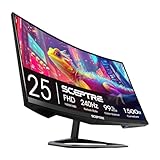
This is the recommendation for most gamers. On a desk 48 to 60 inches wide and 24 to 30 inches deep, a 24 to 24.5-inch 1080p panel fills your central vision without forcing head turns. Pixel density stays crisp for HUD text and crosshairs, and high refresh rates are affordable. For example, the Sceptre Curved 24.5-inch Prime Gaming Monitor up to 240Hz 1080p R1500 1ms with DisplayPort x2 and HDMI x2 and built-in speakers (C255B-FWT240 Series) is about 21.9 inches wide, 16.5 inches tall with stand, and weighs about 7.5 pounds, priced around $110 to $130. These models typically include height adjustment and tilt of -5 to 20 degrees. Sit 24 to 30 inches away for the best balance of sharpness and reaction time.
Large Desk or Hybrid Work and Gaming: 27 Inches (With Caveats)
A 27-inch 1080p monitor is about 24 inches wide and needs a deeper desk to look sharp. Only choose it if your viewing distance is at least 30 inches, ideally 32 to 36 inches. At closer distances, individual pixels become noticeable in text and fine textures, and PPI drops to about 82. If you work from the same display and read small spreadsheet text all day, a 27-inch 1080p panel will look softer than a 24-inch. Budget for $130 to $180 in this size for 144Hz to 180Hz, and confirm your graphics card can maintain your target frame rate at 1080p before paying for extra refresh rate you cannot use.
Deep Desk or Immersive Sim Racing and RPG Setup: 32-Inch Curved
A 32-inch curved 1080p monitor like the SANSUI 32 Inch Curved 240Hz FHD 1080P model creates strong immersion but demands space and distance. It is roughly 28 inches wide and needs a desk at least 28 to 30 inches deep, or a wall mount that pushes the screen back. At 32 inches, PPI falls to about 69, so you must sit 32 to 42 inches away to avoid a visibly pixelated image. These displays weigh 12 to 15 pounds and often have an R1500 to R1800 curve that helps the edges feel closer. Prices typically run $170 to $210 for 180Hz to 240Hz. This size works best for racing, flight sims, or living-room style setups where you lean back, not for close-up competitive shooters on a shallow desk.
Common Sizing Mistakes
1. Buying too big for the resolution. Stretching 1080p to 27 or 32 inches at 24 inches away makes pixels and anti-aliasing artifacts obvious. If you want a 27-inch screen at arm’s length, consider moving to 1440p instead. For 1080p, keep the screen smaller or move it farther back.
2. Ignoring stand depth and eye height. A large V-shaped foot can use 9 to 11 inches of desk depth and push the screen too close, forcing you to crane your neck. Check footprint dimensions and consider a $25 to $45 VESA arm to reclaim depth and get proper eye-level alignment, where the top bezel is at or just below eye level.
3. Forgetting bezel and gap for dual setups. Two 24-inch monitors are not just 42 inches wide. Thick stands, cable clearance, and a 0.5 to 1 inch gap between panels add 2 to 3 inches. Measure total width with everything in place.
4. Choosing refresh rate over viewing comfort. A 240Hz 32-inch panel will not help if you sit too close and see pixelation or have to turn your head to see the minimap. Match size to distance first, then pick the highest refresh rate your budget allows within that size. Most gamers benefit more from a sharp 24-inch 144Hz monitor at the correct distance than a soft 32-inch 240Hz monitor up close.
5. Not checking ports and speaker needs. Many 1080p gaming monitors include two HDMI ports, one DisplayPort, and built-in 2W to 4W speakers that are fine for casual use but not for competitive audio. If you rely on external speakers or a headset DAC, confirm the monitor does not block your cable routing with a low stand.
FAQ
Is 24-inch or 27-inch better for 1080p gaming?
24 inches is better for most desks because it keeps 1080p looking sharp at normal desk distances of 24 to 30 inches. A 27-inch 1080p display can work if you sit 30 to 36 inches away, have a desk at least 28 inches deep, and prefer a larger image over maximum sharpness. For competitive shooters, 24 to 24.5 inches is consistently preferred for clearer text and less eye movement.
How far should I sit from a 1080p monitor?
Use PPI as your guide. For 22 inches, sit 20 to 26 inches away. For 24 to 24.5 inches, sit 24 to 30 inches away. For 27 inches, sit 30 to 36 inches away. For 32 inches, sit 32 to 42 inches away. If you sit closer than the low end of the range, you will start to see individual pixels and jagged edges, especially in high-contrast text.
Can I put a 32-inch monitor on a small desk?
It is not recommended on desks less than 28 inches deep or 50 inches wide. A 32-inch panel is about 28 inches wide and its stand can be 10 to 11 inches deep, leaving little room for peripherals. On a small desk, it also forces a viewing distance under 28 inches, where 1080p looks soft. If your desk is small, choose 22 to 24 inches or use a wall mount or deep monitor arm to push a larger screen back.
Does curved vs. flat change what size I should buy?
Curve does not change the ideal diagonal for 1080p, but it changes comfort at larger sizes. An R1500 curve on 24 to 32-inch models wraps the edges slightly toward you, which reduces head turning and makes a 27-inch or 32-inch monitor feel less wide at the same distance. For 22 to 24 inches, flat and curved are both comfortable, so choose based on price and preference. For 32 inches, curved is generally more comfortable than flat at desk distances.


