
When designing a home office, a dedicated family media center, or a quiet study nook, the physical footprint of our technology matters just as much as its performance. A desktop computer is often the hub of home productivity and entertainment, yet the clutter of cables hidden inside the chassis is an overlooked stressor. If you are building or upgrading a home PC, you will inevitably face a core hardware decision: choosing between a semi-modular and a fully modular power supply unit (PSU) on a budget.
The power supply is the unsung hero of your home system, converting electricity from your wall outlet into usable power for your components. However, managing the thick, snake-like cables that distribute this power can turn a weekend home project into a frustrating chore. If you want a tidy, dust-free, and quiet system without overspending, understanding the physical and financial trade-offs of the semi modular vs fully modular power supply budget debate is essential. This guide will help you balance physical space, airflow, and your household budget to find the perfect match for your living space.
As an Amazon Associate we earn from qualifying purchases at no extra cost to you. Product prices and availability are accurate as of the date shown and are subject to change.



Top 3 picks at a glance
Quick Verdict
For most budget-conscious households, a semi-modular power supply is the smartest financial move. It keeps costs low by permanently attaching only the mandatory cables you are guaranteed to use anyway, making it perfect for tucked-away home office PCs. However, if your computer sits on top of your desk, inside a compact media console, or in a dusty family room, investing slightly more in a fully modular power supply is highly recommended. The ability to remove every single cable simplifies cleaning, improves internal airflow to keep fans quiet, and allows for much easier hardware upgrades down the road.
Side by Side
To help you visualize how these two power supply styles compare in a household environment, here is a breakdown of their key practical characteristics:
| Feature | Semi-Modular Power Supply | Fully Modular Power Supply |
|---|---|---|
| Ease of Build | Moderate; basic cables are pre-attached, saving some prep time. | High; you only plug in what you need, leaving maximum working room. |
| Durability & Warranty | Typically 5 years; excellent reliability for standard home use. | Often 7 to 10 years; premium internal capacitors offer longer lifespans. |
| Price Range | $45 to $65 for reliable 600W–700W models. | $80 to $110 for high-efficiency 750W–850W models. |
| Maintenance & Cleaning | Harder to clean; unused attached cables trap household dust. | Very easy; the entire unit can be disconnected for dusting. |
| Space Needed inside Case | Requires a “shroud” or basement space to stash unused fixed cables. | Minimal; extra space can be used for airflow or extra hard drives. |
| Visual Aesthetics | Clean, though pre-attached cables are usually standard black plastic. | Impeccable; compatible with sleek, custom-sleeved cables. |
| Resale Value | Moderate; appealing to basic budget builders. | High; highly sought after by PC enthusiasts and gamers. |
| Best For | Under-desk home offices, budget builds, and closed metal cases. | Living room media centers, compact cases, and glass-paneled desks. |
Where Semi Modular Wins
The primary appeal of a semi-modular power supply is its incredible value proposition. In a semi-modular design, the essential cables—specifically the large 24-pin motherboard cable and the 8-pin CPU power cable—are hardwired directly into the unit. Because every functioning computer absolutely requires these cables, there is no practical downside to having them permanently attached. The secondary cables, such as those for graphics cards (PCIe) and storage drives (SATA), remain detachable.
This design significantly lowers manufacturing costs. If you are working with a tight budget, options like the Rosewill VSB 650W (priced at $49.97) provide modern ATX 3.0 compatibility and a silent 120mm fan without breaking the fifty-dollar mark. Similarly, the MSI MAG A650BE ($59.99) offers a compact 650W footprint with a 5-year warranty, demonstrating that you do not need to sacrifice reliability to save money.
By opting for a semi-modular unit, you save roughly $20 to $30. In a budget home build, that saved cash can be redirected toward whisper-quiet case fans, a faster solid-state drive, or a more comfortable ergonomic keyboard. If your computer chassis does not have a glass window and sits quietly beneath a desk, the hidden, unused cables stuffed into the bottom of the case will never affect your daily life.
Where Fully Modular Power Supply Budget Wins
A fully modular power supply allows every single cable to be unplugged from the housing. While this might seem like a minor luxury, it completely transforms the physical experience of building and maintaining a home computer. This is particularly true if your PC is integrated into a shared living space or a compact home theater cabinet.
Without any pre-attached cables, you can install the physical power block into your computer case first, and then route only the exact wires your system needs. This eliminates the “cable clutter” that restricts airflow. Better airflow means your internal fans do not have to spin as fast or loud to keep the system cool, maintaining a peaceful atmosphere in your home office.
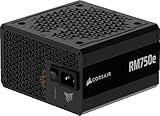
Furthermore, fully modular designs are typically paired with higher-end internal components and superior energy efficiency ratings. For instance, the CORSAIR RM750e ($89.99) features ATX 3.1 support and PCIe 5.1 readiness, making it a highly adaptable choice for modern living room setups. Another excellent choice in this tier is the MSI MAG A750GL PCIE5 ($89.99), which features a gold-rated efficiency design and a reassuring 10-year warranty. Spending around $90 for a fully modular unit ensures that your system runs cooler, wastes less electricity, and can be easily disassembled for seasonal dust removal.
Cost Over 5 Years
When managing a household budget, the initial purchase price of home electronics is only half of the story; we must also consider the ongoing utility costs. Power supplies are categorized by their efficiency ratings, ranging from Basic to Bronze, Gold, and Platinum.
Budget semi-modular units are frequently rated at “80 Plus Bronze” efficiency (roughly 82% to 85% efficient under typical household loads). On the other hand, budget-friendly fully modular units, like those in the $90 range, often carry an “80 Plus Gold” rating (87% to 90% efficient).
Let us look at a realistic household scenario over a five-year period. Suppose a home office computer is active for 6 hours a day, drawing an average of 300 watts of power during mixed-use remote work and light gaming.
- Bronze Semi-Modular PSU (85% efficient): Draws approximately 353 watts from your wall outlet to deliver 300 watts to your components. Over 5 years, this equals about 3,865 kWh of electricity.
- Gold Fully Modular PSU (90% efficient): Draws approximately 333 watts from your wall outlet to deliver the same 300 watts. Over 5 years, this equals about 3,646 kWh of electricity.
If your local household electricity rate is $0.16 per kWh, the Gold fully modular unit will save you roughly $35 in electricity costs over five years. This energy savings almost entirely offsets the initial price difference. Additionally, because higher efficiency means less wasted power is converted into heat, a Gold-rated fully modular system runs cooler and quieter, preserving the peace of your home environment while extending the lifespan of your computer components.
Which One for Your Home
Small Apartment or Studio
If you live in a compact apartment or a studio, space is at a premium. Your computer is likely close to your bed or living room sofa, meaning quiet operation and small physical footprints are essential. A fully modular power supply is the ideal choice here. Removing unnecessary cables allows you to use a compact Micro-ATX or Mini-ITX computer case that sits neatly on a small bookshelf or floating desk without creating an eyesore.
Family with Kids or Pets
In households with children and furry pets, dust, dander, and pet hair are constant battles. Computers act like small vacuum cleaners, pulling airborne particles into their chassis. A fully modular power supply is highly recommended for these busy homes. Because you can unplug every cable, you can easily pull the entire power unit out of the case once a year to blow out trapped dust with compressed air, ensuring your home air quality and system health remain high.
Rental Property or Temporary Setup
If you rent your home or move frequently, durability and ease of transport are major considerations. A semi-modular power supply is a great fit for temporary setups. The fixed motherboard cables are structurally robust and less likely to come loose during a move. It provides a highly reliable, plug-and-play solution that keeps your moving budget intact while delivering plenty of power for remote work or online classes.
Long-Term Family Home
For those established in a long-term family home, building a PC that can grow with your family over the next decade is the goal. As we look ahead to 2026 and beyond, power requirements and cable standards will continue to evolve. Investing in a fully modular power supply with a long warranty (such as a 10-year coverage plan) is the most sustainable choice. When it is time to upgrade components years down the road, you will only need to swap out individual cables rather than replacing the entire power unit.
FAQ
Is a fully modular power supply safer than a semi-modular one?
Both designs are equally safe. Safety is determined by the quality of the internal electrical protections (such as over-current and over-voltage protection) and the certification of the manufacturer, not by whether the cables can be detached. Both styles from reputable brands will safely protect your home electronics.
Can I mix and match cables from different modular power supplies?
No. This is a critical safety rule for your home. Even if a cable physically fits into a different power supply, the internal pin layouts can vary wildly between brands and models. Always use only the exact cables that came in the box with your specific power supply to avoid damaging your components or causing an electrical hazard.
Does a semi-modular power supply run louder than a fully modular one?
Not inherently. Noise levels are determined by the quality of the internal fan and how hard the unit has to work. However, because semi-modular units often have extra, unused cables stuffed inside the case, they can block internal airflow. This blockage can cause your other case fans to spin faster and louder to keep the system cool.
How much clearance space do I need behind the power supply for cables?
Generally, you should allow at least 2 to 3 inches of clearance space behind your power supply inside the computer case. This space is necessary to gently bend the cables without putting strain on the connectors, which is much easier to manage with the flexible, individual connections of a fully modular unit.


