
The best 135mm lens depends on your camera mount and working distance, but the Sony FE 135mm F1.8 GM, Canon RF135mm F1.8 L IS USM, Nikon NIKKOR Z 135mm f/1.8 S Plena, and Sigma 135mm F1.8 DG DN Art are the strongest modern full-frame choices, while an f/2 lens is usually the better value if you want a lighter, less expensive portrait setup.
As an Amazon Associate we earn from qualifying purchases at no extra cost to you.


Our Top Picks
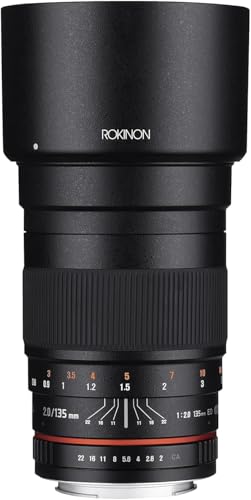


Top 3 picks at a glance
Best 135mm lenses at a glance
| Lens | Mount | Maximum aperture | Weight | Minimum focus distance | Maximum magnification |
|---|---|---|---|---|---|
| Sony FE 135mm F1.8 GM | Sony E | f/1.8 | 950g | 0.70m | 0.25x |
| Canon RF135mm F1.8 L IS USM | Canon RF | f/1.8 | 935g | 0.70m | 0.26x |
| NIKKOR Z 135mm f/1.8 S Plena | Nikon Z | f/1.8 | Approximately 995g | 0.82m | 0.20x |
| Sigma 135mm F1.8 DG DN Art | Sony E, Leica L | f/1.8 | Approximately 1,120g | 0.87m | 0.20x |
| Samyang AF 135mm F1.8 FE | Sony E | f/1.8 | Approximately 772g | 0.69m | 0.24x |
| Canon EF 135mm f/2L USM | Canon EF | f/2 | 750g | 0.90m | 0.19x |
| Zeiss Batis 2/135 | Sony E | f/2 | 1,270g | 0.87m | 0.19x |
Weights and specifications can vary slightly by region or manufacturer listing. The table is most useful for comparing the practical differences: aperture, carrying weight, and how close you can place the camera.
Head-to-head: f/1.8 versus f/2
What the extra third of a stop gives you
An f/1.8 lens admits about 23% more light than an f/2 lens. At the same shutter speed, you can lower ISO by roughly one-third of a stop. For example, a scene that requires 1/250 second at ISO 1600 with an f/2 lens can be captured at approximately ISO 1250 with an f/1.8 lens.
That advantage matters when photographing people indoors, at dusk, or under dim reception lighting. It also gives the camera more light for autofocus, although modern autofocus systems usually depend more on lens motors, camera processing, and subject-recognition algorithms than on this small aperture difference alone.
How much background blur changes
The visual difference between f/1.8 and f/2 is real but modest. At a subject distance of 2.5 metres on a full-frame camera, a 135mm lens produces an approximate depth of field of 37mm at f/1.8 and 41mm at f/2. These figures assume a conventional circle of confusion and are estimates rather than a guarantee of visible sharpness.
In practice, both settings can isolate a face strongly. The f/1.8 setting is not automatically better: at close portrait distances, an eye may be sharp while the nearer eyelashes, nose, or far eye fall outside the usable depth of field. Use f/1.8 for maximum separation, but switch to f/2 or f/2.8 when you need both eyes and more facial structure to remain crisp.
Best 135mm lenses by shooting situation
| Your priority | Best match | Why |
|---|---|---|
| Best native Sony E all-rounder | Sony FE 135mm F1.8 GM | Fast autofocus, strong subject isolation, close 0.70m focusing, and moderate weight for the class |
| Canon RF portrait work | Canon RF135mm F1.8 L IS USM | f/1.8, image stabilization, close focusing, and native RF communication |
| Maximum rendering quality on Nikon Z | NIKKOR Z 135mm f/1.8 S Plena | Excellent control of flare and background rendering, with a premium optical design |
| Lower weight on Sony E | Samyang AF 135mm F1.8 FE | Considerably lighter than many alternatives while retaining f/1.8 autofocus operation |
| Leica L compatibility | Sigma 135mm F1.8 DG DN Art | One of the most capable native 135mm options for L-Mount cameras |
| Value on Canon EF | Canon EF 135mm f/2L USM | Light, compact for a 135mm, and still useful on compatible DSLR or adapted mirrorless bodies |
Autofocus speed: what matters beyond the specification
A 135mm lens magnifies small movements, so autofocus performance is especially noticeable when photographing a moving person. Native mirrorless lenses such as the Sony FE 135mm F1.8 GM, Canon RF135mm F1.8 L IS USM, NIKKOR Z 135mm f/1.8 S Plena, and Sigma 135mm F1.8 DG DN Art are designed to communicate directly with their respective camera systems.
For eye-detection portraits, choose the lens that matches your camera mount natively whenever possible. An adapted DSLR lens may focus accurately in good light, but it can be less predictable with continuous autofocus, subject tracking, or rapid changes in distance. The Canon EF 135mm f/2L USM remains attractive for static portraits and video-style manual focusing, but it is not the same autofocus proposition as a current RF lens on an RF body.
For children, pets, or walking subjects, set continuous autofocus, use a shutter speed around 1/500 second, and enable eye or face detection if your camera supports it. A 135mm lens magnifies camera shake and subject movement, so a theoretically sharper lens cannot compensate for an excessively slow shutter speed.
Minimum focus distance and working distance
At 135mm, working distance is one of the format’s main strengths. A portrait framed from the chest upward typically places you roughly 2.5 to 4 metres from a full-frame subject, which feels comfortable and produces flattering facial proportions without crowding the person.
Minimum focus distance becomes important for tighter headshots, detail portraits, and small products. The Canon RF135mm F1.8 L IS USM, Sony FE 135mm F1.8 GM, and Samyang AF 135mm F1.8 FE can focus at approximately 0.70m or closer. That gives them more flexibility than the Canon EF 135mm f/2L USM, which focuses down to 0.90m.
Do not confuse close focusing with macro capability. A 0.25x maximum magnification means the subject appears at one-quarter of its real size on the sensor; it is useful for a face or detail but not a substitute for a dedicated macro lens.
Weight and handling trade-offs
Most modern f/1.8 135mm lenses weigh between about 770g and 1,120g. That difference is significant during a long portrait session. The Samyang AF 135mm F1.8 FE is notably easier to carry than the Sigma 135mm F1.8 DG DN Art, while the Canon RF and Sony GM options sit near the middle of the group.
The NIKKOR Z 135mm f/1.8 S Plena balances premium optical performance against a near-1kg body. A heavier lens can feel stable when shooting from a tripod or monopod, but it becomes tiring when held at eye level for hours. If your typical session involves walking between locations, a lighter f/1.8 lens or an f/2 design may produce more usable photographs simply because you are less fatigued.
A practical buying decision
- Choose f/1.8 if you regularly shoot in dim light, want the strongest subject separation, or need the extra autofocus light for fast-moving subjects.
- Choose f/2 if low weight, lower cost, or a compact kit matters more than a small gain in brightness and blur.
- Choose a native lens for the camera mount you use most. Native communication generally offers the most dependable eye autofocus, aperture control, and lens correction.
- Choose a close-focusing model if you shoot headshots, beauty details, hands, accessories, or small products.
- Choose stabilization where available if you often photograph static people at slower shutter speeds. Stabilization helps camera movement, but it does not freeze a moving subject.
For most Sony E users, the Sony FE 135mm F1.8 GM is the safest high-performance choice, while the Samyang AF 135mm F1.8 FE is compelling when weight and price are more important. Canon RF shooters gain the most flexibility from the RF135mm F1.8 L IS USM, and Nikon Z photographers seeking a premium rendering-focused lens should consider the NIKKOR Z 135mm f/1.8 S Plena. If your priorities are simplicity and value, an f/2 lens such as the Canon EF 135mm f/2L USM still makes sense when its mount and autofocus limitations fit your camera.
Frequently asked questions
Is a 135mm lens suitable for portraits on a full-frame camera?
Yes. A 135mm lens is well suited to portraits because a chest-up composition typically places you roughly 2.5 to 4 metres from the subject. That working distance feels comfortable and helps produce flattering facial proportions without crowding the person. It also provides strong subject isolation, particularly when used at a wide aperture such as f/1.8 or f/2.
Do I need a tripod or monopod for a 135mm lens?
No, not necessarily. A tripod or monopod can make a heavier lens feel more stable, but handheld shooting remains practical when the shutter speed is appropriate. A 135mm lens magnifies camera shake and subject movement, so stabilization cannot compensate for an excessively slow shutter speed. For moving people, the article recommends a shutter speed around 1/500 second.
Can I use an older Canon EF 135mm lens on a mirrorless camera?
Yes, the Canon EF 135mm f/2L USM can be used on compatible adapted mirrorless bodies, but its autofocus behavior may not match that of a current native lens. The article says an adapted DSLR lens can be less predictable with continuous autofocus, subject tracking, or rapid changes in distance. It remains attractive for static portraits and manual focusing.
Is a 135mm lens useful for photographing small products?
Yes, a 135mm lens can be useful for small products, accessories, hands, and detail portraits, especially when it has a short minimum focus distance. However, close focusing does not make the lens a macro lens. A maximum magnification of 0.25x means the subject appears at one-quarter of its real size on the sensor.
What camera features should I look for when choosing a 135mm lens?
Look for native communication with your camera mount, dependable eye or face detection support, and suitable stabilization if you photograph static people at slower shutter speeds. Continuous autofocus is also important for children, pets, or walking subjects. Native lenses generally provide the most dependable eye autofocus, aperture control, and lens correction with the camera system they support.


