
The best belt drive garage door openers for ultra quiet nighttime operation are the LiftMaster 84505R for a premium double door, the Chamberlain B6753T for a quiet smart opener with battery backup, and the Genie StealthDrive Connect for a strong value-oriented installation.
As an Amazon Associate we earn from qualifying purchases at no extra cost to you.


Our Top Picks
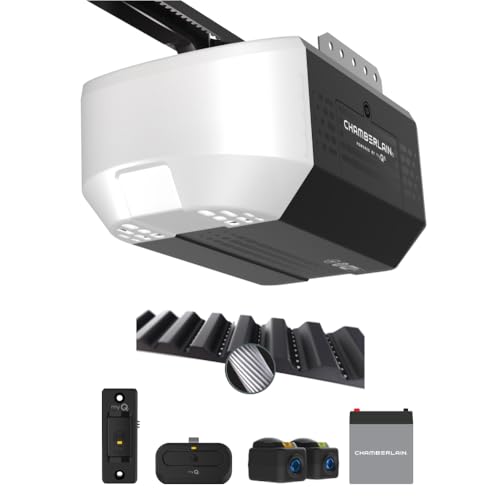


Top 3 picks at a glance
Quietest belt drive garage door openers ranked
The decibel figures below are realistic installed-sound ranges, not absolute laboratory ratings. A garage door’s rollers, hinges, springs, track, ceiling framing, and mounting hardware often contribute more noise than the opener itself. Measurements should be taken about 3 feet from the motor unit with the door moving, using the same smartphone sound-meter app and a quiet nighttime baseline.
| Rank | Model | Typical moving sound | Motor and motion control | Best match | Typical market range |
|---|---|---|---|---|---|
| 1 | LiftMaster 84505R | About 48–55 dBA | DC motor, soft start/stop, belt rail, battery backup | Premium single or lighter double door | Usually $450–$650 |
| 2 | Chamberlain B6753T | About 50–57 dBA | DC motor, soft start/stop, belt drive, battery backup | Smart residential doors, especially attached garages | Usually $350–$550 |
| 3 | Genie StealthDrive Connect | About 51–59 dBA | DC motor, soft start/stop, belt rail, smart control | Single doors and noise-sensitive bedrooms above the garage | Usually $250–$400 |
| 4 | Chamberlain B4613T | About 52–60 dBA | DC motor, soft start/stop, belt drive, battery backup | Single-car garages and midrange installations | Usually $250–$400 |
| 5 | LiftMaster 87504-267 | About 50–58 dBA | Heavy-duty DC motor, soft start/stop, belt drive | Heavy double doors and demanding daily use | Usually $500–$750 |
These ranges are best used to compare designs, not to promise a precise result. A 3 dBA difference is usually difficult to notice in a garage, while a 10 dBA reduction sounds substantially quieter. If the opener is already quiet but the garage still wakes someone upstairs, inspect the door hardware before replacing the motor.
1. LiftMaster 84505R: best premium choice for an attached garage
The LiftMaster 84505R is the strongest all-around choice when quiet operation, backup power, and long-term hardware quality matter more than the lowest purchase price. Its DC motor and belt rail reduce the sharp mechanical noise associated with many chain-drive units, while soft start and soft stop prevent the door from jolting at the beginning and end of travel.
The important advantage is not just the motor. The opener is typically installed with more substantial mounting hardware than budget units, and a properly isolated motor bracket can prevent vibration from transferring into ceiling joists. It is a good fit for a standard residential single door and many lighter double doors, provided the door is balanced and within the opener’s rated limits.
Choose it when
- A bedroom, office, or living space is directly above the garage.
- You want battery backup during a power outage.
- You prefer professional-grade hardware and smart-home features.
- The door is used several times daily and needs controlled acceleration.
2. Chamberlain B6753T: best smart quiet opener for most homes
The Chamberlain B6753T combines a belt drive, DC motor, soft start/stop, integrated lighting, Wi-Fi control, and battery backup. Its motion is particularly suitable for nighttime use because it avoids the abrupt engagement and stopping that make an opener sound louder than its nominal horsepower suggests.
For many homes, this is the sensible middle ground: quieter and smoother than a basic chain-drive opener without requiring the cost of a heavier commercial-style unit. It is generally a strong choice for a single door and for a properly balanced residential double door when the manufacturer’s capacity and door-weight requirements are met.
Its built-in lighting can also be useful in a quiet home: you can open the door remotely before entering, reducing the temptation to run the opener repeatedly while checking whether the door closed.
3. Genie StealthDrive Connect: best value for a noise-sensitive single door
The Genie StealthDrive Connect is a practical choice when the goal is quiet operation without moving into premium pricing. Its belt drive and DC motor provide smooth travel, and the soft-start/stop profile reduces the “thump” transmitted through the door at the limits.
It is most compelling for a single-car garage with a conventional sectional door. For a heavy insulated double door, confirm the exact model’s rated door size and lifting capability rather than assuming that a similar-looking package has the same capacity.
4. Chamberlain B4613T: quiet midrange option
The B4613T is a good fit when you want a belt drive, DC operation, smartphone control, and battery backup but do not need the most powerful or feature-rich package. It is especially appropriate for a single garage door that is correctly balanced and fitted with low-friction rollers.
Its quietness can be undermined by an old door. Steel rollers, loose hinges, dry bearings, or a track that is slightly out of alignment will create rattling that no belt drive can eliminate. Consider replacing worn rollers before paying for a premium opener.
5. LiftMaster 87504-267: best for heavier double doors
The LiftMaster 87504-267 belongs on the shortlist when a wide or heavy double door needs more lifting authority and frequent-cycle durability. Its stronger motor and belt drive provide smooth operation, but it is not automatically quieter than a smaller opener. A larger motor can still transmit vibration if the ceiling mount is rigid or the door is poorly balanced.
Use this class when the door’s weight, size, or usage justifies it—not simply because the horsepower number is larger. An oversized opener does not compensate for broken springs or excessive door friction.
Match horsepower to the door, not the room
| Door situation | Recommended opener class | Why | Quietness priority |
|---|---|---|---|
| Single steel or lightweight insulated sectional door | 1/2 HP-equivalent DC belt drive | Enough capacity when springs and rollers are healthy | Use soft start/stop and isolated mounting |
| Heavy insulated single door or frequent daily cycles | 3/4 HP-equivalent or heavy-duty DC belt drive | Provides more reserve and avoids strained operation | Prioritize smooth acceleration over maximum speed |
| Standard residential double door | 3/4 HP-equivalent DC belt drive, subject to manufacturer limits | More reserve for door width and weight | Use reinforced ceiling attachment and vibration isolation |
| Wood, carriage-house, oversized, or unusually heavy door | Heavy-duty residential or side-mount class | Door weight and balance matter more than nominal horsepower | Have the door professionally balanced first |
A useful check is the manual-lift test: with the opener disconnected, the door should remain approximately halfway open with only modest hand force. If it drops, rises, or feels very heavy, call a garage-door technician. Increasing opener horsepower to mask a spring or balance problem adds noise and can shorten the opener’s life.
How to make any belt drive noticeably quieter
1. Isolate the motor from the ceiling
Use a solid mounting structure attached to framing, but add manufacturer-approved vibration-isolation components between the opener and its support where compatible. A rigid but poorly designed mount can turn a quiet motor into a ceiling-mounted speaker. Do not attach the opener to drywall alone.
2. Service the door before judging the opener
Inspect nylon rollers, hinges, lift cables, tracks, and spring hardware. Replace cracked rollers and tighten loose fasteners, but do not adjust torsion springs unless you are trained to do so. Lubricate hinges and the manufacturer-approved points with garage-door lubricant; avoid spraying lubricant onto the belt or track.
3. Set travel limits carefully
The door should stop when it reaches the floor, not continue pressing hard against it. Excessive downward force creates a final thump and can flex the door. If the opener supports force adjustment, use the lowest setting that reliably closes and reverses when tested with a suitable obstruction test.
4. Reduce nighttime vibration through the structure
If the room above the garage is the problem, add resilient isolation between ceiling finishes and framing during a renovation, seal air gaps around the garage ceiling, and check whether the opener rail touches any framing. Airborne motor noise and structure-borne vibration require different fixes.
Decision guide
- Choose the LiftMaster 84505R for the best premium balance of low noise, battery backup, and refined movement.
- Choose the Chamberlain B6753T for the most broadly suitable smart-home package.
- Choose the Genie StealthDrive Connect for a quiet single-door installation at a lower typical price.
- Choose the Chamberlain B4613T when you want the essential quiet-belt-drive features without premium extras.
- Choose the LiftMaster 87504-267 when a heavy double door needs additional motor capacity and professional-grade hardware.
Frequently asked questions
Do belt drive openers eliminate all garage-door noise?
No, a belt drive opener does not eliminate all garage-door noise. Rollers, hinges, springs, tracks, ceiling framing, and mounting hardware can contribute more sound than the opener. An opener may be quiet while the garage still wakes someone upstairs if the door hardware is worn, loose, dry, or slightly out of alignment.
Can I use a more powerful opener to fix a heavy or difficult door?
No, a more powerful opener should not be used to mask a balance or spring problem. With the opener disconnected, the door should remain approximately halfway open with only modest hand force. If it drops, rises, or feels very heavy, have a garage-door technician inspect it before choosing an opener.
Which belt drive opener is best for a bedroom above the garage?
The LiftMaster 84505R is presented as a strong choice when a bedroom, office, or living space is directly above the garage. Its DC motor, belt rail, soft start and soft stop, and potential for isolated mounting can reduce mechanical noise and vibration when the door is properly balanced and installed.
What should I check if a new belt drive opener still sounds loud?
Check the door hardware and mounting before blaming the opener. Inspect the nylon rollers, hinges, lift cables, tracks, and spring hardware, and look for loose fasteners or an out-of-alignment track. Also check whether the opener rail touches framing and whether the motor support transfers vibration into the ceiling structure.
Do all the listed openers work for double garage doors?
No, their suitability for double doors varies with the door’s size, weight, balance, and the manufacturer’s limits. The LiftMaster 87504-267 is intended for heavier double doors, while the Genie StealthDrive Connect is most compelling for a single-car garage. The LiftMaster 84505R and Chamberlain B6753T can suit some residential double doors when capacity requirements are met.
Final verdict
For ultra-quiet nighttime operation, buy the opener whose capacity matches the door, then spend attention on rollers, balance, and vibration isolation. The LiftMaster 84505R is the best premium pick, the Chamberlain B6753T is the best general recommendation, and the Genie StealthDrive Connect is the best value for a quiet single-car garage. A well-balanced door with a smooth DC belt-drive opener will usually outperform a more powerful model installed on worn or misaligned hardware.


