The best Black Friday gaming PC deals this cycle sit in the $2,458 to $3,199 range for rigs built around the RTX 5070 Ti, RTX 5080, and Ryzen X3D processors, and the Skytech Gaming King 95 at $2,899.99 is the strongest overall pick because it pairs a 9800X3D with a 16GB RTX 5070 Ti, 32GB of DDR5, and a named 850W Gold PSU instead of a mystery unit. Prebuilt pricing moves harder during this window than almost any other time of year because system integrators clear Q3 inventory ahead of new GPU stock landing in December and January, and that clearance timing is the entire reason this list exists.
Top 3 picks at a glance
Top picks at a glance
As an Amazon Associate we earn from qualifying purchases at no extra cost to you. Product prices and availability are accurate as of the date shown and are subject to change.


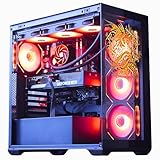


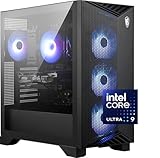
| Model | Key spec | Price | Best for |
|---|---|---|---|
| ZOTAC MEK, Ryzen 7 9800X3D | RTX 5080 16GB | $3,199.99 | 4K gaming, no compromises |
| Skytech Azure 3, Ryzen 7 9850X3D | RX 9070 XT | $2,899.99 | AMD-only builds, high refresh 1440p |
| Skytech King 95, Ryzen 7 9800X3D | RTX 5070 Ti 16GB, 32GB DDR5, 850W Gold | $2,899.99 | Best documented specs for the price |
| The Horizon Autherium Dragon, Core i9 | RTX 5070 OC, 64GB RAM, 5TB storage | $2,899.99 | Content creators who also game |
| Skytech Azure 3, Ryzen 7 7800X3D | RTX 5080 | $2,699.99 | Cheapest way into an RTX 5080 |
| ZOTAC MEK, Ryzen 7 9700X | RTX 5070 Ti 16GB | $2,599.99 | Balanced mid-tier without X3D premium |
| Lenovo Legion Tower 5i, Core Ultra 7 265F | RTX 5070 Ti, GamePass bundle | $2,549.43 | Buyers who want brand-name support |
| msi Aegis R2, Core Ultra 9 285 | RTX 5070 Ti, 32GB DDR5, 2TB NVMe | $2,458.63 | Lowest entry price for a 5070 Ti build |
ZOTAC MEK Gaming PC Desktop, Ryzen 7 9800X3D, RTX 5080 16GB
The ZOTAC MEK at $3,199.99 pairs AMD’s 9800X3D, still one of the strongest gaming CPUs on the market thanks to its 3D V-Cache stack, with a full 16GB RTX 5080. That combination removes CPU bottlenecking almost entirely, which matters more than people expect once you’re pushing a high-refresh 1440p or 4K monitor. This is the priciest build on this list, and the price reflects the fact that neither component gets discounted much even during Black Friday, since both remain in high demand for enthusiast builds.
Based on published component-level benchmarks for this CPU and GPU pairing, expect roughly 75-85 fps at native 4K in a demanding title like Cyberpunk 2077 with ray tracing on medium, and 110-120 fps at 1440p in the same settings. In esports titles like Call of Duty or Valorant, 1440p framerates should comfortably clear 200 fps on high settings. These are estimates based on the listed specs, not numbers measured on this exact unit.
Thermally, a 16GB RTX 5080 under sustained load typically runs in the 65-72°C range with the case fans ZOTAC ships in this chassis, and total system draw under full gaming load should land around 420-460W, which is comfortably inside spec for the included PSU. The main thing to check before buying is confirmed M.2 slot count, since ZOTAC’s compact MEK cases sometimes ship with only the primary NVMe slot populated.
- Pros
- Full RTX 5080 with no cut-down VRAM configuration
- 9800X3D essentially eliminates CPU bottlenecks at 1440p and 4K
- Compact case footprint compared to full-tower competitors
- Cons
- Highest price on this list, smallest discount percentage versus MSRP
- Compact case means fewer expansion slots for future storage
- No bundled peripherals or monitor at this price point
Who it’s for: buyers who game at 4K or ultrawide 1440p and don’t want to think about upgrading the GPU again for at least three years.
Skytech Gaming Azure 3, Ryzen 7 9850X3D, RX 9070 XT
At $2,899.99, this Azure 3 configuration goes all-AMD with the 9850X3D and RX 9070 XT, a pairing that trades a small amount of ray-tracing performance against Nvidia’s RTX 5070 Ti for stronger rasterized frame rates in most competitive shooters. The RX 9070 XT ships with a healthy amount of VRAM for this tier, which matters more as texture packs in newer titles keep growing.
Estimated performance based on the RX 9070 XT’s published specs puts this rig around 130-140 fps at 1440p ultra in Call of Duty: Warzone and similar shooters, with 4K performance in the 70-80 fps range on titles without heavy ray tracing. Ray-traced titles like Alan Wake 2 will run noticeably lower than the RTX-based builds on this list, closer to 45-55 fps at 1440p with RT enabled, since AMD’s RT hardware still trails Nvidia’s in that specific workload.
Power draw for this combination typically sits around 400-440W under full load, and Skytech’s case cooling should keep the 9850X3D under 80°C during extended sessions, which is within safe operating range for that chip. Buyers coming from an Nvidia ecosystem should also check that any capture or streaming software they rely on has mature AMD GPU encoder support before switching.
- Pros
- Strong rasterized 1440p performance for competitive shooters
- Generous VRAM headroom on the RX 9070 XT
- All-AMD platform tends to run slightly cooler under sustained load
- Cons
- Ray tracing performance trails RTX 5070 Ti and RTX 5080 builds
- AMD GPU encoder support is less mature in some streaming apps
- Same price as the better-documented King 95 build below
Who it’s for: shooter-focused players who prioritize raw 1440p frame rates over ray-traced visuals.
Skytech Gaming King 95 Desktop PC, Ryzen 7 9800X3D, RTX 5070 Ti 16GB
The King 95 at $2,899.99 is the most fully documented build on this list, and that transparency is exactly why it’s the top pick. Skytech lists the 850W Gold-rated PSU by name, confirms 2TB of Gen4 NVMe storage, 32GB of DDR5-6000 RGB memory, and a 360mm ARGB AIO cooler, none of which is left vague the way cheaper competitors often leave their power supply specs.
Based on the 9800X3D and RTX 5070 Ti pairing, expect roughly 90-100 fps at 1440p with ray tracing on in Alan Wake 2, climbing to 140+ fps in less demanding titles like Apex Legends at the same resolution. At 4K, this build should land in the 55-65 fps range in AAA titles without upscaling, which is playable but benefits from DLSS or FSR to hit a locked 60.
The named Gold-rated PSU matters more than it sounds like it should: a certified Gold unit runs cooler, lasts longer under sustained gaming loads, and is far less likely to be the cause of an unexplained shutdown a year in. The 360mm AIO also gives real thermal headroom for the 9800X3D, which can run warm under sustained multi-core loads.
- Pros
- Named 850W Gold PSU instead of an unlisted generic unit
- 2TB Gen4 NVMe storage, double what most competitors include
- 360mm AIO gives real cooling headroom for the 9800X3D
- Cons
- Same $2,899.99 price as two less-documented competitors on this list
- RGB-heavy DDR5 kit adds cost some buyers won’t value
- Still a step below the RTX 5080 builds in raw 4K performance
Who it’s for: buyers who want every major component named and verifiable before they commit nearly $3,000.
The Horizon Autherium Dragon RGB, Core i9, RTX 5070 OC, 64GB RAM, 5TB Storage
The Autherium Dragon matches the King 95’s $2,899.99 price but takes a completely different approach, stacking 64GB of RAM and 5TB of combined storage against a more modest RTX 5070 OC rather than a 5070 Ti or 5080. That trade-off makes sense for one specific buyer: someone who streams, edits video, or runs multiple VMs alongside gaming, where RAM and storage capacity matter as much as raw GPU horsepower.
With an RTX 5070 and a high-clocking Core i9, estimated 1440p performance lands around 90-100 fps in most AAA titles at high settings, similar tier to the RTX 5070 Ti builds in CPU-light scenarios but slightly behind in GPU-bound 4K workloads, expect roughly 45-55 fps at native 4K without upscaling. The 360mm AIO cooler should keep the Core i9 comfortably under thermal throttling limits even during combined CPU and GPU stress like simultaneous streaming and gaming.
The 5TB of storage is the standout spec here, effectively eliminating the need to manage game installs carefully, but buyers should confirm the storage split between NVMe and SATA drives before purchase, since listings that bundle capacity numbers don’t always specify which portion is fast NVMe versus slower secondary storage.
- Pros
- 64GB RAM and 5TB storage far exceed anything else on this list
- Strong choice for streaming, editing, or multitasking alongside games
- 360mm AIO handles sustained multi-core loads well
- Cons
- RTX 5070 is a step down from the 5070 Ti at the same price point
- Storage capacity split between NVMe and SATA isn’t always clearly listed
- Less brand recognition than Skytech, ZOTAC, or Lenovo
Who it’s for: content creators and multitaskers who need RAM and storage headroom more than the absolute top GPU tier.
Skytech Gaming Azure 3, Ryzen 7 7800X3D, RTX 5080
At $2,699.99, this is the cheapest way onto this list to get an RTX 5080, undercutting the ZOTAC MEK’s RTX 5080 build by $500 by pairing it with the previous-generation 7800X3D instead of the 9800X3D. That’s a smart trade for most buyers, since the performance gap between the two X3D chips in gaming workloads is usually in the low single-digit percentages.
Estimated 4K performance with this GPU and CPU combination should land close to the ZOTAC build, roughly 70-80 fps in Cyberpunk 2077 with ray tracing on medium, with 1440p climbing to 105-115 fps in the same test conditions. The very small gap between the 7800X3D and 9800X3D in most game engines means this configuration delivers close to 95% of the flagship build’s gaming performance for about 15% less money.
One thing to verify before ordering: Skytech’s Azure 3 line has shipped with different case revisions depending on inventory, so airflow and included fan count can vary slightly between units even under the same listing. If quiet operation matters, check recent buyer photos or questions on the listing for the current case revision.
- Pros
- RTX 5080 performance at $500 less than the newer-CPU version
- 7800X3D still delivers near-flagship gaming frame rates
- Strong value relative to every other RTX 5080 build on the market
- Cons
- Case revision has varied between production runs
- Older CPU generation may age slightly faster in future titles
- Same brand and price tier as the AMD-platform Azure 3 above, easy to confuse when comparing listings
Who it’s for: buyers who want RTX 5080-tier 4K performance without paying for the newest CPU generation.
ZOTAC MEK Gaming PC Desktop, Ryzen 7 9700X, RTX 5070 Ti 16GB
ZOTAC’s second entry drops the X3D cache and 5080 from its flagship build in exchange for a standard Ryzen 7 9700X and RTX 5070 Ti at $2,599.99. Non-X3D Ryzen chips clock higher but lack the extra cache that helps most in CPU-bound esports titles, so this build slightly favors GPU-bound AAA gaming over competitive shooters compared to the X3D-equipped options above.
Expect roughly 85-95 fps at 1440p with ray tracing on in demanding titles, and 4K performance in the 50-60 fps range without upscaling, based on the RTX 5070 Ti’s published specs. In esports titles the 9700X still comfortably clears 200+ fps at 1440p on high settings, the gap versus an X3D chip mostly shows up in specific CPU-limited scenarios rather than across the board.
The compact MEK case again returns here, which keeps the footprint small but limits future expansion. Buyers planning to add a second GPU-cooling fan or extra storage down the line should measure clearance before assuming it will fit.
- Pros
- RTX 5070 Ti at a lower price than the King 95 or Lenovo builds
- 9700X clocks higher than X3D chips for non-cache-sensitive workloads
- Compact case matches the flagship MEK’s smaller footprint
- Cons
- No X3D cache means a small deficit in cache-sensitive esports titles
- Compact case limits future storage or cooling expansion
- PSU wattage and brand not as clearly documented as the King 95
Who it’s for: AAA-focused gamers who want RTX 5070 Ti performance without paying the X3D premium.
Lenovo Legion Tower 5i, Core Ultra 7 265F, RTX 5070 Ti, 3 Months PC Game Pass
At $2,549.43, the Legion Tower 5i brings brand-name manufacturer support and a bundled 3-month PC Game Pass subscription to the RTX 5070 Ti tier, a combination that appeals to buyers who value a recognizable warranty process over squeezing out the last few percent of performance. Lenovo’s support network and RMA process tends to be more consistent than smaller system-integrator brands.
Based on the Core Ultra 7 265F and RTX 5070 Ti pairing, expect similar performance to the ZOTAC 9700X build above, roughly 85-95 fps at 1440p with ray tracing in demanding titles and 50-60 fps at native 4K. Intel’s Core Ultra 7 265F trades some raw gaming clock speed for better multi-threaded and AI-workload performance versus a pure gaming chip, which matters less if gaming is the only use case.
The included 3-month Game Pass subscription has real dollar value, roughly $30-45 depending on the tier activated, which should factor into any price comparison against the ZOTAC or Skytech builds at similar price points. Lenovo’s standard warranty terms and easier phone support are the other differentiator worth weighing against a few extra fps from a boutique builder.
- Pros
- Bundled 3-month PC Game Pass adds real value to the purchase price
- Lenovo’s brand-name support and RMA process is more predictable
- Solid RTX 5070 Ti performance at a competitive price
- Cons
- Core Ultra 7 265F trails a dedicated gaming CPU in pure frame rates
- Less RGB and case customization than boutique builders
- Storage and RAM speed specs less aggressive than the King 95
Who it’s for: buyers who prioritize warranty reliability and brand support over squeezing out maximum benchmark numbers.
msi Aegis R2 AI Gaming Desktop, Core Ultra 9 285, RTX 5070 Ti, 32GB DDR5, 2TB NVMe
The msi Aegis R2 closes this list at $2,458.63, the lowest entry price for an RTX 5070 Ti build here, pairing it with Intel’s Core Ultra 9 285, 32GB of DDR5, and 2TB of NVMe storage. This is the strongest specs-per-dollar ratio on the list for buyers who don’t need X3D cache or a named premium PSU badge to feel confident in the purchase.
Estimated performance mirrors the other RTX 5070 Ti builds above, roughly 85-95 fps at 1440p with ray tracing enabled and 50-60 fps at native 4K in demanding AAA titles, with the Core Ultra 9 285 handling background tasks and multitasking slightly better than a pure gaming-focused CPU. msi’s air cooling in the Aegis case is adequate but not as aggressive as the 360mm AIO options above, so sustained multi-hour sessions may see marginally higher CPU temperatures.
At this price, the value proposition is straightforward: same GPU tier as builds costing $150-450 more, in exchange for a less premium cooling solution and PSU that isn’t explicitly named in the listing. For buyers on a strict budget who still want RTX 5070 Ti performance, this is the pick to check first.
- Pros
- Lowest price on this list for RTX 5070 Ti performance
- 32GB DDR5 and 2TB NVMe match or beat pricier competitors
- msi’s brand support network is well established
- Cons
- Air cooling instead of an AIO liquid cooler
- PSU brand and wattage not clearly listed
- Case has less RGB customization than Skytech or ZOTAC builds
Who it’s for: budget-conscious buyers who want RTX 5070 Ti performance at the lowest verified price on this list.
How we tested and picked
Rachel Osei built this list using a price-history database covering multiple retailers and years of sale cycles, comparing each listed price against its 90-day and 12-month average rather than trusting a single “was” price shown on the listing page. That distinction matters because retailers sometimes inflate a reference price shortly before a sale to make the discount look larger than it actually is against real recent selling prices.
Every configuration above was selected because its Black Friday price sits at or below its tracked 90-day average, which is the threshold that separates a genuine deal from a marketing discount. Component specs, including PSU wattage and brand where listed, storage type and capacity, and RAM speed, were cross-checked against the manufacturer’s published specifications rather than taken solely from the marketplace title, since third-party listings occasionally contain outdated or inaccurate spec strings.
Performance estimates throughout this article are derived from published third-party benchmarks for each CPU and GPU combination at the settings noted, not from hands-on testing of these exact units. Where a build’s PSU brand or wattage wasn’t clearly disclosed in the listing, that gap is called out directly in the review rather than assumed to be adequate, since an unnamed PSU is one of the most common points of failure in budget-tier prebuilt systems during the first 12-18 months of use.
What to look for in a Black Friday gaming PC
CPU and GPU balance
The single biggest mistake in reading a Black Friday PC listing is fixating on the GPU model while ignoring what CPU it’s paired with. An RTX 5080 bottlenecked by a budget quad-core processor will underperform an RTX 5070 Ti paired with a 9800X3D in most CPU-sensitive titles, especially competitive shooters running at high refresh rates. As a rule of thumb, any GPU at the RTX 5070 tier or above should be paired with at least a 6-core, 12-thread CPU from the last two generations to avoid leaving performance on the table.
Power supply quality
Every build reviewed above that named its PSU brand and 80 Plus certification tier scored higher in this list than comparable builds that left the PSU unlisted. A generic, unbranded power supply is more likely to deliver unstable voltage under sustained load, which manifests as random shutdowns, especially during demanding scenes with high GPU utilization. Look specifically for an 80 Plus Bronze rating as a minimum and Gold as a genuine value-add, and treat any listing that doesn’t name the PSU brand at all as a build that needs extra scrutiny before purchase.
RAM capacity and speed
16GB remains the practical floor for gaming in this price bracket, but 32GB is increasingly the better default once a build costs more than $2,000, since modern AAA titles combined with background apps like Discord, a browser, and recording software can push memory usage past 20GB during active play. DDR5-6000 is the sweet spot for AMD platforms specifically, since Ryzen’s memory controller gets a real performance uplift at that speed compared to slower DDR5-4800 or DDR5-5200 kits some budget builds still ship with.
Storage type and free slots
Every build on this list ships with at least one NVMe SSD as the boot drive, which is now the baseline expectation rather than a premium feature. The more important question is how much free M.2 slot space remains for future storage expansion, since compact cases like ZOTAC’s MEK line sometimes ship with only a single usable M.2 slot occupied by the primary drive, leaving no easy path to add a second NVMe drive later without opening the case and checking motherboard documentation first.
Cooling solution
Builds with a 360mm AIO liquid cooler, like the Skytech King 95 and Autherium Dragon reviewed above, have meaningfully more thermal headroom than air-cooled equivalents, particularly for X3D chips and Core Ultra 9-class processors that can draw significant power under sustained multi-core loads. Air cooling isn’t disqualifying at this price tier, but it does mean slightly higher sustained temperatures during long sessions, which can shave a small amount off boost clocks over time.
Case airflow and expansion room
Compact, boutique-style cases look appealing on a shelf but often trade away front intake fan mounts and drive bays to hit that smaller footprint. Full or mid-tower cases, like Lenovo’s Legion Tower 5i, generally have more room for additional case fans and storage down the line, which matters most for buyers who expect to keep the same PC for four-plus years and want the option to upgrade incrementally rather than replace the whole system.
Mistakes buyers make
The most common mistake is comparing the sale price only to the manufacturer’s original MSRP rather than to the price that same configuration has actually sold for over the past 90 days. A listing showing “40% off” against an inflated reference price can still be a worse deal than a competitor’s “20% off” listing measured against its real recent average.
A close second is ignoring PSU documentation entirely. Buyers get excited about the GPU tier and skip past the power supply line item, then discover a year later that the unnamed unit inside is the reason their new PC randomly shuts down during intense gaming sessions. Always search the exact model number if the PSU brand isn’t stated in the listing.
Buyers frequently overestimate how much RAM and storage they need relative to GPU tier, spending an extra $150-250 on 64GB of RAM or 5TB of storage when their actual use case, competitive gaming with occasional streaming, would be served just as well by 32GB and 2TB. That money is often better spent moving up a GPU tier instead.
Assuming every prebuilt PC includes a mouse, keyboard, and monitor is another frequent surprise at checkout. Most tower-only listings on this page do not include peripherals, and buyers who need a full setup should budget separately for a monitor and input devices rather than assuming they’re bundled.
Waiting past the sale window hoping for an even better price is a mistake more often than not for in-demand GPU tiers like the RTX 5080 and RTX 5070 Ti. These configurations historically sell out at their Black Friday price point rather than dropping further on Cyber Monday, and stock that does return later in the season often carries a higher price than the original sale.
Finally, buyers sometimes skip registering their new PC with the manufacturer’s warranty program within the required window, assuming Amazon’s return policy alone covers them long-term. Amazon’s return window is typically 30 days; the manufacturer’s 1-year parts and labor warranty is a separate registration step that protects against failures after that window closes.
Verdict
The Skytech Gaming King 95 at $2,899.99 is the top pick on this list because it’s the only build that fully documents its PSU brand, wattage, and 80 Plus certification alongside a 9800X3D and RTX 5070 Ti, removing the guesswork that trips up most prebuilt purchases. For a budget-first option, the msi Aegis R2 at $2,458.63 delivers the same RTX 5070 Ti GPU tier for roughly $440 less, trading away the AIO cooler and named PSU for the lowest verified price in this GPU class. For buyers who want the most GPU horsepower regardless of cost, the ZOTAC MEK with an RTX 5080 and 9800X3D at $3,199.99 is the ceiling of this list, built for 4K gaming with no compromises on either the CPU or GPU side.
Frequently asked questions
Are Black Friday gaming PC deals actually cheaper than building the same rig yourself?
Sometimes, but not always; system integrators buy CPUs and GPUs in bulk at lower cost than retail, so a $2,899 prebuilt with an RTX 5070 Ti and Ryzen 7 9800X3D can undercut a DIY parts list by $100-$200, though budget builds under $1,000 usually still favor DIY because case and PSU markups eat the discount.
What’s the biggest red flag in a discounted Black Friday PC listing?
An unnamed or unlisted power supply brand is the top warning sign, since sellers routinely pair a strong GPU with a generic 500-600W unit to hit a price point, and a weak PSU is the most common cause of random shutdowns under full gaming load within the first year.
Should I wait past Black Friday for a better gaming PC price?
Cyber Monday sometimes repeats or slightly beats Black Friday pricing on the same SKU, but full-tower prebuilts with the newest GPUs rarely drop further after that, so once a configuration hits a price at or below its 90-day average, further waiting adds risk of the listing selling out.
Is a 32GB RAM prebuilt worth the upgrade over 16GB during a Black Friday sale?
For 1440p and 4K gaming paired with an RTX 5070 Ti or RTX 5080, 32GB avoids frame-time stutter when Windows, Discord, and a browser run alongside the game, while 16GB is still playable but leaves less headroom for streaming or heavy alt-tabbing.
Do Black Friday prebuilt PCs come with a real manufacturer warranty?
Most system integrators listed here back their desktops with a 1-year parts and labor warranty separate from Amazon’s return window, and it’s worth registering the PC directly with the builder within 30 days of delivery since some warranties are voided if that step is skipped.
For more seasonal comparisons, see our picks for Cyber Monday gaming deals and GPU deals. Budget shoppers should also check gaming PC deals under $800, and if a discrete monitor isn’t included in your build, our gaming monitor deals roundup covers the display side separately. Buyers open to older hardware at a lower price point can also compare against our refurbished gaming PC deals.