
The best DJI action cameras for travel and sports are the Osmo Action 5 Pro for the strongest overall package, the Osmo Action 4 for better value, and the Osmo Action 3 for budget buyers who still want 4K stabilization. The right choice depends less on headline resolution than on how much low-light footage you shoot, whether you need long recording sessions, and how much you will spend on batteries, mounts, and waterproof accessories.
As an Amazon Associate we earn from qualifying purchases at no extra cost to you.


Our Top Picks


Top 3 picks at a glance
Quick comparison: DJI action cameras for 2026
| Camera | Stabilization | Low-light quality | Battery endurance | Waterproofing | Typical market range |
|---|---|---|---|---|---|
| DJI Osmo Action 5 Pro | RockSteady 3.0, HorizonSteady | Best of the three; 1/1.3-inch sensor and improved processing | Up to about 4 hours in favorable conditions; less at high frame rates | Up to 20 m without a case; deeper with the waterproof case | Usually $350–$450, depending on bundle |
| DJI Osmo Action 4 | RockSteady 3.0, HorizonSteady | Very good; large sensor remains strong at dusk and indoors | Roughly 2–3 hours of practical 4K recording per battery | Up to 18 m without a case; deeper with the waterproof case | Usually $250–$400 |
| DJI Osmo Action 3 | RockSteady 3.0, HorizonSteady | Good in daylight; more noise in dim scenes | Roughly 2–2.5 hours of practical recording per battery | Up to 16 m without a case; deeper with the waterproof case | Usually $180–$300 |
Battery figures vary with resolution, frame rate, stabilization, temperature, screen use, and wireless connectivity. Treat the table as a planning guide rather than a guarantee.
DJI Osmo Action 5 Pro: best overall for travel and demanding sports
The Osmo Action 5 Pro is the best DJI action camera when one device must cover cycling, skiing, hiking, snorkeling, and evening travel footage. Its 1/1.3-inch sensor, improved image processing, dual touchscreens, and long claimed runtime give it the widest margin in difficult conditions.
Why it leads
- Stabilization: RockSteady 3.0 reduces running and vehicle vibration, while HorizonSteady helps keep the horizon level when the camera rotates. Horizon correction can crop the image, so use it when level footage matters more than the widest view.
- Low light: The large sensor and newer processing make it the strongest option here for sunset walks, forest trails, indoor sports, and city footage after dark. It still cannot match a larger interchangeable-lens camera, but it produces cleaner action footage than small-sensor budget cameras.
- Battery endurance: The extended runtime is valuable for travel because fewer battery changes mean less equipment and fewer missed moments. Cold weather and 4K120 recording will reduce the advantage.
- Waterproofing: Its depth rating is sufficient for rain, kayaking, surface swimming, and ordinary snorkeling without a housing. Use the waterproof case for scuba diving or repeated deep-water use.
- Mounting: DJI’s quick-release system makes it easy to move between a chest mount, helmet mount, handle, and selfie stick. The front and rear screens are useful when the camera is mounted facing either direction.
Choose the Action 5 Pro if you regularly record in changing light, need long continuous sessions, or want the least compromised single-camera travel kit. It is also the best choice for skiing and winter trips, where battery capacity and low-light performance matter more than saving the last portion of the purchase price.
DJI Osmo Action 4: the value sweet spot
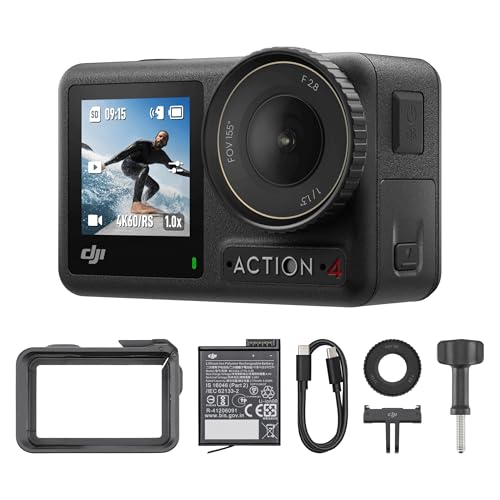
The Osmo Action 4 remains the sensible choice for many buyers because it retains the large 1/1.3-inch sensor, strong stabilization, front and rear displays, and useful waterproofing at a lower market price.
In daylight sports footage, the difference from the Action 5 Pro is often less important than the difference between using the correct mount and using an unstable one. RockSteady 3.0 is effective for running, mountain biking, and motorcycle footage, while HorizonSteady is helpful for handlebars and rotating camera positions.
The Action 4 is particularly attractive when a discounted multi-battery bundle costs substantially less than the newer model. Its main disadvantages are shorter endurance and less advanced image processing in difficult light. If your footage is mostly recorded outdoors during the day, those disadvantages may barely affect the final video.
For travelers, the Action 4 balances image quality and total kit size well. It supports DJI’s quick-release mounting ecosystem, standard tripod-compatible adapters, and external microphones through compatible accessories. Check the exact bundle before buying: a low camera price can become less attractive if it includes only one battery and no charging solution.
DJI Osmo Action 3: best budget entry point
The Osmo Action 3 is still a capable budget action camera for daylight hiking, family trips, cycling, and casual water sports. It records stabilized 4K video, has front and rear screens, and uses a practical quick-release mounting design.
Its 1/1.7-inch sensor is smaller than the sensors in the newer models, so dim scenes show more noise and lose detail sooner. That makes it less suitable for night rides, indoor events, and shaded forests. It is also an older design, so compare its bundle price carefully against a discounted Action 4.
Buy the Action 3 when the camera body and a basic mount are all you need, or when you want an inexpensive second camera for a helmet or vehicle. Do not choose it solely because the advertised resolution matches newer models: resolution does not compensate for poorer low-light capture or a less flexible battery budget.
Head-to-head by buying criterion
Stabilization
All three cameras offer RockSteady stabilization and HorizonSteady, so the choice is not simply “stabilized versus unstabilized.” The practical difference is how much cropping and image processing you can accept. Use RockSteady for normal movement and HorizonSteady for aggressive rotation or uneven mounting. For a very wide landscape view, turn stabilization down or off and use a rigid mount instead.
Low-light quality
Choose the Action 5 Pro first, Action 4 second, and Action 3 only when price dominates. For evening footage, record at 4K30 rather than 4K60 or 4K120. The longer exposure time and lower processing burden usually produce a cleaner image. Avoid excessive digital zoom, which magnifies noise rather than adding detail.
Battery endurance
Plan around the usable runtime, not the laboratory maximum. A simple travel calculation shows why:
Example: If you expect six hours of active recording across a day and one battery gives approximately 2.5 hours in your chosen mode, then 6 ÷ 2.5 = 2.4. Round up to three batteries. If cold weather reduces capacity by roughly 20%, plan for 6 ÷ 2.0 = 3 batteries, then add a charging margin if you cannot recharge during lunch or at the hotel.
The Action 5 Pro can reduce the number of spare batteries, but a multi-battery bundle may still be cheaper and more convenient than relying on a single extended-runtime camera.
Waterproofing
Built-in waterproofing is sufficient for rain, splashes, shallow swimming, and many snorkeling trips when the battery door and USB cover are completely closed. Salt water and sand are the bigger long-term risks: rinse the camera with fresh water, dry it before opening any cover, and inspect seals for grit.
Use a waterproof case for scuba diving, deeper freediving, high-impact water sports, or any situation where replacing a damaged camera would be costly. A case may also make buttons harder to use and can affect audio, so it is not automatically better for everyday rain.
Mounting options
For cycling and running, use a chest mount when you want a stable view of the route and a helmet mount when you want the footage to follow your gaze. For skiing, a chest mount shows poles and terrain, while a helmet mount provides a more immersive viewpoint. For motorcycles and cars, use a rigid, vibration-resistant mount and a safety tether.
The cameras use DJI’s quick-release approach, but the total cost rises if you need several dedicated positions. Standard tripod adapters improve compatibility with generic accessories, while a selfie stick or extension pole is useful for travel but can become visible in ultra-wide footage.
Total accessory cost: the part many comparisons miss
| Travel or sports setup | Typical additional items | Approximate added cost |
|---|---|---|
| Minimal travel kit | One spare battery, small grip, basic mount, memory card | $70–$140 |
| Full-day sports kit | Two or three spare batteries, charging case, chest or helmet mount, card | $150–$280 |
| Water and multi-position kit | Charging case, waterproof case, floating grip, chest mount, helmet mount, cards | $220–$400 |
These are general market ranges and vary by bundle and accessory brand. A cheaper Action 3 can lose its value advantage if you add several batteries, a charging case, and a waterproof housing. Conversely, a premium Action 5 Pro bundle may be economical if it already includes multiple batteries and mounting hardware.
Which DJI action camera should you buy?
- Choose the Osmo Action 5 Pro for frequent low-light recording, cold-weather travel, long days without charging, or the strongest all-round performance.
- Choose the Osmo Action 4 for the best balance of sensor quality, stabilization, waterproofing, and price—especially when discounted.
- Choose the Osmo Action 3 for daylight use, a second camera, or a strict budget, provided its total bundle cost is clearly below the Action 4.
For most travelers, the Action 4 is the value recommendation. For serious sports recording and mixed lighting, the Action 5 Pro justifies its higher cost through better endurance and more dependable image quality. The Action 3 remains worthwhile only when its lower purchase price is preserved after adding the batteries and mounts you actually need.
Frequently asked questions
What resolution and frame rate should I use for evening footage?
Use 4K30 for evening footage rather than 4K60 or 4K120. The article says the longer exposure time and lower processing burden usually produce a cleaner image. The Action 5 Pro is the strongest of these three in low light, followed by the Action 4; the Action 3 is less suitable for night rides, indoor events, and shaded forests.
How many spare batteries should I pack for a full day of recording?
Plan around your expected recording time and the runtime in your chosen mode. For six hours of active recording at approximately 2.5 hours per battery, the article’s example rounds up to three batteries. In cold weather, capacity may drop by roughly 20%, so allow for that and add a charging margin if you cannot recharge during lunch or at the hotel.
How should I care for an action camera after using it in salt water?
Rinse it with fresh water, dry it before opening any cover, and check the seals for grit. Salt water and sand can pose long-term risks even when the camera is built for water use. Make sure the battery door and USB cover are completely closed before getting the camera wet.
When should I use a waterproof case instead of the camera’s built-in waterproofing?
Use a waterproof case for scuba diving, deeper freediving, high-impact water sports, or situations where camera damage would be costly. Built-in waterproofing is described as sufficient for rain, splashes, shallow swimming, and many snorkeling trips when covers are closed. A case can make buttons harder to use and affect audio.
Which mount is best for cycling, skiing, or motorcycling?
For cycling, a chest mount gives a stable view of the route, while a helmet mount follows your gaze. For skiing, a chest mount shows poles and terrain, and a helmet mount offers a more immersive viewpoint. For motorcycles and cars, use a rigid, vibration-resistant mount and a safety tether.


