
The best high end spotting scopes for long range observation in 2026 are 85mm to 95mm class models like the Swarovski ATX/STX 95, Zeiss Victory Harpia 95, Kowa TSN-99A Prominar, and Leica APO-Televid 82, because they combine 70x+ usable magnification with apochromatic glass that holds edge sharpness and low-light contrast beyond 1,500 yards where smaller 65mm scopes wash out.
As an Amazon Associate we earn from qualifying purchases at no extra cost to you.


Our Top Picks

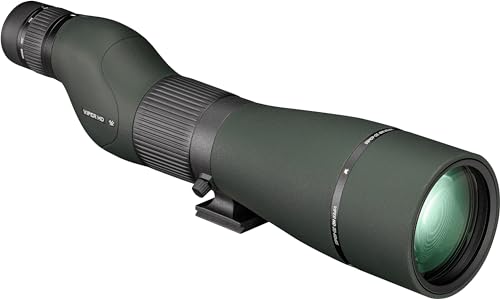
Top 3 picks at a glance
How to Choose a High-End Spotting Scope for Long Range
Buying for long-range viewing is not about finding the highest number on the zoom ring. Usable detail at distance depends on five linked factors: objective size, magnification range, optical correction, low-light transmission, and stability on a tripod. Get one wrong and the others cannot compensate.
1. Objective Size: 65mm vs 82-85mm vs 95-99mm
Objective diameter controls two things: light gathering and theoretical resolution. For distant observation at dawn, dusk, or in heat haze, this is the most important spec.
- 65mm class: Lightest for backpacking (around 38-48 oz body only), adequate to about 800-1,000 yards in good light. Fails earliest in low light and when mirage forces you to drop magnification.
- 82-85mm class: The sweet spot for most long-range users. Noticeably brighter than 65mm with only a moderate weight penalty. Works well as a do-everything long-range and digiscoping platform.
- 95-99mm class: Maximum detail and twilight performance. Required if you routinely glass beyond 1,500 yards, evaluate bullet trace, or need to resolve antler or target detail in the last 20 minutes of light. Demands a heavy-duty tripod.
Rule of thumb: If you carry the scope more than a mile, choose 85mm. If you glass from a vehicle, fixed position, or short walk-in, choose 95-99mm.
2. Magnification Range and Why More Isn’t Always Better
Most high-end zooms now offer 25-60x or 30-70x on an 85mm+ body, with wide-angle eyepieces. Above 60x, atmospheric conditions, not the scope, usually limit you. Heat shimmer at midday can make 70x look worse than 40x. A quality 30-60x that stays sharp to the edge will beat a cheaper 20-80x that goes soft past 50x.
Look for three things: a wide true field of view at low power for finding targets, a smooth zoom without blackouts, and consistent eye relief (ideally 17-20mm) so you can glass for hours without eye strain, even with glasses.
3. Edge Sharpness and Chromatic Aberration Control
Center sharpness is easy; edge sharpness is what separates high-end scopes. Apochromatic (APO) and fluorite crystal objective systems from Swarovski, Kowa, Zeiss and Leica use extra-low dispersion glass to eliminate color fringing on high-contrast edges, such as a dark target against sky or a backlit ridgeline. This matters at long range because chromatic aberration steals contrast that you need to distinguish fine detail.
Field flatteners and wide-angle eyepiece designs (like the Zeiss Victory Harpia’s 72-degree apparent field) keep the outer 30% of the image from smearing or curving. When panning across a hillside or tracking moving game, you will notice this immediately. Test it by placing a straight edge, like a fence line, at the edge of the field at 50x – on a true high-end scope it stays straight and color-free.
4. Low-Light Performance: Exit Pupil and Twilight Factor
Low-light performance is not marketing. You can calculate it from magnification and objective size. Two useful numbers:
Exit Pupil = Objective Diameter / Magnification. Your eye’s pupil in low light dilates to about 5-7mm. If the scope’s exit pupil is smaller than your eye’s pupil, the image looks dim. Below 2.0mm, the image gets dark and your eye placement becomes critical.
Twilight Factor = sqrt(Magnification x Objective Diameter). This estimates ability to resolve detail in dim light. Higher is better.
| Configuration | Exit Pupil | Twilight Factor | Low-Light Use Case |
|---|---|---|---|
| 65mm at 40x | 1.63mm | 51.0 | Daylight only; dim at dusk |
| 85mm at 40x | 2.13mm | 58.3 | Usable to last light |
| 85mm at 60x | 1.42mm | 71.4 | Bright detail but darker image, needs stable tripod |
| 95mm at 40x | 2.38mm | 61.6 | Bright, comfortable for extended glassing |
| 95mm at 60x | 1.58mm | 75.5 | Best resolution at distance, acceptable brightness |
| 99mm (Kowa TSN-99A) at 70x | 1.41mm | 83.2 | Maximum long-range detail, tripod critical |
What this tells you: An 85mm or 95mm scope at 40x delivers a 2.1-2.4mm exit pupil that remains comfortable at dusk, while a 65mm at the same power is already dim. At 60x, all scopes get darker, which is why high-end 95-99mm models justify their weight – they preserve twilight factor above 75 while keeping the image viewable.
5. Weight and Tripod Compatibility
High-end spotting scopes magnify shake as much as they magnify the target. A 95mm body alone typically weighs 65-75 oz, and needs a tripod and head rated for at least double that weight to damp vibration in wind.
- Under 50 oz (65mm bodies): Works with a mid-weight carbon tripod and compact video head. Good for mountain hunting and backcountry.
- 55-65 oz (82-85mm bodies): Requires a full-size carbon tripod with 30mm+ leg diameter and a dedicated fluid or gimbal head.
- Over 65 oz (95-99mm bodies): Requires a systematic tripod with no center column and an Arca-Swiss compatible fluid head. Do not pair a $3,000+ scope with a light travel tripod – you will never reach its potential.
Check two compatibility details before buying: 1) Does the foot have 1/4″-20 and 3/8″-16 threads plus Arca-Swiss dovetail, and 2) does the eyepiece rotation and focus collar clear your tripod head when angled steeply uphill. Swarovski ATX/STX modular, Zeiss Harpia, and Kowa TSN series all offer rotating collars and interchangeable eyepieces, but balance point differs.
Top High-End Spotting Scopes for Long-Range Observation Compared
All models below use apochromatic/fluorite glass and are fully nitrogen-purged and waterproof. Market pricing for this tier is usually $2,400–$3,900 for the body and eyepiece/zoom module combined, with flagship 95mm systems usually $3,200–$4,800 as a set.
| Model | Objective | Magnification (with stock zoom) | Weight (body + eyepiece) | Key Strength |
|---|---|---|---|---|
| Swarovski ATX/STX 95 with 30-70x | 95mm | 30-70x | ~71 oz (2,010g) | Modular design, exceptional edge sharpness and low-light contrast |
| Zeiss Victory Harpia 95 with 23-70x | 95mm | 23-70x | ~71 oz (2,030g) | Widest field of view in class, dual-speed focus |
| Kowa TSN-99A Prominar with TE-11WZ II 30-70x | 99mm | 30-70x | ~74 oz (2,110g) | Pure fluorite crystal objective, highest twilight factor |
| Leica APO-Televid 82 with 25-50x WW ASPH. | 82mm | 25-50x | ~59 oz (1,680g) | Compact for its aperture, excellent color fidelity |
| Swarovski ATX/STX 85 with 25-60x | 85mm | 25-60x | ~62 oz (1,760g) | Best balance of portability and long-range performance |
Decision Matrix: Which Scope Fits Your Situation
Match your primary use to the right class instead of just buying the largest objective:
| If Your Primary Use Is… | Choose This Class | Why |
|---|---|---|
| Backpacking 2+ miles and glassing to 1,000 yards | 65mm or 82mm (Leica 82, Swarovski ATX 65/85) | Saves 1-2 lbs and still resolves game at moderate range |
| Truck or base-camp glassing beyond 1,500 yards | 95-99mm (Swarovski 95, Zeiss Harpia 95, Kowa 99A) | Maximum brightness and resolution, weight is secondary |
| Target shooting / spotting trace and impacts at 1,000+ yards | 95-99mm with 70x zoom | Need high twilight factor and fine focus control |
| Digiscoping and long-range photography | Zeiss Harpia 95 or Kowa 99A | Wide field and low chromatic aberration improve phone/camera adapters |
| One scope for hunting, birding, and range days | 85mm class | Most versatile weight-to-performance ratio |
Setup Tips to Get Sharp Images at Extreme Distance
Even the best glass looks poor if setup is wrong. Use these concrete settings in the field:
- Tripod height: Extend the thickest leg sections first. Avoid raising the center column more than 4-6 inches – it introduces vibration that is magnified 60x. Sit or use a low chair so the scope is at eye level with legs only two sections extended.
- Magnification in mirage: Start at 30-35x in midday heat. Increase until the target starts to wash, then back off 5x. This is your usable max for that hour. Early morning and late afternoon will let you use the full 60-70x.
- Diopter and focus: Set the diopter with the zoom at max power on a high-contrast edge, then leave it. Use the fine focus wheel in tiny turns – high-end dual-focus systems like Zeiss and Kowa allow micro-adjustment without overshooting.
- Eye relief: Twist the eyecup out fully if you do not wear glasses, in one click if you do. Correct eyecup position prevents vignetting at low power and kidney-beaning at high power.
- Sun shade: Always extend the built-in sun shade, even on overcast days. It reduces side glare and protects the objective from dust that scatters light and lowers contrast at long range.
What to Avoid at This Price Level
Do not pay for extra magnification beyond 70x without a larger objective to support it – the exit pupil becomes too small to be useful. Avoid scopes without apochromatic correction if your main use is high-contrast long-range viewing; single ED glass will show purple fringing at 50x+ that obscures detail. Finally, do not adapt a lightweight photo tripod – vibration at 60x will make any scope look soft regardless of glass quality.
FAQ
Is a 65mm high-end scope enough for 1,000-yard observation?
In bright midday light, yes, a premium 65mm with a fluorite/APO element can resolve a deer-sized target or steel plate at 1,000 yards. In low light, haze, or when you need to judge fine detail, an 85mm or larger provides a brighter, higher-contrast image and will be noticeably better.
Are angled or straight bodies better for long range?
Angled bodies (45 degrees) are more comfortable for long glassing sessions and for sharing the scope among users of different heights, and they allow a lower tripod position for stability. Straight bodies are faster to acquire moving targets and align with a rifle. For static long-range observation from a fixed position, most experienced users prefer angled.
Do I need a fluorite crystal objective?
For short-range birding, high-quality ED glass is often enough. For long-range use past 800 yards where you push 50-70x on high-contrast targets, pure fluorite (as in the Kowa Prominar series) provides the cleanest correction of secondary spectrum and the highest perceived sharpness at the edge, especially in harsh light.


