
The best indoor TV antennae for clear reception in 2026 are the amplified flat-panel models with 30-45 mile effective range and switchable amplifiers, such as the Mohu Leaf Supreme Pro, Antennas Direct ClearStream Eclipse Amplified, Winegard FlatWave Amped, and Channel Master Flatenna 35 – flat designs with detachable amplifiers win indoors because they balance UHF/VHF reception, long cable reach, and flexible mounting without the bulk of traditional rabbit ears.
As an Amazon Associate we earn from qualifying purchases at no extra cost to you.



Our Top Picks
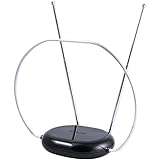
 Philips Rabbit Ears Black Indoor TV AntennaRabbit Ears1.25 x 7.5 x 8.5 Inches0.4 PoundsCheck on Amazon


Top 3 picks at a glance
How Indoor Antenna Range Really Works (And Why 80-Mile Claims Mislead)
Box claims of 60, 80, or even 120 miles are measured in ideal line-of-sight conditions on a tower, not inside a living room. Indoors, every wall, window coating, and floor above you cuts signal. A realistic rule of thumb for 2026 models:
- Claimed 60-80 mile amplified antenna: 30-45 miles reliable indoors for UHF, 15-25 miles for High-VHF (channels 7-13)
- Claimed 35-50 mile non-amplified/ passive flat antenna: 15-30 miles reliable indoors
- Claimed 25-mile rabbit ears / loop: 10-15 miles, highly dependent on line-of-sight
That drop is not marketing trickery alone. UHF signals (most major networks since the repack) are line-of-sight. A wood-frame home might lose 3-6 dB per exterior wall, while a concrete apartment with Low-E glass can lose 10-15 dB before the signal even reaches the antenna. An amplifier cannot create signal that never entered the room – it only raises the signal and noise together to overcome cable loss and tuner sensitivity limits.
Worked Example: Do You Actually Have Enough Signal Margin?
Use this simple link-budget check to see if an indoor antenna can work for your distance before you buy. You don’t need exact tools – FCC signal search or RabbitEars.info gives you Noise Margin (NM) in dB for your address.
Example for a suburban home 32 miles from transmitters:
- Starting NM from RabbitEars for weakest desired channel: +28 dB (positive means predicted reception with outdoor antenna)
- Subtract indoor penalty: -12 dB for first-floor placement with vinyl siding and standard glass
- Subtract multipath/furniture penalty in urban edge: -3 dB
- Antenna gain (flat panel passive): +3 dB
- Resulting NM at antenna terminals: 28 – 12 – 3 + 3 = +16 dB
- Subtract coaxial cable loss (15 ft RG59 thin cable often included): -2 dB, or (15 ft RG6): -1 dB
- Final NM at tuner: ~ +14 to +15 dB
If the final NM stays above +10 dB, reception will generally be stable. Between 0 and +10 dB, you will see dropouts when weather or leaves change. Below 0 dB, even an amplifier will not help – you need a different placement (window facing transmitters, second floor) or an attic/outdoor option. Adding a 15-20 dB amplifier to the +15 dB example above lifts it to +30 dB at the tuner, which helps the tuner lock but does not fix the +16 dB air signal if it were already negative.
Best Indoor TV Antennae Compared: Real-World Specs
For indoor use, flat panel antennas with switchable amplification dominate because they receive both UHF and High-VHF without requiring precise aiming like directional yagis. Here is how the leading classes compare on the specs that actually affect clear reception.
| Model Class | Claimed Range | Realistic Indoor Effective Range | Amplifier Gain | Included Cable Length / Type | Best Mounting Options |
|---|---|---|---|---|---|
| Mohu Leaf Supreme Pro | 65 miles | 30-45 miles UHF, 20-25 miles VHF-Hi | 15 dB switchable, USB powered | 12 ft RG6 + 3 ft USB power | Wall, window, paintable panel |
| Antennas Direct ClearStream Eclipse Amplified | 60 miles | 30-42 miles UHF, 18-24 miles VHF-Hi | 20 dB switchable with Sure Grip | 15 ft RG6 detachable | Wall, window with adhesive, stand |
| Winegard FlatWave Amped FL5500A | 60 miles | 28-40 miles UHF, 15-22 miles VHF-Hi | 18 dB inline, USB powered | 18.5 ft RG6 + USB | Window, wall, behind TV |
| Channel Master Flatenna 35 (Passive) | 35 miles | 18-30 miles UHF, 12-18 miles VHF-Hi | None (passive) | No cable, add your own RG6 | Wall, window, easel |
| Antop AT-206B Paper Thin Smartpass | 65 miles | 30-40 miles UHF, 18-23 miles VHF-Hi | Switchable Smartpass 10-18 dB | 16 ft RG6 | Wall, window, ceiling |
| Traditional Rabbit Ears + Loop (Generic amplified) | 40-50 miles | 10-20 miles UHF, 12-25 miles VHF-Hi with extended dipoles | 10-12 dB often non-switchable | 5-6 ft RG59 fixed | Tabletop, requires constant re-aiming |
Takeaway: No indoor antenna reliably delivers 60+ miles through walls. The difference between winners and losers is not the number on the box, but whether the amplifier can be turned OFF, the cable is RG6 and long enough to reach a window, and the VHF performance is documented – many flat antennas are UHF-only and will miss ABC, FOX, or PBS on channels 7-13 in some markets.
Amplifiers: When They Help and When They Hurt
An amplifier is useful for two situations only:
- You are 20-40 miles out and have a long cable run (15+ feet) to reach the optimal window, or you split the signal to 2 TVs
- Your tuner needs a stronger signal floor to lock, and you already have positive NM at the antenna
An amplifier hurts in strong-signal urban areas (within 10-15 miles of towers). Over-amplification overloads the tuner and causes the exact pixelation people try to fix. That is why switchable models like the Mohu Leaf Supreme Pro, ClearStream Eclipse, and Antop Smartpass series are the safest buy for most rooms – you can run passive near downtown and click amplification on in the suburbs.
General market price context in 2026: Passive flat panels usually $25-$45, amplified flat panels usually $45-$80, amplified rabbit ears usually $20-$40. Anything above that is usually paying for design or bundling, not more range.
Concrete Setting: How to Set an Amplifier Correctly
- Connect antenna to TV without amplifier power (or switch set to OFF / Passive) and run a full channel scan from your TV’s Settings > Channels > Auto Scan.
- Check signal strength meter under Settings > Channels > Signal Information (on most LG, Samsung, TCL, Sony sets) – note readings for your weakest major channel.
- Turn amplifier ON and rescan. If you gain 2-5 stable channels without losing strong locals, leave it on.
- If strong locals (within 10 miles) start breaking up or signal meter shows 95-100% strength but quality drops, the amp is overloading – turn it off or move antenna 3-4 feet away from the TV/metal objects.
Reasoning: Tuners need both strength and quality. Strength at 100% with quality below 60% almost always means overload or multipath reflection, not weak signal.
Mounting and Cable Length: The Real Reception Difference Indoors
Placement beats product choice indoors. A $30 passive antenna in a window facing the transmitters will beat a $70 amplified antenna behind the TV every time.
Mounting options ranked for clear reception:
- Window facing transmitter tower: Best for concrete/brick apartments and Low-E glass homes. Use adhesive pads or suction grip (ClearStream Eclipse, FlatWave) and keep at least 12 inches from metal window frames.
- High wall (7+ feet): Second best, avoids furniture and human body interference. Flat panels with paintable surface disappear here.
- Behind TV / low console: Worst for multipath – the TV itself and HDMI cables radiate noise. Only use if towers are within 15 miles.
Cable length matters more than it seems. Most included cables are 10-18 feet. Measure from your ideal window to your TV before buying. If you need more than 20 feet, buy a separate RG6 cable (quad-shield not needed indoors) and avoid joining two thin RG59 cables, which can add 3-5 dB loss. Detachable RG6 models (ClearStream Eclipse, Antop AT-206B) make extensions easy; fixed-cable rabbit ears do not.
Decision Matrix: Which Indoor Antenna for Your Room
Map your situation to the right class instead of chasing the highest mile number.
| Your Situation | Distance to Towers | Building Type | Recommended Class | Why |
|---|---|---|---|---|
| Urban apartment, transmitters visible or <15 miles | 0-15 miles | Concrete, Low-E glass, high RF noise | Passive flat panel (Flatenna 35) or amplified flat with amp OFF | Prevents overload, window mount bypasses glass loss |
| Urban but blocked by buildings/hills | 5-20 miles | Dense blockage, multipath | Amplified flat with switchable amp (ClearStream Eclipse) | Re-aiming less critical, amp helps after finding hot spot |
| Suburban single-family, 2nd floor option | 20-35 miles | Wood frame, vinyl/brick | Amplified flat panel (Leaf Supreme Pro, FlatWave Amped) | 18-20 dB amp overcomes cable loss to upstairs window |
| Suburban ground floor, far edge | 30-45 miles | Any, needs window reach | Amplified flat with longest RG6 (Winegard FlatWave 18.5 ft or Antop 16 ft) | Cable length lets you reach the only usable window |
| Rural fringe / >45 miles from major towers | 45+ miles | Any | No indoor antenna recommended – use attic or outdoor | Indoor NM will be negative; amplification cannot fix it |
| Need VHF-Hi channels 7-13 (check RabbitEars) | Any | Any | Flat panel rated for VHF-Hi or rabbit ears with 28-36 inch dipoles extended | Many UHF-only flats will miss VHF even at short range |
How to Aim and Scan for Maximum Channels
Flat panels are multidirectional but still have a favored side – the side without the cable bulge usually faces the towers. Use this sequence:
- Find your tower direction at RabbitEars.info or the FCC DTV Reception Map, then note which window faces that azimuth.
- Tape antenna temporarily to that window, 5-7 feet high, and run Auto Scan.
- If channels break up, move antenna in 2-foot increments horizontally along the same wall – multipath nulls can be that narrow indoors – and rescan each time. Do not just rotate; slide.
- Only after you find the spot with the most stable locks, secure it permanently and manage the cable with clips to avoid pulling the panel off the glass when the cable warms.
If you receive strong UHF but no VHF-Hi, extend dipoles to roughly 30 inches total tip-to-tip for channel 7-13 and place them horizontal, not V-shaped. Flat-only designs without dipoles will need replacement with a VHF-capable model.
FAQ
Do I need a 4K-ready antenna for 2026 broadcasts?
No. ATSC 1.0 and ATSC 3.0 (NextGen TV) use the same frequencies. Any quality UHF/VHF antenna works for 4K over-the-air where available – “4K antenna” is marketing. What matters is UHF vs VHF support and amplifier quality.
Will a longer cable hurt reception?
Yes, but modestly if it is RG6. Expect about 2 dB loss per 50 feet on UHF with RG6, versus 4-5 dB with thin RG59. A 15 dB amplifier easily compensates for a 20-foot RG6 run, but cannot compensate for 50+ feet of RG59 in a weak-signal location.
Why do I lose channels at night or when it rains?
That is a sign your final Noise Margin is near 0 dB. Atmospheric changes shift signals 2-5 dB. Fix it by moving the antenna to a higher window or turning on the amplifier if you were running passive, not by buying a higher “mile” box.


