
The best modulation pedals depend on whether you want one instantly usable effect or several modulation voices in a compact setup: choose the Boss CE-2W or Walrus Audio Julianna for chorus, the MXR Phase 95 for phaser, the Boss BF-3 for flanger, and the Boss MD-200 or Strymon Mobius when one pedal must cover all four categories.
As an Amazon Associate we earn from qualifying purchases at no extra cost to you.


Our Top Picks
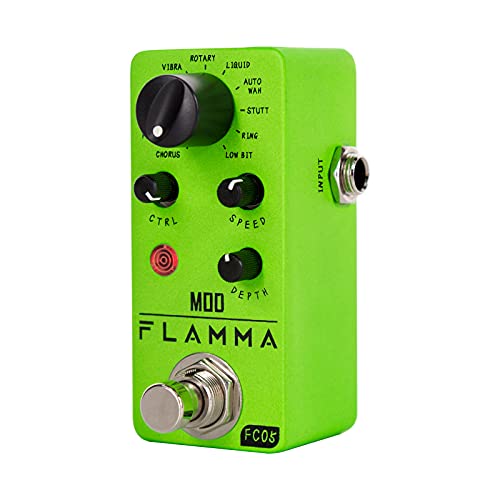 FLAMMA FC05 Modulation Guitar Pedal with Chorus FlangerMINI1.9 x 3.2 x 2 inches0.4 poundsCheck on Amazon
 FLAMMA FS05 Multi Modulation Pedal Electric Guitar Stereo2.75 x 1.97 x 4.78 inches0.7 PoundsCheck on Amazon


Top 3 picks at a glance
Quick comparison: which modulation pedal fits your board?
| Pedal type | Strong starting choice | Typical controls | Stereo routing | Approx. footprint | Dial-in difficulty |
|---|---|---|---|---|---|
| Chorus | Boss CE-2W | Rate, depth, mode | Mono input, stereo outputs | Standard compact | Very easy |
| Chorus/vibrato | Walrus Audio Julianna | Rate, depth, lag, waveform, drift, tap/secondary controls | Stereo input and output | Medium | Moderate |
| Phaser | MXR Phase 95 | Speed, script, phase stages | Mono | Mini | Very easy |
| Flanger | Boss BF-3 | Manual, depth, rate, resonance, modes | Stereo outputs | Standard compact | Moderate |
| Multi-modulation | Boss MD-200 | Dedicated controls, presets, selectable algorithms | Stereo input and output | Large compact | Moderate to high |
| Deep multi-effect | Strymon Mobius | Algorithm-specific controls, presets, MIDI, expression | Stereo input and output | Large | Moderate to high |
These categories overlap, but they do not feel interchangeable. Chorus creates a doubled, widened impression by delaying and modulating a copy of the signal. A phaser uses moving phase cancellations for a smoother, more vocal sweep. A flanger produces a tighter, more metallic comb-filter effect. Multi-modulation pedals trade the fastest one-effect workflow for flexibility and preset recall.
Best chorus pedals for width without losing the dry guitar
Boss CE-2W: the simplest route to a classic chorus tone
The Boss CE-2W is a strong choice when the priority is a familiar chorus sound with minimal setup. Its rate and depth controls make it difficult to get lost, while its stereo outputs allow the wet signal to spread between amplifiers or recording channels. The CE-2W is not the most programmable option, but that is part of its appeal: it encourages adjustment by ear rather than menu navigation.
Start with rate around 9–10 o’clock and depth around 10–11 o’clock. This gives clean arpeggios gentle movement without producing an obviously seasick pitch wobble. For a more pronounced ’80s texture, raise depth first, then rate slightly. Raising both controls too far can make sustained chords sound out of tune.
Walrus Audio Julianna: better for expressive stereo movement
The Julianna adds vibrato, stereo operation, expanded modulation shapes, and more control over the character of the movement. It suits players who want chorus for rhythm parts but also need a seasick vibrato, ramping effects, or a more animated stereo field. Its larger control set takes longer to learn, yet it can replace separate chorus and vibrato pedals.
Choose a conventional chorus pedal instead if you change sounds with your feet during a song and need every control to be immediately obvious. Choose the Julianna when nuanced movement and sound design matter more than one-knob-per-function simplicity.
Best phaser pedals for a compact pedalboard
MXR Phase 95: maximum phaser variety in a mini enclosure
The MXR Phase 95 is one of the most space-efficient choices for players who want several recognizable phaser flavors. Its speed knob handles the main sweep, while its switches select different phase-stage and feedback-style voicings. That makes it useful for everything from a slow, barely moving clean tone to a sharper, more psychedelic pulse.
For a subtle rhythm setting, place speed near 9 o’clock and use the gentler voice. For a more obvious lead effect, move speed toward noon and select the more intense stage option. A phaser usually works best before overdrive when you want the sweep to remain distinct; placing it after distortion makes the movement more prominent and can be useful for dramatic parts.
The MXR Phase 90 is another sensible choice if you prefer a larger enclosure with a single speed control and a highly direct workflow. The Phase 95 is the better fit when pedalboard footprint matters.
Best flanger pedals when you need control over the sweep
Boss BF-3: broad control and stereo capability
Flanger is the easiest modulation type to make harsh, so control layout matters. The Boss BF-3 provides manual, depth, rate, and resonance controls, along with modes suited to different levels of intensity. Manual shifts the position of the sweep, depth determines how far it moves, and resonance emphasizes the comb-filter peaks.
Use these starting values for a musical flanger:
- Manual: around 10 o’clock
- Depth: around 10–11 o’clock
- Rate: around 9 o’clock
- Resonance: around 9–10 o’clock
This setting leaves enough movement to hear the effect while limiting the metallic edge. For a jet-plane sweep, raise depth and resonance, but reduce output level if the effect becomes louder than the bypassed signal. Stereo output can make the BF-3 feel much larger, although the most noticeable benefit requires two amps, two recording channels, or a stereo effects return.
Best multi-modulation pedals for one-pedal flexibility
Boss MD-200: practical control without a deep menu system
The Boss MD-200 is a good compromise between individual pedals and a large studio-style processor. It provides separate modulation algorithms, onboard memory, tap tempo, and stereo routing while retaining physical controls for the main parameters. It is especially suitable for a player who needs chorus for one song, phaser for another, and flanger or tremolo elsewhere in the set.
Its main advantage is repeatability. Instead of trying to recreate a sound with four knobs between songs, you can save a preset and recall it. The trade-off is physical size: the MD-200 occupies substantially more board space than a compact chorus or mini phaser. It also has more controls than a dedicated pedal, so it is worth programming sounds at home rather than expecting every useful tone to appear immediately.
Strymon Mobius: the choice for extensive presets and MIDI
The Strymon Mobius is aimed at players who want many modulation families, detailed editing, stereo operation, expression control, and integration with MIDI-based rigs. It is a stronger choice than the MD-200 when the pedalboard already includes a MIDI controller, multiple presets, or complex signal routing.
For a small board with only a few sounds, the Mobius can be excessive. Its capabilities are valuable only if you will use preset recall, advanced routing, expression control, or several of its algorithms. If you mainly need one chorus and one phaser, two compact pedals may be faster to operate and easier to troubleshoot.
How stereo routing changes the buying decision
Stereo outputs do not automatically make a mono rig sound wider. They become useful when the signal reaches two amplifiers, two interface inputs, a stereo delay or reverb, or a mixer with separate left and right channels. In a single-amp setup, a stereo pedal still works, but the second output has no practical destination unless the rest of the chain is stereo.
There is also a routing decision between the front of the amplifier and the effects loop. Chorus, phaser, and flanger before distortion produce modulation that is itself distorted, often creating a more integrated vintage texture. After the preamp, the sweep is clearer and more hi-fi. If your amplifier has a saturated preamp, try the modulation in the effects loop first; if the result feels too polished, move it before the drive section.
Decision matrix by playing situation
| Your situation | Best direction | Why |
|---|---|---|
| Small board, one moving effect | MXR Phase 95 or Boss CE-2W | Compact footprint and fast adjustment |
| Clean stereo rig | Boss CE-2W or Walrus Audio Julianna | Chorus widens clean sounds without requiring extreme settings |
| Heavy amp with an effects loop | Boss BF-3 or Boss MD-200 | Clearer modulation after preamp distortion |
| Several set-list sounds | Boss MD-200 | Preset recall with direct front-panel control |
| MIDI-controlled professional rig | Strymon Mobius | Deep preset, expression, and routing options |
| Uncertain about modulation | Dedicated chorus or phaser first | Lower cost and faster learning than a large multi-effect |
Power, footprint, and budget checks
Check current draw before buying a multi-modulation pedal. A common isolated power supply may provide 100 mA on several outputs, while advanced digital pedals can require substantially more. For example, if a pedal needs 200 mA at 9 V, its nominal power requirement is:
9 V × 0.2 A = 1.8 W
That does not mean any 9 V adapter is safe: voltage, polarity, plug size, and current capacity must all match the manufacturer’s specification. Digital multi-effects may also behave poorly with noisy daisy chains, so an isolated output is preferable.
Dedicated compact modulation pedals commonly occupy about 60–70 mm of width, mini pedals roughly 35–45 mm, and larger programmable units around 100–140 mm. Measure the usable gap on your board rather than relying on the pedal’s advertised category. A multi-effect can save space compared with four individual pedals, but it may still be physically larger than the two effects you actually use.
As a general market guide, basic mini and compact modulation pedals often fall around $80–$180, higher-end dedicated stereo pedals around $180–$300, and advanced multi-modulation units around $300–$450. The more important comparison is not only purchase price but whether you need presets, stereo I/O, MIDI, and expression control.
Frequently asked questions
What is the difference between chorus, phaser, and flanger?
Chorus, phaser, and flanger create different kinds of movement. Chorus modulates a delayed copy of the signal for a doubled, widened impression; a phaser creates moving phase cancellations for a smoother, more vocal sweep; and a flanger produces a tighter, more metallic comb-filter effect. Their sounds and controls are not interchangeable.
Where should I place a modulation pedal in my signal chain?
Place modulation before distortion for a more integrated, vintage texture, or after the preamp for a clearer, more hi-fi sweep. If your amplifier has a saturated preamp, the article suggests trying the effects loop first; if the result feels too polished, move the pedal before the drive section.
Will a stereo modulation pedal sound wider with one amplifier?
Not necessarily: stereo outputs do not automatically make a mono rig sound wider. They are useful when the signal reaches two amplifiers, two interface inputs, a stereo delay or reverb, or separate left and right mixer channels. With one amplifier, the second output has no practical destination unless the rest of the chain is stereo.
How can I make chorus subtler or more pronounced?
For a gentle chorus on clean arpeggios, start with rate around 9–10 o’clock and depth around 10–11 o’clock. For a more pronounced ’80s texture, raise depth first and then raise rate slightly. Avoid turning both too far up, since sustained chords can sound out of tune.
What should I check before buying a digital multi-modulation pedal?
Check its current draw and whether your power supply can provide what it needs. The article notes that a common isolated power supply may provide 100 mA on several outputs, but the provided text ends before specifying any particular pedal’s power requirement. Also consider whether its footprint and preset features suit your board and playing needs.
Final recommendations
For the fastest path to a rich, usable tone, start with the Boss CE-2W for chorus or the MXR Phase 95 for phaser. Choose the Boss BF-3 when flanger is central to your sound and you want detailed sweep control. The Walrus Audio Julianna is better for expressive chorus and vibrato textures, while the Boss MD-200 is the most practical all-rounder for multiple saved sounds. Choose the Strymon Mobius when advanced presets, MIDI, and deep stereo modulation justify its larger footprint and higher cost.


