
The easiest first setup for most people is a fully automatic belt-drive turntable with a built-in phono preamp — the Audio-Technica AT-LP70X is the best overall pick — paired with a pair of powered speakers, because that combination needs two cables, no amplifier and no separate phono stage. If you already own a receiver or integrated amp with a PHONO input, put the same money into a Fluance RT82 instead and get a better tonearm and an upgradeable Ortofon cartridge. The single biggest budget decision is not the turntable itself but whether the phono preamp lives inside it or outside it.
As an Amazon Associate we earn from qualifying purchases at no extra cost to you.

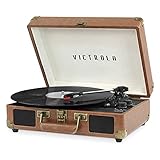

Our Top Picks
 Audio-Technica AT-LP60X-BK Fully Automatic Belt-Drive Stereo Turntable6.3014.7 x 14.1 x 3.8 inches8.11 PoundsCheck on Amazon


Top 3 picks at a glance
Quick comparison: beginner turntables worth budgeting for
| Pick | Best for | Key specs | Typical price |
|---|---|---|---|
| Audio-Technica AT-LP70X | Best overall first setup | Fully automatic belt drive, built-in switchable phono preamp, AT-VM95C cartridge (stylus upgradeable to VM95E/ML), 33/45 | usually $200–$250 |
| Audio-Technica AT-LP60X | Best under $200 | Fully automatic, built-in preamp, fixed-body AT3600L cartridge (stylus-only replacement), 33/45 | usually $130–$180 |
| Sony PS-LX310BT | Bluetooth-first rooms | Fully automatic, built-in preamp, Bluetooth transmitter, fixed-body cartridge | usually $180–$230 |
| Fluance RT82 | Best upgrade path | Belt drive with auto-stop, no built-in preamp, Ortofon OM10 (stylus upgradeable through OM20/OM30), MDF plinth | usually $280–$330 |
| Denon DP-300F | Best mid-range automatic | Fully automatic, built-in preamp, upgradeable moving-magnet cartridge, 33/45 | usually $300–$380 |
| Pro-Ject Debut Carbon EVO | Sound-first, manual | Carbon tonearm, Ortofon 2M Red, no preamp, manual operation | usually $550–$650 |
The picks in detail
Best overall: Audio-Technica AT-LP70X
It suits anyone starting from zero who wants to press a button and hear music. Per Audio-Technica’s spec sheet the deck is fully automatic, includes a switchable phono preamp, and ships with an AT-VM95C cartridge on a standard half-inch mount. That last detail matters more than it looks: the VM95 body accepts VM95E, VM95EN and VM95ML styli, so a $40–$150 stylus swap is a real upgrade later. The trade-off is a plastic plinth and a lightweight platter — it will not out-resolve a $600 deck, but nothing at this price does.
Best budget: Audio-Technica AT-LP60X
The LP60X is the cheapest route that still behaves well: automatic start/stop, built-in preamp, factory-aligned cartridge. Its limitation is structural — the cartridge body is fixed, so you can replace the stylus but not move to a different cartridge family. Buy it if you want to spend the rest of your budget on speakers and records. Skip it if you already know you’ll want to tinker.
Best for Bluetooth rooms: Sony PS-LX310BT
If your speakers are Bluetooth-only, this is the least-fuss option because the transmitter is inside the deck. It is also fully automatic and has a built-in preamp, so it works with wired powered speakers too. The trade-off is the same fixed cartridge as the LP60X, plus the extra analog-to-digital conversion of Bluetooth — fine for casual listening, noticeably softer than a wired connection on a good system.
Best upgrade path: Fluance RT82
Per Fluance’s product page, the RT82 has no built-in preamp and ships with an Ortofon OM10. That sounds like a downside and is actually the point: if your amp has a PHONO input, you avoid paying twice for a phono stage you don’t need. The OM body takes OM20 and OM30 styli later, and the deck has a heavier MDF plinth and adjustable feet. The trade-off: no preamp, and it’s manual with auto-stop, so you cue the arm yourself.
Best mid-range automatic: Denon DP-300F
This is the step up for people who want automatic convenience but a cartridge they can change. It has a built-in preamp and accepts standard half-inch cartridges, so a $100–$200 moving-magnet upgrade is a screwdriver job. The trade-off is that the stock cartridge is unremarkable — budget for a replacement within the first year if you get serious.
What a built-in preamp actually saves you
A moving-magnet cartridge such as the AT-VM95C puts out roughly 4–5 mV at 1 kHz according to its published spec. A line-level AUX input needs about 150–200 mV to reach full volume. That gap is a factor of 30–40, or about +30 to +32 dB, which is why a phono stage applies roughly 40 dB (100×) of gain plus RIAA equalization — approximately +20 dB at 20 Hz and −20 dB at 20 kHz relative to 1 kHz, undoing the bass cut and treble boost used when the lacquer is cut.
That math drives the budget directly. A complete $400-ish system looks like this:
- Turntable with built-in preamp: $200–$250 (AT-LP70X class)
- Powered speakers: $120–$170
- RCA cable: usually included; a spare set is $10–$20
- Total: about $330–$440
Compare that with a no-preamp deck at the same quality: $280–$330 for the turntable, plus $60–$120 for an external phono stage, plus the same speakers, lands at roughly $460–$620. The no-preamp route only wins if you already own an amplifier with a PHONO input — then you’re spending that money on the deck instead of duplicating a circuit you have.
Cartridge upgrades: what actually swaps
Three stylus families cover most beginner decks, and all of them let you upgrade the stylus without changing the cartridge body:
- Audio-Technica VM95 (LP70X, LP120XUSB): VM95C conical → VM95E elliptical → VM95ML microline, roughly $30–$150 per stylus. Tracking force stays in the 1.8–2.2 g window across the range.
- Ortofon OM (Fluance RT82): OM5E → OM10 → OM20 → OM30. Specified tracking force is 1.25–1.75 g; set 1.5 g.
- Ortofon 2M (Fluance RT83/RT84, Debut Carbon EVO): 2M Red → 2M Blue. Specified tracking force 1.6–2.0 g; set 1.8 g.
The exception is fixed-body cartridges on the AT-LP60X and Sony PS-LX310BT — you can replace the stylus, but not the cartridge family. That’s the main technical reason to spend the extra $60–$80 on an LP70X if you think you’ll keep the hobby.
Speaker connections: powered, passive or Bluetooth
- Powered speakers (Edifier, Audioengine, Kanto and similar) have the amplifier inside and take a line-level RCA or 3.5 mm input. Pair them with a preamp-equipped turntable and you’re done — two cables total.
- Passive speakers need an integrated amp or receiver. Use its PHONO input with a no-preamp deck, or any line input with a preamp-equipped deck.
- Bluetooth only works if the deck has a transmitter built in (PS-LX310BT, AT-LP70XBT) or you add a separate transmitter. Wired always sounds better; Bluetooth is a convenience compromise.
Two connection mistakes cause most first-week problems. Setting the turntable’s PHONO/LINE switch to the wrong position gives either near-silence with no bass or loud, distorted, bass-heavy sound. And skipping the thin ground wire produces a steady hum — connect its spade lug to the amp’s ground screw and it usually disappears.
Match your situation to a setup
| Your situation | What to buy | Why it works |
|---|---|---|
| No amp, no speakers, total budget under $350 | AT-LP60X + powered speakers ($100–$150) | Built-in preamp plus powered speakers means two RCA cables and no receiver |
| You own a receiver with a PHONO input | Fluance RT82 | You’d be paying for a phono stage you already have |
| Speakers are Bluetooth-only | Sony PS-LX310BT or AT-LP70XBT | The Bluetooth transmitter is inside the deck |
| You want to upgrade the cartridge later | AT-LP70X, Denon DP-300F or Fluance RT82 | VM95 and OM styli swap onto the same body |
| You want push-button automatic operation | AT-LP70X, Sony PS-LX310BT, Denon DP-300F | Manual cueing is the most common source of beginner frustration |
| Budget $700+ and you want room to grow | Pro-Ject Debut Carbon EVO + external phono stage | Carbon tonearm and 2M Red reward better speakers |
Setting up your first turntable
- Level the plinth. Use a small bubble level on the platter. An unlevel deck tilts the stylus in the groove and wears one channel harder than the other.
- Remove transport locks. Many decks ship with the tonearm tied down or the platter secured. Leaving them in place is the classic “why won’t it spin” moment.
- Float the tonearm first. Set anti-skate and tracking force to zero, then turn the counterweight until the arm hovers level. This establishes the zero reference every other setting depends on.
- Set tracking force to the cartridge spec, typically 1.5–2.0 g depending on the model, then set anti-skate to the same number. Too light causes mistracking and distortion; too heavy wears records and the stylus.
- Match the input correctly. Preamp-equipped deck goes to AUX/LINE; a deck without one goes to PHONO or through an external stage. Attach the ground wire either way.
- Check speed. Play a 33⅓ record and confirm the pitch is stable; belt-drive decks need the belt moved to a second pulley or a speed button for 45s.
Frequently Asked Questions
Do I need a separate phono preamp if my turntable has one built in?
No. If the deck has a built-in preamp and you connect it to a line-level AUX input, the chain is complete. The one thing to avoid is stacking two stages: turntable preamp into an amplifier’s PHONO input gives you roughly 80 dB of gain and will sound badly distorted.
Can I use Bluetooth speakers with a turntable?
Yes, if the turntable has a Bluetooth transmitter built in, as the Sony PS-LX310BT and AT-LP70XBT do, or if you add a separate transmitter to a wired output. Expect a slight softness compared with a wired connection because the signal is converted to digital and back, and check latency if you’re watching video at the same time.
Is belt drive or direct drive better for a beginner?
Belt drive is the norm under $400 and is perfectly adequate — it isolates the motor from the platter and keeps costs down. Direct drive, as on the AT-LP120XUSB, gives faster startup and steadier speed for DJ-style cueing. For home listening, choose based on features and cartridge compatibility rather than drive type.
How much should I budget for a complete first setup?
A workable wired system runs about $330–$440: $200–$250 for a preamp-equipped turntable and $120–$170 for powered speakers. If you already own an amp with a PHONO input, you can put that preamp money into the deck instead and get a better tonearm and cartridge for the same total.
Can I upgrade the cartridge on a cheap turntable?
Only if the deck takes a standard half-inch mount. The AT-LP70X, Denon DP-300F and Fluance RT82 all do, so stylus or full cartridge upgrades are straightforward. Fixed-body decks like the AT-LP60X and Sony PS-LX310BT allow stylus replacement only, which caps how far you can take them.
Why does my new turntable hum, and how do I fix it?
Hum almost always comes from a missing or loose ground connection. Check that the thin wire from the turntable is attached to the ground screw on your amp or phono stage. If it persists, move the turntable away from the amplifier’s power supply and from any router or power brick sitting next to it.


