
Shopping for a budget gaming keyboard sounds simple until you unbox one that feels cheap, sounds hollow, or takes up half your desk. The most common mistakes are buying blind based on RGB lighting, assuming any mechanical board is automatically better, and ignoring size and switch type. Gamers often pay for a full-size keyboard when they need more mouse space, or they choose loud clicky switches for shared spaces and late-night sessions. Others overlook build quality and comfort, then deal with wobbling keys, cramped layouts, and wrist fatigue after a few weeks.
This guide cuts through the marketing to what actually affects your play. As of 2026, budget keyboards have improved dramatically, but key differences in layout, switches, materials, and polling rates still determine whether a keyboard helps or hurts your performance.
As an Amazon Associate we earn from qualifying purchases at no extra cost to you. Product prices and availability are accurate as of the date shown and are subject to change.


Top 3 picks at a glance
Decide These 3 Things First
Before you compare models, lock in these three decisions. They narrow your options instantly and prevent expensive regrets.
1. Your desk and play style: Do you play fast-paced FPS games where mouse space matters most, or MMO and productivity tasks where you need dedicated keys? Competitive FPS players benefit from compact boards. If you use your keyboard for work, spreadsheets, or macros, you will want more keys.
2. Your switch feel: Do you prefer a loud, clicky confirmation, a smooth linear press for rapid inputs, or a tactile bump without the noise? Your choice here determines noise level, speed, and fatigue.
3. Your hard budget cap: Set a clear ceiling and stick to it. An honest range helps you compare real value. For budget gaming, most buyers should decide between under $30, $30 to $60, and $60 to $90 before looking at specific features.
Size and Layout: Picking the Right Footprint
Size is not just about looks. It changes desk space, ergonomics, and how you play. Keyboards are measured by the percentage of a standard full-size layout they keep.
Full-Size (100%): 104 to 108 keys, including number pad, function row, navigation cluster, and arrow keys. Typical dimensions are 17 to 18.5 inches wide by 5 to 6 inches deep and 1.2 to 1.6 inches tall. Weight is usually 1.8 to 2.8 pounds. Best for gamers who need the numpad for work, MMOs, or sim games and have desks at least 48 inches wide.
Tenkeyless (TKL – 80%): 87 to 88 keys. Drops the numpad but keeps function row and navigation keys. Width drops to about 14 to 15 inches, saving 3 to 4 inches of desk space for mouse movement. This is the sweet spot for most gamers who want balance.
75%: 81 to 84 keys. Keeps nearly everything a TKL has but compresses navigation keys into a tighter 12.5 to 13.5 inch frame. Great for smaller desks without losing the function row.
60%: 61 to 68 keys. Drops the function row, navigation cluster, and numpad. Width is just 11 to 12 inches and depth is 4 to 4.5 inches. Weight is often 1.2 to 1.7 pounds. Models like compact 60 percent boards save up to 6 inches of width versus full-size, which is a major advantage for low-sensitivity FPS players who need wide mouse swipes. The trade-off is that you access F-keys and arrows through a function layer.
Measure your desk depth first. If your desk is under 24 inches deep, a full-size board will push your mouse too close to the edge. If you travel or have limited space, a 60% or 75% board is far more practical.
Switch Types: What Clicky, Linear, and Tactile Actually Mean
Switches are the mechanism under each key. They determine sound, feel, actuation force, and speed. For budget boards, most use mechanical or membrane-mechanical hybrids. True mechanical switches are more durable and consistent.
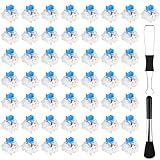
Clicky (Blue switches): Provide both a tactile bump and a loud click at the actuation point. Actuation force is typically 50 to 60 grams, actuation distance around 2.0 to 2.2 mm, and total travel 4.0 mm. They are satisfying for typing and audible feedback, but they are the loudest option at 65 to 75 decibels at desk distance and can be distracting for roommates or on voice chat. DIY replacement packs, such as 50-piece blue clicky sets for $7 to $9, show how common and affordable this switch type is for repairs and customization.
Linear (Red switches): Smooth from top to bottom with no bump. Actuation force is lighter at 40 to 50 grams, making them fast for double-taps and rapid movement in FPS games. They are quieter than blues and preferred when you need quick, repeated presses without tactile interruption.
Tactile (Brown switches): Offer a noticeable bump without the loud click. Actuation force is 45 to 55 grams. They are a middle ground for gamers who want feedback without extra noise, and they work well for mixed gaming and typing.
Magnetic Hall Effect switches: Found on newer budget boards in the $40 to $70 range, these allow adjustable actuation from 0.1 mm to 3.4 mm and enable features like Rapid Trigger, which resets a key the moment you start lifting it. They also support 1000 Hz to 8000 Hz polling rates. While 1000 Hz (1 ms response) is sufficient for most players, 8000 Hz (0.125 ms) can reduce input latency for high-refresh-rate setups with 240 Hz or higher monitors.
If you can, choose hot-swappable boards. Hot-swap sockets let you pull switches out with a switch puller and replace them without soldering. That means you can try blues now and swap to linears later for $5 to $12 per 10-pack.
Materials and Build Quality That Survive Daily Gaming
Price does not have to mean flimsy, but materials tell you a lot about longevity.
Keycaps: Most budget boards use ABS plastic. Quality ABS with double-shot or UV-coated legends resists shine for 6 to 12 months of heavy use. PBT keycaps are denser, more textured, and resist shine for years, but they are rare under $45. Look for keycap thickness of 1.0 mm or more to reduce wobble.
Case and plate: An ABS plastic case keeps weight down to 1.3 to 2.0 pounds but can feel hollow. A board with an aluminum top plate or steel reinforcing plate, even at $35 to $55, adds rigidity and reduces flex when you press hard during intense sessions. Lift the board in the store image and check for plate-mounted switches versus PCB-mounted only. Plate-mounted is sturdier.
Stabilizers and construction: Large keys like spacebar, shift, and enter should not rattle. Plate-mounted stabilizers are common on budget boards and benefit from factory lubrication. Also check the board’s height and angle. Adjustable feet should offer 4 to 8 degrees of incline, and the front height should stay under 1.5 inches for comfortable wrist position.
Durability ratings matter. Look for rated switch life of 50 million to 100 million keystrokes for mechanical switches. Spill resistance with drainage channels is a useful bonus on budget wired boards, especially those with sealed PCB coatings.
Comfort, Performance, and Features That Matter
Comfort and performance are where cheap keyboards either save money wisely or cut the wrong corners.
Anti-ghosting and rollover: Do not accept less than 6-key rollover, and ideally choose N-key rollover where every simultaneous press registers. This prevents missed inputs when you sprint, crouch, and strafe at once.
Polling rate and latency: Standard budget keyboards run at 1000 Hz. That equals a 1 millisecond report time to your PC. Ultra-budget membrane boards may run at 125 Hz to 250 Hz, which creates 4 to 8 ms delay. For competitive play, stay at 1000 Hz minimum.
Backlighting and visibility: Single-color or RGB LED backlighting should offer at least 5 brightness levels. RGB is not just cosmetic. It helps with visibility in dark rooms and for key zone mapping. Check whether lighting is per-key or zone-based. Per-key is better for custom profiles.
Power and cable: Wired USB keyboards draw very little power, typically 0.3 to 0.5 watts (60 to 100 mA at 5V), so they do not need separate power. Look for a 1.5 to 1.8 meter braided or reinforced cable and a strain relief where the cable enters the case. Detachable USB-C cables are more durable and easier to replace.
Ergonomics: Ultra-slim designs at 0.9 to 1.2 inches tall reduce wrist extension but can feel less cushioned. If the board has no included wrist rest, plan for neutral wrist posture and consider a separate rest that is 0.75 to 1.0 inch thick and at least as wide as your board.
Price Tiers: What You Get at Every Budget
Understanding tiers helps you avoid overspending for features you will not use.
Under $30: Entry-level wired mechanical or membrane boards. Expect 104-key layouts, blue switches, ABS keycaps, single or basic RGB zones, 1000 Hz polling, and plastic cases. Example range is $25 to $30 for a 104-key RGB board with anti-ghosting and spill resistance. These are functional and durable for casual gaming but lack hot-swap and software customization.
$30 to $60: The true value sweet spot. You gain hot-swappable switches, better stabilizers, PBT or thicker ABS keycaps, per-key RGB, software for macros and lighting, and more compact options like 75% and 60% layouts. Magnetic Hall Effect boards with Rapid Trigger and 8000 Hz polling now appear around $45 to $60. Weight and build quality improve noticeably in this range.
$60 to $90: Premium budget. Adds gasket mounting for softer typing feel, five-layer foam dampening, full aluminum cases, PBT keycaps standard, and advanced software with adjustable actuation points, 0.1 mm increments, and onboard memory for 3 to 5 profiles. If you stream or compete regularly, this tier offers the best long-term comfort and consistency without going over $100.
Avoid paying over $90 if your target keyword is strictly budget. Above that you are paying for enthusiast features like QMK/VIA programming or wireless tri-mode connectivity that most budget gamers do not need.
Warranty, Delivery, and Assembly Considerations
The cheapest price is not a deal if support and shipping create problems.
Warranty: Look for at least a 1-year manufacturer warranty. Some brands in the $40 to $90 range offer 2 years. Check what is covered. Switches and LEDs should be included. Keycap shine and wear are typically excluded. Keep your receipt and original packaging for 30 days after delivery.
Delivery: Most budget keyboards ship in boxes 18 x 7 x 2 inches and weigh 2 to 4 pounds packed. Check estimated delivery time, especially for marketplace sellers. If a switch replacement kit is shipped separately, it may arrive in a padded envelope with 35 to 50 switches, a puller, and a cleaning brush. Verify return windows. A 30-day free return is standard. Some sellers charge restocking fees for opened keyboards.
Assembly: The good news is most boards are plug-and-play with no assembly. You plug in USB-A or USB-C and the system installs drivers automatically in 10 to 20 seconds. Customization requires software installation for macros, RGB, and key remapping. If you buy a hot-swappable board and extra switches, assembly is simple: use the included puller to remove the old switch straight up, align the new 3-pin or 5-pin switch, and press firmly until seated. No soldering is needed for hot-swap. Non-hot-swap boards require desoldering and should not be modified at home.
Spec Checklist
| Spec | Budget (Under $35) | Mid ($35 to $60) | Premium ($60 to $90) |
|---|---|---|---|
| Layout Options | Full-Size 104 keys | Full-Size, TKL, 75%, 60% | All layouts plus compact with function knob |
| Switch Type | Clicky Blue, membrane | Choice of Blue / Red / Brown, hot-swappable, Hall Effect | Pre-lubed linear / tactile, Hall Effect with adjustable actuation |
| Polling Rate | 1000 Hz | 1000 Hz to 8000 Hz | 8000 Hz with Rapid Trigger |
| Key Rollover | 6-key or N-key | N-key rollover | N-key with onboard memory |
| Keycaps | Thin ABS 0.8 to 1.0 mm | Thick ABS or PBT 1.0 to 1.4 mm, double-shot | PBT double-shot 1.3 to 1.5 mm |
| Case Material | Full ABS plastic, 1.3 to 1.8 lbs | ABS with aluminum plate, 1.7 to 2.3 lbs | Aluminum or gasket mount, 2.0 to 2.8 lbs |
| Backlighting | Zone RGB, 3 to 5 levels | Per-key RGB, 5 to 10 levels + software | Per-key RGB with custom profiles |
| Connection | Wired USB-A 1.5 m | Wired detachable USB-C 1.6 to 1.8 m | Detachable USB-C with extra ports |
| Warranty | 90 days to 1 year | 1 to 2 years | 2 years |
Red Flags
Watch for these warning signs that signal a keyboard will disappoint.
- No listed rollover or polling rate. If a seller hides these specs, assume the lowest performance at 125 Hz and limited ghosting protection.
- Unbranded switches with no pin type or life rating. Quality switches list 3-pin or 5-pin and 50 million plus keystroke life.
- Lighting advertised as mechanical but the description says membrane. True mechanical boards list the switch color and brand.
- Non-standard bottom row layout that prevents aftermarket keycap replacement. Look for standard 6.25u spacebar and 1.25u modifiers if you plan to customize.
- Claims of waterproof instead of spill-resistant. No budget board is fully waterproof. Drainage holes only handle small spills of 50 to 100 ml.
- Warranty under 90 days or no clear return policy. Budget does not mean disposable.
- Excessive flex in video reviews or hollow typing sound with no foam dampening mentioned. This indicates thin case construction.
FAQ
What switch is best for budget gaming, blue, red, or brown?
For pure gaming speed and lower noise, red linear switches are usually best because they have a light 40 to 50 gram force and smooth travel. Browns give tactile feedback without loud clicks and are good for mixed use. Blues are fun and clicky but loud. If you share a room, avoid blues. Choose hot-swappable so you can change later without buying a new board.
What keyboard size should I choose for gaming in a small space?
For desks under 40 inches wide or shallow depth under 24 inches, pick a 75% or 60% board. You save 3 to 6 inches of width for mouse movement. If you need a number pad for work, choose TKL and add a separate $15 to $25 USB number pad. Full-size only makes sense if you use the numpad daily and have plenty of desk space.
Do I need 8000 Hz polling and Rapid Trigger on a budget?
Most players do not need 8000 Hz. A stable 1000 Hz connection is fast enough for 60 Hz to 165 Hz monitors. The benefit of 8000 Hz and Rapid Trigger becomes noticeable at 240 Hz plus and for competitive FPS where every millisecond counts. If you are casual or mid-range competitive, prioritize comfort and build quality first, then consider these features if they fit within your $45 to $60 budget.
Are cheap mechanical keyboards durable enough for daily use?
Yes, if you check the specs. Look for 50 million keystroke rating, plate-mounted switches, and at least 1.0 mm thick keycaps. A $28 to $50 wired board with proper anti-ghosting and a 1-year warranty can last 3 to 5 years of daily gaming. To extend life, clean with compressed air monthly, avoid eating over the board, and keep liquids at least 12 inches away despite spill-resistant claims.


