
Top 3 picks at a glance
The Short Answer
Most budget gaming PC builds need between 400 and 650 watts of power supply capacity. If you’re building around an entry-level graphics card like an RX 560 or GTX 1650-class GPU paired with a mid-range CPU, a quality 450–500W unit is plenty. Step up to an RTX 4060 or RTX 5060-class card and you’ll want 550–650W. A good rule of thumb: take your GPU’s recommended wattage, add 100–150W for the CPU and the rest of the system, then buy a power supply rated slightly above that total so it runs at 50–70% load, where efficiency is best.
Wattage isn’t the only “size” that matters, though. Power supplies come in standard physical formats, and cases have fixed dimensions that determine what fits. Below we cover both sides of sizing: the electrical side (wattage) and the physical side (PSU form factors and case clearances).
As an Amazon Associate we earn from qualifying purchases at no extra cost to you. Product prices and availability are accurate as of the date shown and are subject to change.

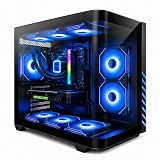


Standard Sizes
Power supplies and gaming desktops follow predictable industry formats. Here’s what you’ll encounter when shopping:
| Component / Format | Typical Dimensions (inches) | Typical Dimensions (cm) | Typical Wattage / Notes |
|---|---|---|---|
| ATX power supply | 5.9 W x 3.4 H x 5.5–7.1 D | 15.0 x 8.6 x 14.0–18.0 | 450–1000W; the standard for mid-tower builds |
| SFX power supply | 4.9 W x 2.5 H x 3.9–5.0 D | 12.5 x 6.4 x 10.0–12.7 | 450–750W; for mini-ITX and compact cases |
| TFX / small-form-factor PSU | 3.4 W x 2.5 H x 6.7 D | 8.6 x 6.4 x 17.0 | 300–500W; slim OEM and office-style cases |
| Compact budget prebuilt (e.g., STGAubron-style) | 15–17 H x 7–8 W x 14–16 D | 38–43 x 18–20 x 36–41 | Ships with 400–500W PSU; 11–15 lb (5–7 kg) |
| Mid-tower ATX gaming case | 18–20 H x 8–9 W x 16–19 D | 46–51 x 20–23 x 41–48 | Fits ATX PSU up to ~180mm deep; 20–30 lb (9–14 kg) |
| Mini-ITX cube case | 10–13 H x 8–10 W x 10–13 D | 25–33 x 20–25 x 25–33 | Requires SFX PSU; 8–15 lb (4–7 kg) |
Note that deeper power supplies exist above roughly 850W (some reach 180–200mm / 7.1–7.9 inches deep), so if you’re building a budget system, a 450–650W unit has the advantage of fitting nearly any case.
How to Measure Your Space
- Measure your desk or floor clearance. Mid-tower cases run 18–20 inches tall and 16–19 inches deep. Check under-desk and beside-desk gaps and subtract an inch for airflow.
- Check rear clearance for cables. Leave 4–6 inches (10–15 cm) behind the case for cable routing and the power plug.
- Confirm PSU depth limits. Open your case spec sheet and look for “max PSU length.” Most mid-towers accept 160–180mm (6.3–7.1 inches); compact cases may cap at 140mm (5.5 inches).
- Calculate your wattage. Add your GPU’s typical board power, your CPU’s TDP, and roughly 75–100W for the motherboard, RAM, drives, and fans. Add 30% headroom and round up to the nearest standard rating (450W, 550W, 650W, 750W).
- Verify your wall outlet and surge protector. A single 120V/15A circuit in a US home provides up to ~1,800W, which is far more than any single gaming PC draws, but avoid daisy-chaining power strips under a heavy load.
- Weigh it. A loaded mid-tower with an ATX PSU weighs 20–30 lb (9–14 kg). If it lives on a shelf, confirm the shelf rating.
By Room or Use Case
Dorm or Small Apartment Desk
Space is tight, so compact builds win here. A prebuilt like the STGAubron Core i5 / RX 560 4G desktop ($399.99 as a reference point) draws roughly 150–220W under load and needs a 400–450W PSU at most. These smaller chassis run about 15–17 inches tall and squeeze onto crowded desks. Expect 1080p gaming at medium settings in esports titles like Fortnite, Valorant, and Rocket League.
Bedroom 1080p Main Setup
This is the sweet spot for budget builders. A Ryzen 5 or Core i5-class CPU (like the i5-14400F, a 65W part) with an RTX 4060 or RTX 5060 draws roughly 300–350W at the wall during gaming. A 550–650W 80 Plus Bronze or Gold PSU covers it comfortably. A prebuilt in the $1,100–1,300 range — think the CyberPowerPC i5-14400F / RTX 5060 configuration at $1,265 — fits this profile and sits fine in a standard mid-tower about 19 inches tall.
Living Room / TV Gaming
If the PC lives next to an entertainment center, measure the cabinet’s internal compartment carefully — many are only 14–16 inches deep, which rules out full mid-towers. Look for cases 16 inches deep or less, keep vent clearance of at least 2 inches, and stick to a 500–650W system so heat stays manageable in an enclosed space.
High-Refresh or VR-Capable Build
Still “budget” but pushing toward the top of it: an RTX 4060 Ti system like the liquid-cooled Ryzen 7 8700F build ($1,158.88 reference) draws around 350–400W under load. A 650W PSU is the right call, and the 240mm liquid cooler adds about 1.2 inches (30mm) of thickness to the case top — confirm your case supports it. Step up to an Alienware RTX 5060 Ti / Intel Ultra 7 265F machine at $1,668.99 and you’re still comfortably under 450W at the wall; a 650–750W supply handles it with room to grow.
Shared Office That Doubles as a Gaming Den
Noise and footprint matter as much as wattage here. Choose an 80 Plus Gold unit in the 550–650W range — higher efficiency means less waste heat and quieter fan curves. Mid-towers with sound-dampened panels measure roughly 9 inches wide and tuck beside a filing cabinet.
Common Sizing Mistakes
- Buying wattage you can’t use. A 1000W PSU on a 350W build runs at low load, below peak efficiency, and often costs $40–80 more. Right-size, don’t supersize.
- Ignoring PSU depth. Long units (over 170mm) can collide with drive cages in budget cases. Always check the case’s max PSU length spec.
- Trusting no-name wattage claims. Generic “600W” units frequently deliver far less on the 12V rail and can fail under load. Stick to 80 Plus-certified units from brands with real warranties (5–10 years is standard).
- Forgetting transient spikes. Modern GPUs can briefly spike 30–50% above their rated board power. That’s the real reason headroom matters — a 550W minimum recommendation for a 160W card isn’t marketing fluff.
- Measuring the case but not the door. A 20-inch-tall tower fits the desk cubby but not the gap under it. Measure both.
- Skipping the cooler height check. Tower air coolers run 6.1–6.5 inches (155–165mm) tall; many budget cases top out at 6.1 inches. Check “max CPU cooler height” before buying.
FAQ
Is 500W enough for a budget gaming PC?
Yes, for most. A system drawing 250–350W under gaming load — anything up to an RTX 4060-class card with a 65W CPU — runs comfortably on a quality 500W unit. If you plan a future GPU upgrade, buy 650W now to avoid replacing it later.
What happens if my PSU wattage is too low?
Under heavy load the system may shut off suddenly, freeze, or fail to boot under game launch spikes. Repeated stress can degrade a cheap unit faster. There’s no damage to other components in most cases — the PSU’s protection circuits cut power — but it’s a miserable experience and easy to avoid with proper sizing.
Does a higher wattage PSU use more electricity?
No. A PC draws only what its components demand. A 750W PSU powering a 300W system pulls roughly 300–350W from the wall depending on efficiency. Higher-rated units cost more up front, not more per month.
How much does a good budget PSU cost?
Expect $40–55 for a reliable 450–550W 80 Plus Bronze unit and $60–90 for a 650W Gold model with modular cables and a 7–10 year warranty. In a $400–800 build, allocate about 10–12% of the budget to the power supply.


