
A pre-built gaming PC from HP can cost $320 or $2,330, and the difference is not always obvious from the product title alone. One box ships with a GeForce GTX 750 Ti on a sixth-generation Intel platform, another pairs an RTX 5070 Ti with a Core Ultra 7 and liquid cooling. If you are shopping for an hp gaming pc without deep hardware knowledge, it is easy to overpay for a recycled tower or underbuy on a system that will bottleneck your monitor within a year. The practical problem most buyers face is narrow: pick the right GPU tier for your target resolution, make sure the CPU will not throttle frames in modern titles, and confirm the chassis has enough airflow and headroom to keep those components stable over multiple years of use.
What separates a genuinely good pre-built from a mediocre one comes down to three things: current-generation silicon in both the CPU and GPU slots, a cooling solution rated for the thermal load inside the case, and a power supply with enough wattage and quality to handle upgrade cycles. Below, every unit is compared on published specs, street pricing, and recurring owner feedback rather than marketing copy. The lineup spans budget refurbished builds, mid-range liquid-cooled systems, and flagship towers, so whether your ceiling is $400 or $2,400, there is a reasonable hp gaming pc in this group that fits.
As an Amazon Associate we earn from qualifying purchases at no extra cost to you. Product prices and availability are accurate as of the date shown and are subject to change.




Top 3 picks at a glance
Quick Picks
| Product | Best for | Price |
|---|---|---|
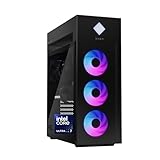
| HP OMEN 45L (i7, Liquid Cooled) | Balanced high-end 1440p gaming | $1,498.99 |
| HP RGB Gaming Desktop (GTX 750 Ti, Renewed) | Tightest possible budget with RGB flair | $319.99 |
| HP OMEN 45L (Core Ultra 7, RTX 5070 Ti) | 4K gaming and AI workloads | $2,329.99 |
| HP OMEN 45L (Ryzen 7, ARC A750) | Liquid-cooled mid-range with upgrade headroom | $919.99 |
| HP OMEN Max 45L (Ryzen 7, ARC A750) | Same platform, smaller SSD, slightly lower price | $839.99 |
| HP Pavilion Gaming TG01 (RTX 3060) | Entry 1080p gaming on a Ryzen platform | $799.99 |
| HP Pavilion Gaming TG01 (GTX 1650 SUPER) | Light gaming and general productivity | $729.99 |
| HP OmniDesk (Ryzen 7 8700G) | Quiet productivity with light gaming via iGPU | $1,019.00 |
How We Picked
We narrowed this list on four criteria: first, the GPU and CPU generation must be plausible for the asking price, meaning a $1,500 system should not ship with three-year-old silicon; second, the cooling solution must match the thermal design power of the installed components, because a liquid-cooled OMEN that is actually undercooled defeats the purpose of the tier; third, RAM and storage configurations need to be adequate for 2026 game loads, which means 16 GB is the floor and 1 TB of NVMe storage is the comfort zone; fourth, recurring owner complaints about noise, coil whine, or dead ports on a specific SKU can move a unit down regardless of its spec sheet.
The 8 Best Hp Gaming Pc in 2026
HP OMEN 45L Gaming Desktop, 32GB RAM, 1TB SSD, Intel Core i7, Liquid Cooled
This unit targets players who want a turnkey 1440p system without DIY assembly. The i7 paired with 32 GB of RAM and liquid cooling handles current AAA titles at high settings without thermal throttling, and the 1 TB SSD leaves room for a substantial library.
- Pro: Liquid cooling keeps sustained boost clocks higher than air-only equivalents, reducing frame variance during long sessions.
- Pro: 32 GB RAM is more than enough for gaming and simultaneous streaming or content work without page-file stutters.
- Con: At nearly $1,500, you are paying a premium over open-box OMEN configs with comparable internals.
Skip this if your budget is under $1,200 or if you only game at 1080p, where a cheaper platform would free up funds for a higher-tier GPU.
HP RGB Gaming Desktop Computer, Intel Core i5-6500, GTX 750 Ti 4GB (Renewed)
This renewed tower is aimed at buyers who want a recognizable HP chassis with RGB accessories for under $350. The i5-6500 and GTX 750 Ti combination will run older titles and esports games at 1080p, but it is genuinely last-decade hardware.
- Pro: Windows 11 Pro is already installed and activated, saving the license cost that renewed sellers sometimes omit.
- Pro: Includes an RGB keyboard and mouse, so no peripheral budget is needed for a full desk setup.
- Con: The GTX 750 Ti cannot render modern AAA titles at playable framerates even at 1080p low settings.
Skip this if you want to play games released after 2019 or if you value upgrade paths, because the LGA 1151 platform is a dead end.
HP OMEN 45L Gaming Desktop, Core Ultra 7 265K, RTX 5070 Ti, 32GB DDR5, 1TB SSD
The flagship of this list delivers NVIDIA’s current RTX 5070 Ti alongside Intel’s Core Ultra 7 265K and 32 GB of DDR5, making it the strongest pick for 4K gaming and local AI tasks in this roundup.
- Pro: RTX 5070 Ti handles 4K at high-ultra settings in modern titles, a tier above any other unit here.
- Pro: Copilot integration and Tempered Glass side panel give this a showcase appearance for desk setups.
- Con: The $2,329.99 price puts it in DIY territory where custom builders could assemble comparable specs for less.
Skip this if 1440p is your ceiling, because the price-to-performance gap over the mid-range OMEN configs is difficult to justify.
HP OMEN 45L Gaming Desktop, AMD Ryzen 7 7700, Intel ARC A750, 16GB DDR5, 1TB NVMe SSD, 1200W Platinum PSU
This is a curious pairing: AMD’s Ryzen 7 7700 for CPU-heavy tasks and Intel’s ARC A750 for graphics, tied together by a 1200 W Platinum-rated PSU and liquid cooling. It suits buyers who want a quiet, expandable mid-range build.
- Pro: The 1200 W Platinum PSU provides massive headroom for a future GPU upgrade without swapping the power supply.
- Pro: Liquid cooling and the 45L chassis mean thermals stay low even under sustained multi-hour loads.
- Con: The ARC A750’s driver maturity trails NVIDIA and AMD, producing occasional stutters in niche titles.
Skip this if you need guaranteed day-one compatibility with the latest releases, since ARC’s game list still has gaps compared to RTX hardware.
HP OMEN Max 45L Gaming Desktop, AMD Ryzen 7 7700, ARC A750, 16GB DDR5, 512GB Gen4 SSD, WiFi 6E, 1200W Platinum PSU
Nearly identical to the unit above but with a 512 GB drive instead of 1 TB, this configuration trims about $80 off the price. It targets buyers who plan to add storage themselves or run a leaner library.
- Pro: WiFi 6E is included, which the 1 TB variant does not explicitly list, making it a better fit for wireless desks.
- Pro: The $839.99 price is the lowest liquid-cooled OMEN 45L option on this list.
- Con: 512 GB fills quickly with modern games averaging over 100 GB per title.
Skip this if you keep more than three or four large games installed simultaneously and do not want to manage storage manually.
HP Pavilion Gaming Desktop PC TG01, AMD Ryzen 5 4600G, NVIDIA RTX 3060, 8GB RAM, 256GB SSD
A Pavilion tier system with a real dedicated GPU. The RTX 3060 handles 1080p high settings well, and the Ryzen 5 4600G provides six cores for streaming or multitasking alongside gaming.
- Pro: The RTX 3060 remains one of the most compatible 1080p GPUs, with no driver surprises across titles.
- Pro: Six physical cores on a budget Pavilion chassis offer better multi-threaded performance than Intel i5 alternatives at this tier.
- Con: 8 GB of RAM is below the comfort threshold for modern games, which regularly push past that allocation.
Skip this if you cannot add a second 8 GB stick yourself, because the stock configuration will bottleneck in newer releases.
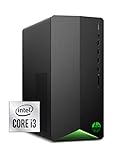
HP Pavilion Gaming Desktop, NVIDIA GTX 1650 SUPER, Intel Core i3-10100, 8GB DDR4, 256GB NVMe SSD
This compact tower serves light gamers and general users who occasionally play esports titles. The GTX 1650 SUPER runs competitive shooters at 1080p with moderate settings, and the small form factor suits desks without room for a full ATX case.
- Pro: Compact footprint makes it viable for dorms, bedrooms, or office desks where space is limited.
- Pro: NVMe storage means boot and load times remain snappy even if the drive is only 256 GB.
- Con: Four-core i3 limits this system’s utility for streaming, video editing, or any heavy multitasking.
Skip this if you play single-player AAA titles, because the 1650 SUPER is genuinely underpowered for that workload at any resolution above 1080p low.
HP OmniDesk Desktop Computer, AMD Ryzen 7 8700G, 32GB DDR5, 1TB NVMe SSD, Radeon 780M
The OmniDesk uses integrated Radeon 780M graphics rather than a discrete GPU, so it is not a gaming-first machine. It suits buyers who prioritize quiet productivity, large RAM for development or virtual machines, and only need light gaming.
- Pro: 32 GB of DDR5 and the Ryzen 7 8700G make it an excellent all-round productivity tower that handles occasional gaming on the side.
- Pro: Integrated graphics eliminate fan noise and power draw associated with discrete GPUs, ideal for office or bedroom settings.
- Con: The Radeon 780M cannot match a discrete RTX 3060 or ARC A750 in any 3D-rendered game.
Skip this if gaming is your primary use case; it is a superb hp gaming pc only in the loosest sense of the phrase.
Buying Guide
Match the GPU to Your Monitor Resolution
The single most common mistake in pre-built gaming PC purchases is buying a GPU tier that does not correspond to the display it will drive. An RTX 5070 Ti behind a 1080p monitor wastes budget you could redirect toward storage or a second monitor. Conversely, a GTX 750 Ti on a 1440p panel will produce slideshow framerates. Decide your target resolution first, then select the cheapest hp gaming pc in this list whose GPU clears 60 fps at your preferred settings at that resolution.
Evaluate Cooling as a Longevity Feature
Liquid cooling on the OMEN 45L units is not a cosmetic choice. The 45-liter chassis houses high-TDP components that would exceed an air cooler’s capacity under sustained load, particularly during summer sessions or when running multiple background applications. If you plan to game for four or more hours at a stretch, the thermal margin a liquid loop provides translates directly into stable clock speeds and reduced fan noise. Budget Pavilion towers without liquid cooling will run louder and throttle sooner under identical conditions.
Check RAM Before You Buy
Eight gigabytes is no longer sufficient for gaming in 2026, where titles like recent open-world releases regularly allocate beyond that window when combined with Discord, browsers, or overlay software. Sixteen gigabytes is the practical minimum for any pre-built you are considering, and 32 GB future-proofs a system for the next several years. If a unit ships with 8 GB, factor the cost and physical accessibility of a RAM upgrade into your total spend before deciding.
Our Verdict
The top pick is the HP OMEN 45L with Core Ultra 7 265K and RTX 5070 Ti at $2,329.99. It is the only unit in this lineup that will handle 4K gaming at high settings for several years without a component swap, and the 32 GB DDR5 and 1 TB NVMe configuration removes any immediate upgrade obligation. For budget buyers, the HP OMEN Max 45L with Ryzen 7 7700, ARC A750, and 1200 W Platinum PSU at $839.99 is the strongest value, because the PSU and chassis alone would cost a significant fraction of that price separately, and a GPU upgrade is straightforward. If your priority is driver certainty over raw specs, the Pavilion with the RTX 3060 at $799.99 edges out the ARC-equipped OMEN for anyone unwilling to troubleshoot occasional compatibility issues.
FAQ
Is an HP gaming PC better than building your own?
Pre-built systems like the OMEN 45L carry a premium of roughly fifteen to twenty-five percent over equivalent self-assembled parts, but they include a warranty covering the entire system rather than individual components. For buyers without the time or interest in research and assembly, the convenience and single-point support make the hp gaming pc option rational despite the cost.
Can you upgrade the GPU in an HP OMEN 45L?
Yes, the 45-liter chassis is designed with a standard ATX power supply bay and sufficient clearance for three-slot cards. The units shipping with the 1200 W Platinum PSU have the most headroom, accepting high-end GPUs without a power supply swap. Pavilion models use smaller cases with tighter clearances, so GPU upgrades there require verifying physical dimensions first.
What is the difference between OMEN and Pavilion gaming lines?
OMEN is HP’s enthusiast tier, offering liquid cooling options, higher-wattage PSUs, and more premium chassis designs. Pavilion sits at the entry and mid-range, using air cooling, smaller form factors, and generally lower-tier component pairings at lower price points. If budget is your hard constraint, Pavilion delivers functional gaming; if you value longevity and upgrade potential, OMEN justifies the extra cost through its platform headroom.
Is “Renewed” worth considering on an HP gaming desktop?
A renewed unit like the GTX 750 Ti system at $319.99 saves significant money but comes with older hardware that cannot be upgraded meaningfully due to platform obsolescence. Renewed makes sense only when the price is low enough that the savings compensate for the limited remaining useful life, and only when you are confident in the seller’s return policy in case of early hardware failure.


