
The Short Answer
A vertical GPU mount is worth it if — and only if — you own a large, heavy graphics card (roughly 300mm or longer and 3kg or heavier) and you’re bothered by how it looks or how much it sags in a horizontal slot. If your card is a compact two-slot model under 280mm, the answer is no: you’d pay $60–$80 plus a riser cable’s potential for signal loss purely for aesthetics you’ll barely see in a standard tower case. It’s a “depends” purchase that only becomes a clear “yes” for side-panel showcase builds.
What You Actually Get
A vertical GPU kit is two things sold together: a steel or aluminum bracket that replaces some of your case’s PCI slot covers and holds the card perpendicular to the motherboard, and a PCIe riser cable that carries the signal from the motherboard slot over to the repositioned card. That’s it — no performance hardware, no cooling hardware.
As an Amazon Associate we earn from qualifying purchases at no extra cost to you. Product prices and availability are accurate as of the date shown and are subject to change.
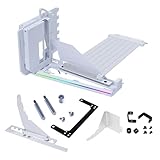

The riser is the critical component. The Cooler Master Vertical GPU Holder Kit V3 ships with a 165mm PCIe 4.0 riser for $65.92 and an adjustable SGCC steel bracket that fits E-ATX, ATX, and micro-ATX cases. The LIAN LI VG4v4 kit steps up to a PCIe 5.0-rated riser with a four-slot bracket for $74.99, which matters if you’re running a current-generation card on a PCIe 5.0 board and want headroom for next-gen GPUs.
Installation takes 20–40 minutes: remove the case’s expansion slot covers, mount the bracket, connect the riser to the top PCIe x16 slot, seat the card into the bracket, and route the cable. Most kits require 2–4 inches of additional clearance between the motherboard slot and the case’s side panel, so check your case’s internal width — a card plus bracket combo typically needs 70–90mm of depth beyond the slot itself.
Pros
- Shows off the card. In a tempered-glass case, a vertical mount puts your GPU’s fans, backlighting, and shroud design face-out instead of edge-on. If you spent $1,000+ on a flagship card, this is the one upgrade that makes it the visual centerpiece.
- Eliminates GPU sag. Cards like the RTX 4090-class models weigh 2.2–2.5kg and routinely sag without support. A vertical bracket holds the card at both ends, removing stress from the PCIe slot’s solder joints.
- Improves visibility of the die side. Some cards (certain FE and dual-fan designs) have fans or accent lighting on the face you can’t see in a horizontal mount.
- Better clearance for bottom-case airflow in some layouts. Freeing the horizontal slots can help air reach the card’s fans directly from the side panel gap, though this varies heavily by case.
- Riser cables are reusable. A quality PCIe 4.0 riser survives multiple case and card swaps if handled carefully.
Cons
- Potential thermal penalty. A vertically mounted card typically sits close to the glass side panel, which can restrict airflow to its fans. Results vary from negligible to a few degrees Celsius depending on your case’s panel gap — manufacturers don’t publish standardized numbers, so treat any claim of “zero thermal impact” with skepticism.
- Riser signal risk. PCIe 4.0 risers are finicky about length and bending; a poorly made cable can cause instability, dropped links, or failure to boot. PCIe 5.0 risers (like the LIAN LI VG4v4’s) are newer and less battle-tested, and they cost more.
- Blocks PCIe slots. A 4-slot vertical mount like the VG4v4 covers the expansion slots beneath your GPU. If you use a capture card, sound card, or a second M.2 adapter in those slots, you lose them.
- Case compatibility is not universal. Many mid-tower cases lack the clearance or mounting points. You need roughly 70mm+ of panel-to-slot depth and compatible screw hole spacing.
- Cost for what it is. $60–$80 for a steel plate and a cable is steep relative to other case upgrades.
- Cable management gets harder. The riser’s bulk behind the motherboard tray adds 10–15mm of depth and another cable to route.
Who Should Buy It
Buy a vertical mount if you have a showcase build with a tempered-glass side panel, your GPU is a three- or four-slot monster over 300mm long, and you’re running a PCIe 5.0 board and want the riser to match — the LIAN LI VG4v4 at $74.99 fits that scenario well. It’s also a reasonable buy if your card visibly sags despite an anti-sag bracket and you’d rather solve the problem structurally. Builders planning to display their rig at LAN events or on a desk where the glass faces the room will get genuine daily enjoyment out of it.
Who Should Skip It
Skip it if your case sits on the floor or under a desk where nobody sees the interior. Skip it if your card is under 280mm — you won’t notice the difference. Skip it if your case barely fits your current card; adding a bracket and riser into a cramped chassis worsens airflow and may physically prevent the side panel from closing. And skip it if you rely on the PCIe slots beneath your GPU for other expansion cards — the four-slot bracket will cover them.
Cheaper Alternatives
| Option | Cost | Trade-off |
|---|---|---|
| Adjustable GPU anti-sag support stick (aluminum or acrylic) | $8–$15 | Fixes sag with zero signal risk, but doesn’t change the card’s orientation or show it off |
| Case with an included vertical mount option (bracket included, riser sold separately) | $20–$40 for a riser alone if your case has the bracket | Cheaper if you already own a compatible case, but you still pay riser costs and accept the same thermal trade-offs |
| Upgrade to a case with better GPU display windows or a dual-chamber design | $100–$180 | Solves the aesthetic goal holistically, but it’s a full rebuild, not an add-on |
| Do nothing — use the motherboard slot as designed | $0 | Best performance and reliability; no showcase appeal and possible sag on very heavy cards |
FAQ
Does a vertical GPU mount hurt performance?
Not directly — a riser cable doesn’t reduce frame rates if the link trains correctly. The indirect risk is thermal: if the vertical position places the card’s fans close to the glass panel, intake air becomes more restricted, and temperatures can rise slightly. Keep at least 30mm of gap between the card’s fans and the panel, and you’re generally fine.
Do I need a PCIe 5.0 riser cable?
If your motherboard and GPU both support PCIe 5.0 and you want to run the slot at full spec, yes — the LIAN LI VG4v4’s PCIe 5.0 riser is built for that. In practice, a PCIe 4.0 riser like the Cooler Master V3’s 165mm cable costs less and loses only a few percent of bandwidth in GPU-bound gaming scenarios. If your card is PCIe 4.0 anyway, don’t pay extra for 5.0.
Will a vertical mount fit my case?
Measure before you buy. You need clearance from the motherboard’s top PCIe slot to the side panel — typically 70mm or more for the card plus bracket — plus mounting points for the bracket itself. Check the kit’s listed case compatibility: the Cooler Master V3 covers E-ATX, ATX, and mATX layouts with an adjustable bracket, while the LIAN LI VG4v4 is designed around four-slot spacing and suits larger cases.
Is the sag problem real, or is a vertical mount overkill for it?
It’s real for high-end cards. Modern flagships weighing over 2kg put visible leverage on the PCIe slot, and long-term stress isn’t good for the board. That said, a $10 anti-sag bracket or support stick solves sag just as effectively. Vertical mounting is the premium solution to a problem a cheap accessory already fixes — which is why the honest answer is: buy it for the looks, not the engineering.


