
The Short Answer
No, a vertical GPU mount is generally not worth it for a budget-focused PC build. The single condition where it becomes justifiable is if you are dealing with a massive, heavy graphics card that is causing severe physical sag, threatening to crack your motherboard’s PCIe slot, and your specific case layout prevents you from using a standard $10 horizontal support bracket.
When you are working within a tight financial limit, every dollar must be funneled into components that directly yield better frame rates, faster load times, or smoother multitasking. Spending $65 to $75 on a premium mounting kit—such as the Cooler Master Gen5 Vertical Graphics Card Holder ($64.99) or the Lian Li 4 Slots Vertical GPU Kit ($74.99)—represents roughly 10% of a modest $600 total system budget. That money is far better spent upgrading from a budget processor to a mid-range champion, or doubling your system RAM.
As an Amazon Associate we earn from qualifying purchases at no extra cost to you. Product prices and availability are accurate as of the date shown and are subject to change.

What You Actually Get
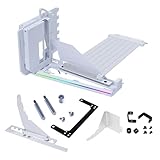
To understand if this accessory fits into your financial plans, you need to understand exactly what you are paying for. A vertical GPU mount is a structural modification kit. It consists of two primary components: a steel or aluminum mounting bracket that replaces the standard horizontal expansion slots at the rear of your PC case, and a flexible extension ribbon known as a PCIe riser cable.
Physically, this kit rotates your graphics card 90 degrees. Instead of the card sitting flat with its fans pointing downward toward the bottom of the case, the fans and the decorative shroud face directly out toward your side panel window. For home office setups where the PC sits on top of the desk as a visual centerpiece, this orientation completely transforms the room’s aesthetic. It turns a piece of functional machinery into a design statement.
However, the hidden complexity lies in the riser cable. Modern graphics cards communicate with the motherboard at incredibly high speeds using PCIe Gen 4 or Gen 5 protocols. To transmit these signals without latency or crash-inducing interference, the riser cable must be heavily shielded and precisely manufactured. This engineering is why reputable kits cost between $60 and $80. If you attempt to cut corners by purchasing a cheap, unshielded $20 riser cable from an unknown online marketplace, you run a high risk of system instability, black screens, or being forced to manually downgrade your motherboard PCIe speeds in the BIOS, which defeats the purpose of buying modern hardware.
Pros
- Striking Visual Presentation: It showcases the most expensive and aesthetically detailed component in your system. Instead of hiding custom RGB lighting and stylized fan shrouds, they become the focal point of your desk setup.
- Complete Elimination of GPU Sag: Modern graphics cards have ballooned in size, with some triple-fan models weighing between 3 and 5 pounds. Mounting the card vertically transfers this heavy load from the delicate motherboard PCIe slot directly to the steel chassis of the computer case.
- Cleaner Cable Routing: Thick, stiff PCIe power cables (which can pull anywhere from 150W to over 300W of power) no longer have to bend awkwardly against your side glass panel. Instead, they can be routed cleanly downward or backward toward the motherboard tray.
- Improved Bottom-of-Case Clearance: Elevating the card can open up physical space at the bottom of your micro-ATX or mid-tower case, allowing for better placement of decorative elements, custom water-cooling pumps, or additional intake fans.
Cons
- Poor Performance-to-Cost Ratio: A vertical mount contributes exactly zero frames per second to your gaming performance. Spending $70 on a mount instead of a better GPU can cost you up to 15% to 20% in raw hardware performance.
- Thermal Choking Risks: If your PC case is shallow, mounting a thick 2.5-slot or 3-slot GPU vertically pushes the intake fans dangerously close to the glass side panel. If there is less than 1 to 1.5 inches of clearance, the fans will struggle to pull in cool air. This can cause GPU temperatures to spike by 5°C to 12°C, forcing the fans to spin at maximum speed and creating a loud, disruptive hum in your home office.
- Loss of Expansion Slots: Once a vertical bracket is installed, it physically blocks access to the rest of your motherboard’s PCIe slots. If you plan to use a dedicated sound card, a Wi-Fi card, or an internal capture card, a vertical mount will likely make that impossible.
- Installation and Compatibility Headaches: Not all PC cases are designed to accept universal brackets. Some require you to permanently cut the metal bars dividing the rear expansion slots of your case with metal shears, a destructive process that voids your case warranty.
Who Should Buy It
You should consider a vertical GPU mount if you have already finalized your core hardware components, have no interest in further performance upgrades, and prioritize the visual design of your workspace above all else. If your PC sits prominently on your desk at eye level, the aesthetic upgrade can be highly satisfying. It is also an excellent option for builders who own a spacious, dual-chamber “aquarium” style case where there is plenty of depth to prevent thermal choking, and who are using a heavy graphics card that is visibly warping under its own weight.
Who Should Skip It
You should absolutely skip a vertical mount if you are trying to squeeze every ounce of performance out of a tight budget. If your total system budget is under $1,000, that $70 is the difference between a budget 500GB SSD and a spacious 2TB NVMe drive, or a entry-level power supply and a highly efficient, modular gold-rated unit. As we look ahead to building clean, minimalist home offices in 2026, the trend is moving toward smarter, highly efficient spending rather than over-budget aesthetics. If your case is compact, or if you rely on expansion cards for work or hobbies, stick to the traditional horizontal layout.
Cheaper Alternatives
If you are asking yourself: is a vertical gpu mount worth it for budget setups, you are likely looking for ways to protect your hardware or improve its looks without spending a fortune. Fortunately, you do not need an expensive riser kit to solve the problem of GPU sag. Below are several budget-friendly alternatives that keep your hardware safe for a fraction of the cost.
| Option | Cost | Trade-off |
|---|---|---|
| Adjustable Support Pillar | $8.00 – $15.00 | Purely functional; does not change the orientation of the card or show off the fan shroud. |
| Horizontal Bracket (Slot-Mounted) | $10.00 – $18.00 | Can block the expansion slot directly underneath the GPU; requires careful alignment. |
| DIY Lego or Toy Support | $0.00 (Free) | Highly customizable and holds weight perfectly, but may look childish or unprofessional in a clean home office. |
| Fishing Line / Clear Thread | $2.00 – $5.00 | Virtually invisible and highly effective, but requires patience to tie and secure safely to the top of the case. |
FAQ
Does mounting a GPU vertically reduce its lifespan?
No, mounting a GPU vertically does not inherently damage the card or shorten its lifespan. Modern graphics cards are designed to operate in various orientations. However, if the vertical mount places the card too close to the side glass panel, the resulting heat buildup and thermal choking can cause the card to run consistently hotter. Sustained high temperatures (above 85°C) over several years can degrade the thermal paste and silicon faster than a well-ventilated horizontal setup.
Will a PCIe 4.0 riser cable work with a PCIe 5.0 motherboard and GPU?
Yes, but with a caveat. PCIe standards are backward and forward compatible. If you connect a PCIe 5.0 GPU to a PCIe 5.0 motherboard slot using a PCIe 4.0 riser cable, the system will automatically drop its communication speed to PCIe 4.0 to match the weakest link. For current budget and mid-range graphics cards, this reduction in bandwidth has a negligible impact on actual gaming performance (usually less than 1% to 2%). However, to avoid boot-loop issues, you may sometimes need to plug the GPU directly into the motherboard first, manually set the PCIe slot speed to Gen 4 in your BIOS, and then install the riser cable.
Can I use a vertical GPU mount in a Micro-ATX or Mini-ITX case?
It depends entirely on the specific dimensions of your case. Small form factor (Mini-ITX) cases sometimes have built-in vertical mounting slots because it is the only way to fit a large GPU inside a tiny footprint. However, for standard Micro-ATX cases, aftermarket vertical mounts like the Lian Li VG4v4 or Cooler Master Gen5 often will not fit because these cases do not have enough vertical clearance or expansion slots (typically requiring at least 7 free horizontal slots) to accommodate the bracket.
Is GPU sag actually dangerous, or is it just ugly?
Severe GPU sag can be genuinely dangerous over time. While minor drooping of a few millimeters is purely cosmetic, heavy sag exerts constant leverage on both the motherboard’s PCIe slot and the graphics card’s contact pins. Over months or years of heat cycles (expanding and contracting), this physical stress can crack the solder joints on the motherboard, split the PCB of the graphics card itself, or cause intermittent connection drops that manifest as sudden system crashes or blue screens.


