
The best high end 60 inch and longer built in linear electric fireplaces are the Dimplex Ignite XL Bold for convincing flame depth, the Modern Flames Landscape Pro Slim for installation flexibility, the Amantii Panorama SLIM for media and finish customization, and the Simplifire Scion Trinity when a three-sided design matters most.
At this size, the right choice is less about screen length and more about five practical differences: how the flame is produced, whether the heater can warm the room or only take the chill off, what the framing manual permits, how many media layouts are included, and whether controls work reliably from the sofa.
As an Amazon Associate we earn from qualifying purchases at no extra cost to you.

Our Top Picks
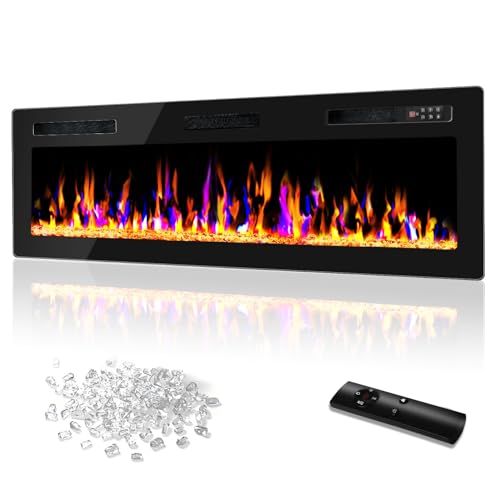 Vitesse 60 Inch Ultra Thin Electric Fireplace-Narrow Bezel60inch3.2 x 72 x 18.11 Inches58 PoundsCheck on Amazon

Quick comparison of large built-in electric fireplaces
| Model or product family | Available long sizes | Flame and viewing design | Typical heat class | Best suited to |
|---|---|---|---|---|
| Dimplex Ignite XL Bold | 60, 74, and 100 inches | Deep, layered visual effect with realistic logs and crystals | About 5,000 BTU supplemental heat; model-dependent | Feature walls where flame depth is the priority |
| Modern Flames Landscape Pro Slim | 60, 72, 84, and 96 inches | Multi-color flame, ember bed, and adjustable flame presentation | Usually about 5,000 BTU on 120V versions | Media walls with a shallow cavity or a wide aspect ratio |
| Amantii Panorama SLIM | 60, 72, 88, and 100 inches, depending on configuration | Bright LED flame with extensive media and trim choices | Commonly 5,000 BTU on standard configurations | Custom interiors where finish options matter |
| Simplifire Scion Trinity | Long sizes including 60, 72, 84, and 100 inches | Three-sided viewing on selected installations; realistic ember presentation | Roughly 5,000 BTU supplemental class | Room dividers, corners, and peninsula-style installations |
| Napoleon Alluravision | 60, 74, and 100-inch class models | Clean modern flame with log and crystal media options | Model-dependent, generally supplemental heat | Minimalist surrounds and straightforward wall installations |
Dimensions, voltage, trim, and heater ratings can differ by exact model suffix and installation configuration. Treat the table as a buying shortlist, not a substitute for the current installation manual.
Head-to-head: flame realism and visual depth
Best for a deeper, more layered flame: Dimplex Ignite XL Bold
A long fireplace can look surprisingly flat if its flame is confined to a narrow screen. The Ignite XL Bold is a strong choice when the insert will be viewed from several seating positions because its flame presentation, ember area, logs, and glass create more visual layering than a simple colored LED strip. It is particularly effective in a dark or neutral media wall, where the flame is not competing with glossy tile or strong accent lighting.
Its limitation is that no electric flame produces the irregular smoke movement or radiant depth of a real fire. The effect remains a carefully animated light display, and bright daylight can reduce the perceived contrast.
Best for color control and a slim cavity: Modern Flames Landscape Pro Slim
The Landscape Pro Slim is appealing when the wall cannot accommodate a very deep firebox. It offers a wide, contemporary flame composition and multiple flame and ember color settings. That flexibility is useful for matching warm wood, gray stone, or a television wall, although the most saturated colors can look less natural than a restrained amber setting.
Best for customization: Amantii Panorama SLIM
Amantii’s Panorama SLIM range is a practical choice for designers who want to change the look after installation. Crystal, ember, and log-style media can produce very different results. Use sparse media for a modern appearance; use the supplied logs and a modest amount of crystal for a more convincing ember transition. Filling every visible area with reflective glass usually makes the flame look brighter but less fire-like.
Heat output: large does not mean powerful
A 100-inch electric fireplace may have the same heater as a 60-inch model. The heating element is usually mounted in a separate upper or lower section, so the visible width mainly affects appearance rather than heat capacity.
For a common 1,500-watt heater, the electrical calculation is:
1,500 watts ÷ 120 volts = 12.5 amps.
That is close enough to a typical 15-amp circuit’s practical limit that the fireplace should normally have its own correctly rated circuit, with the final arrangement confirmed by the manual and a qualified electrician. A 2,400-watt, 240-volt heater would draw:
2,400 watts ÷ 240 volts = 10 amps.
Higher-voltage versions can therefore deliver more heat without drawing as much current, but they require the appropriate branch circuit. Do not assume a standard receptacle can support a larger heater.
In room terms, most 5,000-BTU-class built-ins are supplemental heaters. They can help a well-insulated family room of roughly 300–500 square feet, depending on ceiling height, windows, climate, and insulation. They should not be treated as the sole heat source for a large open-plan area or a poorly insulated room. Models with a 240-volt, higher-output heater are better for a chilly great room, but still may not replace the home’s primary heating system.
Installation clearances and cavity planning
“Built-in” does not mean “bury it anywhere.” Before framing, check four separate requirements:
- Firebox cavity: Confirm the required opening width, height, depth, ventilation, and permitted framing materials.
- Electrical access: Plan the receptacle, junction box, disconnect, and cable route where the unit’s manual allows them—not directly in a prohibited hot zone.
- Television clearance: A mantel, heat-deflecting shelf, or minimum vertical distance may be required above the fireplace. A TV mounted directly over the opening can be exposed to heat even when the fireplace is electric.
- Finishing material: Verify whether the surround accepts drywall, tile, stone, combustible trim, or a particular adhesive system. Some units permit zero-clearance framing but still impose limits on decorative materials around the opening.
Measure the complete finished opening, not only the glass. A 60-inch unit may need a cavity materially wider and taller than 60 inches once framing, trim, and service access are included. Leave a removable access strategy if the unit may need to be replaced without demolishing the entire wall.
Media, controls, and everyday usability
Look for an included log set, crystal media, ember pieces, and a way to arrange them without blocking the flame path or heater outlet. More media is not automatically better. The most natural arrangement usually leaves some dark space around the flame and places larger logs toward the rear.
Control systems commonly include a handheld remote, touch controls, a wall thermostat connection, and sometimes an app or smart-home integration. A remote with separate flame, ember, heater, and brightness controls is more useful than one that only cycles through presets. For a television wall, choose a model that can run the flame without heat and that remembers the last flame setting after power interruption.
App control is convenient but should be considered secondary. The fireplace should remain fully usable if Wi-Fi changes, the app is discontinued, or the unit is installed in a room with weak wireless coverage. A thermostat-capable connection is more valuable than decorative smart features if the fireplace will provide regular supplemental heat.
Choose by room and installation situation
| Your situation | Most suitable direction | Why | Watch for |
|---|---|---|---|
| 60–72-inch media wall in a medium family room | Landscape Pro Slim or Ignite XL Bold | Balanced proportions and practical supplemental heat | Keep the television’s lower edge outside the specified heat zone |
| 84–100-inch statement wall | Panorama SLIM, Landscape Pro Slim, or Ignite XL Bold 100 | Wide flame fills a large architectural opening | Confirm circuit load; length alone does not increase heating |
| Corner or peninsula installation | Scion Trinity or another approved multi-sided configuration | Flame remains visible from adjacent seating areas | Check which sides can be opened and how finishing returns are built |
| Shallow renovation cavity | Landscape Pro Slim or Panorama SLIM | Designed around a slimmer built-in format | Do not reduce required depth to save space |
| Primary goal is heating a large open room | Higher-output 240V model | More heating capacity and lower current draw for the same wattage | Requires electrical planning and remains supplemental heat |
Recommended buying order
- Measure the finished wall and seating distance. A 100-inch fireplace viewed from only 7 feet can dominate the room, while a 60-inch model may look undersized on a 20-foot feature wall.
- Decide whether heat is essential. If appearance is the priority, compare flame depth and controls first. If heating matters, compare watts, voltage, circuit requirements, and thermostat support.
- Download the installation manual before ordering. Check cavity dimensions, clearances, wiring, media restrictions, and TV placement.
- Choose the media style. Logs generally look more traditional; crystals create a cleaner contemporary effect; a restrained combination often looks least artificial.
- Plan service access. Avoid permanently sealing the unit behind expensive stone unless the manufacturer provides a clear removal method.
For most large built-ins, the Dimplex Ignite XL Bold is the strongest visual choice, the Modern Flames Landscape Pro Slim is the safest all-round direction for shallow contemporary walls, and the Amantii Panorama SLIM is especially attractive for highly customized interiors. Choose the Simplifire Scion Trinity when the room layout makes side visibility a central design requirement, and select a higher-output 240V configuration only when the electrical and heating plan supports it.
Frequently asked questions
Can a television be mounted directly above a built-in electric fireplace?
A television should not be mounted directly above the opening without checking the fireplace manual’s heat-clearance requirements. The installation may require a mantel, heat-deflecting shelf, or minimum vertical distance. Even an electric fireplace can expose a television to heat. Confirm the complete arrangement before framing, including the finished opening, surrounding materials, and any required separation.
Does a 100-inch fireplace produce more heat than a 60-inch model?
A 100-inch fireplace does not necessarily produce more heat than a 60-inch model. The heater is usually separate from the visible firebox, so width mainly affects appearance. Many large units remain in the 5,000-BTU supplemental class. Check the exact model’s heater rating, voltage, and installation manual rather than choosing based on length.
What electrical planning is needed for a 1,500-watt fireplace?
A 1,500-watt fireplace at 120 volts draws 12.5 amps, which is close to the practical limit of a typical 15-amp circuit. It should normally have its own correctly rated circuit, with the final arrangement confirmed by the manual and a qualified electrician. Do not assume a standard receptacle can support a larger heater.
Can these fireplaces run the flame without producing heat?
These fireplaces can generally run the flame without heat, and that feature is especially useful in a television wall. The article recommends choosing a model with separate flame and heater controls. This lets you use the visual effect when heating is unnecessary, while avoiding the assumption that the fireplace must operate its heater whenever the flame is visible.
How should logs and crystals be arranged for a natural-looking effect?
A natural arrangement usually leaves some dark space around the flame and places larger logs toward the rear. Sparse media creates a more modern appearance, while supplied logs with a modest amount of crystal can create a more convincing ember transition. Filling every visible area with reflective glass may increase brightness but make the flame look less fire-like.


