For most woodworkers the best spokeshave to buy first is a flat-sole (straight) model with screw-adjustable blade depth and lateral alignment — the Veritas Low-Angle Spokeshave is the strongest all-round pick, while the Stanley 151 remains the value option at roughly a quarter of the price. Add a round-sole spokeshave only when you actually cut concave curves, such as the inside of a chair arm or a scoop, because a flat sole physically cannot reach the bottom of a tight inside curve. If you make chairs, Windsor-style spindles, or curved handles regularly, the honest answer is that you want one of each.
As an Amazon Associate we earn from qualifying purchases at no extra cost to you.

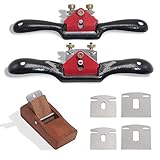


Our Top Picks


Top 3 picks at a glance
Quick comparison: what’s worth considering in 2026
| Pick | Best for | Sole & blade | Key specs | Typical price |
|---|---|---|---|---|
| Veritas Low-Angle Spokeshave | Best overall | Flat, bevel-up | ~12° blade bed; PM-V11 or O1 iron; screw depth + lateral adjusters; screw-set mouth | usually $110–$160 |
| Veritas round-sole spokeshave | Best for concave work | Round, bevel-up | Curved sole for inside curves; same adjuster layout as the flat version | usually $110–$160 |
| Lie-Nielsen Boggs Spokeshave | Best premium build | Flat or round, bevel-down | Bronze body; A2 iron; ~2 in (50 mm) class cutter; sold in both sole profiles | usually $180–$250 |
| Stanley 151 / 152 | Best budget | 151 flat / 152 round | Cast-iron body; two adjuster knobs; high-carbon steel iron; thin blade stock | usually $25–$45 |
| Kunz 51 / 52 | Mid-budget traditional | 51 flat / 52 round | Stanley-pattern body, generally thicker casting and better finish than current Stanley stock | usually $40–$70 |
| Lie-Nielsen small bronze spokeshave | Detail work, smaller hands | Flat or round | Narrower cutter (~1-1/2 in class), shorter sole for tight radii and model-scale work | usually $140–$190 |
Flat sole vs round sole: the geometry decides the job
The sole profile is not a preference, it’s a constraint. A flat sole registers on the workpiece at two points, one ahead of the blade and one behind it. That makes it ideal for straight edges, chamfers, tenon shoulders, and convex (outside) curves — on a convex surface the sole simply rocks, and the blade traces a fair curve as long as you keep your strokes even. A round sole does the opposite: its curved underside lets the blade dip into a concave (inside) curve, which is why it’s the tool for the inside of a chair arm, a scoop, a bowl rim, or a shaped drawer pull.
You can work out exactly why a flat sole fails on inside curves with a bit of arithmetic. Say you’re shaping a concave curve with a 6 in (150 mm) radius, and the flat sole’s contact span is about 2 in (50 mm). The sole bridges the curve, and the gap at the midpoint is:
gap = R − √(R² − (L/2)²) = 6 − √(36 − 1) = 6 − 5.916 = 0.084 in (about 2.1 mm)
A spokeshave taking a fine cut projects its blade somewhere around 0.05–0.15 mm (0.002–0.006 in). The blade would have to project more than 2 mm — roughly fifteen times a normal shaving — before it touched the bottom of that curve. That is the whole argument for owning a round sole. Tighten the radius and the number gets worse fast; flatten the curve and it shrinks toward zero, which is why a flat sole handles gentle arcs perfectly well.
Blade adjustment: the feature that separates a tool from a toy
Almost every decent spokeshave has two adjusters: one screw that advances or retracts the blade for depth, and a second that tilts it so the edge sits parallel to the sole. On a Stanley-pattern shave these are the two knurled knobs behind the blade; on the Veritas and Lie-Nielsen tools the layout is similar but the threads are finer and the blade is held more rigidly. Fine threads matter more than they sound — a coarse adjuster moves the blade in visible jumps, and you end up tapping the iron with a mallet to dial it in.
Setup values that work: start with the blade projecting about 0.05 mm (0.002 in) and advance in eighth-turns, testing on scrap. Aim for a mouth opening of roughly 0.5–1 mm for a fine cut, wider for heavy stock removal. When you first set the lateral adjuster, sight down the sole from the front — the edge should be even across its full width, with no more than a hair’s difference corner to corner.
The other adjustment axis is blade bedding. Traditional spokeshaves are bevel-down: the iron lies at roughly 45° with the bevel facing the wood, so the cutting angle is about 45° no matter what angle you hone at. Low-angle spokeshaves are bevel-up: per Lee Valley’s spec sheet for the Veritas low-angle spokeshave, the blade bed sits at about 12°, so a 25° honed bevel gives a 37° cutting angle. That lower angle slices end grain and short-grain curves noticeably more cleanly, but the blade is supported by less metal behind the edge, so a heavy-handed cut on hard maple can chatter. The trade is real, and it’s the main reason both designs still sell.
Best overall: Veritas Low-Angle Spokeshave
For a first serious spokeshave, this is the one that does the most jobs well. It suits anyone shaping curved furniture parts — chair spindles, crest rails, shaped stretchers, tool handles — and anyone who wants to set depth repeatably without fiddling. The low bed angle handles end grain and tight radii cleanly, the adjusters are precise, and the mouth can be closed down with a screw for fine work. The trade-off is cost: it runs several times a Stanley, and if your work is mostly straight chamfers on softwood, you’ll never use the extra capability. Blade steel is worth choosing deliberately — O1 takes the keenest edge and sharpens fastest, while PM-V11 holds an edge substantially longer in abrasive woods.
Best for concave work: a round-sole spokeshave
Buy this when your parts curve inward. The round-sole version of the same family is the natural pairing, and the round-sole Lie-Nielsen Boggs is the premium alternative. It suits chairmakers, boatbuilders fairing curved frames, and anyone shaping scoops or hollows. The trade-off is that a round sole is genuinely worse than a flat one for straight work: it rocks on a flat surface, so you cannot take a controlled full-width cut on a square edge. Two spokeshaves is not a luxury for a chairmaker; it’s the minimum kit.
Best premium build: Lie-Nielsen Boggs Spokeshave
The bronze body is the selling point. Extra mass means more momentum in the cut, which translates into fewer stalls on hard, figured stock and less vibration through your hands on long shaping sessions. It comes in flat and round sole versions, uses an A2 iron, and suits a professional or a hobbyist who shapes curved parts weekly and wants a tool that will outlast them. The trade-offs: it costs the most here, and A2 is slower to sharpen than O1 — a real consideration if you’re still building your honing routine.
Best budget: Stanley 151 (flat) and 152 (round)
The Stanley 151 and its round-sole sibling, the 152, remain the standard entry point. They suit beginners, occasional users, and anyone who wants to try a spokeshave before committing. The trade-off is consistent quality control: modern production castings often need the sole flattened on a diamond plate or a sheet of abrasive on glass, the blade back flattened, and the cap iron tuned before the tool works well. That’s an hour of work and it’s worth doing — a fettled 151 is a genuinely useful tool. If you’d rather skip the fettling, the Kunz 51/52 pattern usually arrives closer to flat for a modest premium.
Handle comfort and body mass
Handles come in two broad families. Traditional tang-and-handle designs (Stanley, Kunz) have two wooden grips pushed onto steel tangs; they’re light, which is nice for overhead work, but thin grips and steel tangs transmit vibration. Knob-style bodies (Veritas) give you two round grips that sit better in a closed fist and are easier to control on a pull stroke. Handle diameter matters more than material — if your hands are large, thin vintage-pattern grips will cramp you after twenty minutes. As a rule, shape with a pull stroke toward your body for control and switch to a push stroke for hogging off material, and let the tool’s weight do part of the work rather than gripping harder.
Sharpening: what each design actually demands
Every spokeshave blade needs a flat back and a honed bevel. Start with a 25° primary bevel, then decide based on the bedding:
- Bevel-down (Stanley, Kunz, Lie-Nielsen Boggs): hone a 30° micro-bevel. Because the iron beds at about 45°, the cutting angle stays near 45° and the micro-bevel only improves edge durability and clearance. Raising the honing angle does not change how the tool cuts.
- Bevel-up (Veritas low-angle): the bevel is the cutting angle. A 25° bevel plus a 12° bed gives 37°. If you hit figured wood that tears out, hone a 35° micro-bevel instead — 35° + 12° = 47°, which behaves much like a standard-angle shave and tames the grain. Keep a spare iron honed at each angle and you can swap rather than re-hone mid-project.
Blade stock on most spokeshaves runs about 0.09–0.12 in (2.3–3 mm) thick, thinner than a bench plane iron, so it flexes. Support it flat on the stone and don’t press hard. For concave work, add a slight camber — a few thousandths of an inch of curve across the edge — so the corners don’t dig in on a radius. How often to sharpen depends on the wood: a PM-V11 iron in pine may go a long session, while the same iron in teak or ipe may need attention in twenty minutes.
How to choose: a decision matrix
| Your situation | Sole | What to set up | Budget band |
|---|---|---|---|
| First spokeshave, general shaping and chamfers | Flat | 30° micro-bevel, mouth ~0.5 mm, blade out 0.05 mm | $25–$160 |
| Chairs, spindles, inside curves | Round (plus a flat) | Cambered edge, light cuts, pull stroke | $110–$250 |
| End grain and short-grain radii | Flat, low-angle | 25° bevel → 37° cutting angle | $110–$160 |
| Figured hardwoods that tear out | Either, bevel-up | 35° micro-bevel → 47° cutting angle, tight mouth | $110–$160 |
| Model-scale or very tight radii | Flat or round, small | Narrow cutter, short sole, frequent honing | $140–$190 |
| Occasional use, tight budget | Flat | Flatten sole and blade back first; expect an hour of tuning | $25–$70 |
Frequently Asked Questions
Can a round-sole spokeshave replace a flat one?
No. A round sole rocks on flat stock, so you can’t take a controlled full-width cut on a straight edge or a chamfer, and you’ll get a dished surface instead of a flat one. It’s also harder to keep a consistent depth on gentle convex curves. Treat the round sole as a specialist for concave work and keep a flat sole for everything else.
Do I really need two spokeshaves?
Only if you cut both convex and concave shapes. For straight chamfers, tenon shoulders, and outside curves, one flat-sole spokeshave covers all of it. Chairmakers and anyone shaping scoops or hollows will use both regularly enough that swapping blades between bodies isn’t practical.
How do I stop a spokeshave from tearing out?
Close the mouth to roughly 0.5 mm, take lighter cuts, and increase the effective cutting angle. On a bevel-up shave that means honing a steeper micro-bevel — 35° on a 12° bed gives a 47° cutting angle, which behaves like a standard bench plane. Skewing the tool slightly so the blade slices rather than scoops also helps on figured grain.
How often does a spokeshave blade need sharpening?
Judge by the shaving, not the calendar. When the tool starts skating over the surface instead of cutting, or the shaving comes off crumbly rather than as a continuous ribbon, it’s time. Abrasive species like teak and ipe can dull an edge in twenty minutes of work, while softwoods may run for a full session.
Is a cheap spokeshave worth buying?
Yes, with caveats. A budget Stanley or Kunz typically needs the sole flattened on abrasive paper over glass, the blade back flattened, and the cap iron fitted properly before it performs well. After that tuning it’s a capable tool. If you’d rather not spend the hour, a low-angle Veritas arrives ready and is the better long-term value.
Can I use a spokeshave on end grain?
Yes, and a low-angle bevel-up shave is the better choice for it. A 37° cutting angle shears end grain more cleanly than a 45° bevel-down cut, and the thin blade lets you take very light passes. Support the workpiece firmly and work from the outside edges toward the center to avoid blowing out the far side.
Related guides
More from Amazon
Programs that pair well with the guide above. Offers and eligibility are set by Amazon and may change.
Free shipping on eligible items, Prime Video and more. Eligible new members can start with a free trial.
Start a Prime free trialAd-free music streaming. Eligible new subscribers can start with a free trial.
Try Music Unlimited freeA Prime membership for ages 18-24 with a trial period. Eligibility is set by Amazon.
See Prime for Young AdultsAudiobooks and podcasts to listen to on the go. Eligible new members can start with a free trial.
Try Audible freeAs an Amazon Associate we earn from qualifying purchases.