
The best wireless mouse for most people in 2026 is the Logitech G305 LIGHTSPEED. It is the one mouse on this list that is genuinely comfortable in both a fast-paced shooter and a spreadsheet: a 1,000 Hz USB-receiver link for gaming-grade responsiveness, a 12,000 DPI HERO sensor, six programmable buttons, and a single-AA power design rated in the region of 250 hours at full polling — with a low-power mode that stretches the same battery into months of desktop work. It suits anyone who wants one mouse for a gaming PC and a work laptop, and it carries a premium-tier price without premium-tier upkeep.
If you never game, the maths changes completely. The Logitech M330 Silent Plus is the better everyday desk pick because silent switches matter more than polling rate once you share an office, and the Logitech M240 is the better travel pick because it drops the USB receiver entirely and connects over Bluetooth. When budget is the hard constraint, the Acer 1600 DPI and the Amazon Basics 2.4 GHz mouse cover the basics for very little. Everything below is sorted by what you actually do with the mouse.
Our Top Picks
 Logitech M185 Compact Ambidextrous 2.4 GHz Wireless Mouse1 Pack1.54 x 3.89 x 2.36 inches0.3 poundsCheck on Amazon
 Amazon Basics 2.4 GHz Wireless Optical Computer Mousenano3.97 x 2.28 x 1.57 inches0.2 poundsCheck on Amazon
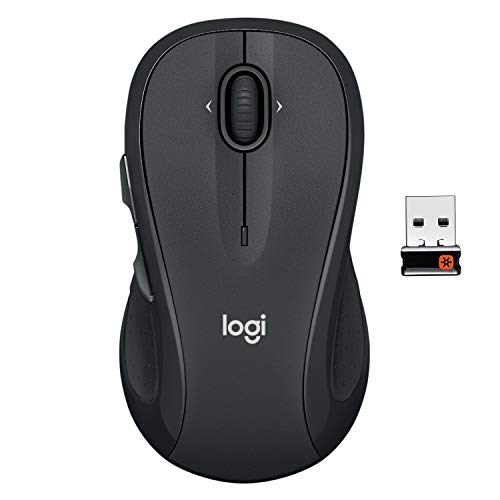 Logitech M510 Full Size Ambidextrous 2.4 GHz WirelessOne Size2.83 x 1.81 x 5.16 inches0.28 poundsCheck on Amazon


Top 3 picks at a glance

Quick Comparison
| Product | Best for | Key specs | Price tier |
|---|---|---|---|
| Logitech M185 | Laptop bags and everyday desktop use | 2.4 GHz nano receiver with in-shell storage, compact ambidextrous shell, optical sensor, 3 buttons, 1× AA (brand-rated up to 12 months) | Mid-range |
| Amazon Basics 2.4 GHz Wireless Optical Mouse | Absolute lowest spend, spare or backup mouse | 2.4 GHz nano receiver, optical tracking, 3 buttons, 1× AA, auto-sleep | Budget |
| Logitech M510 | Full-size desk comfort with back/forward buttons | 2.4 GHz nano receiver, full-size contoured shell, 5 buttons plus wheel, rubber side grips, 2× AA (brand-rated up to 2 years) | Premium |
| Logitech G305 LIGHTSPEED | Gaming and work on a single mouse | LIGHTSPEED 1,000 Hz link, HERO sensor up to 12,000 DPI, 6 buttons, onboard memory, 1× AA (~250 h at 1 ms, months in endurance mode) | Premium |
| Acer Wireless Mouse 1600 DPI | Budget laptop mouse with on-the-fly DPI switching | 2.4 GHz nano receiver, 3 adjustable DPI levels up to 1,600, 3 buttons, slim laptop shell | Budget |
| TECKNET 2600 DPI | Cheap ergonomic shape in a colour that stands out | 2.4 GHz nano receiver, up to 2,600 DPI with DPI button, contoured ergonomic shell, purple finish | Budget |
| Logitech M240 Silent | Silent travel on Bluetooth-only laptops and tablets | Bluetooth LE (no receiver), silent click switches, compact shell, 1× AA, multi-OS support | Mid-range |
| HP X3000 G3 | Long battery life and side grips for mobile work | 2.4 GHz nano receiver, blue LED optical sensor, textured side grips, 15-month battery class, travel-friendly size | Mid-range |
| Rii 10-Pack Wireless Mouse | Classrooms, labs, kiosks and multi-seat deployments | 10 × 2.4 GHz portable mice, individual nano receivers per unit, identical shells | Premium |
| Guiheng 1200 DPI | Six buttons on a very tight budget | 2.4 GHz nano receiver, 1,200 DPI, 6 buttons, laptop-oriented shell | Premium |
| VssoPlor Slim | Ultra-slim carry in a bag pocket | 2.4 GHz nano receiver, low-profile slim shell, 3 buttons, black-and-gold finish | Budget |
| Logitech M330 Silent Plus | Quiet full-size office work | 2.4 GHz nano receiver, silent switches, full-size shell, 1× AA (brand-rated up to 2 years) | Mid-range |
How We Chose
This roundup is built from published specification sheets, brand documentation and the practical realities of how each category of mouse gets used — not from hands-on time with the units. Selection came down to four filters. First, category fit: a travel mouse is judged on receiver storage, shell height and weight, while a gaming mouse is judged on polling rate, sensor class and latency path, and a bulk-pack mouse is judged on how ten identical units behave in one room. Second, connection options, because 2.4 GHz receivers, Bluetooth LE and dual-mode designs solve different problems and are not interchangeable. Third, battery architecture: single-AA, dual-AA and rechargeable lithium all change the ownership experience more than any marketing figure does. Fourth, upgrade path — whether the model leaves you somewhere sensible in twelve months, or locks you into a shape, a receiver ecosystem or a battery type you will resent. Anything that could only be described by inventing a number was left described by specification class instead.
1. Logitech M185 – Best for Laptops and Everyday Portability
As an Amazon Associate we earn from qualifying purchases at no extra cost to you.

The M185 is the mouse that ends up in more laptop bags than any other model here, and it earns that spot by being unremarkable in the right ways. It is a compact, ambidextrous 2.4 GHz mouse with a nano receiver that stores inside the shell, so the dongle travels with the mouse instead of living permanently in a USB port waiting to be snapped off. It suits students, commuters, secondary desk setups and anyone who wants a mouse that simply works when it is plugged in.
Key specs
- Connection: 2.4 GHz via USB nano receiver, with an in-shell storage slot
- Sensor: optical, fixed 1,000 DPI class
- Buttons: left, right and a clickable scroll wheel
- Power: one AA battery, brand-rated up to around 12 months of typical use
- Shape: compact ambidextrous shell, roughly 95–100 mm long, suitable for smaller to medium hands
- Compatibility: Windows, macOS, Chrome OS and Linux as a standard HID device; no software required for basic use
The strengths here are logistics rather than performance. A fixed 1,000 DPI sensor at a 125 Hz default report rate is completely adequate for document work, browsing and light photo editing, and the low report rate is precisely what buys the long battery figure. Because it presents itself as a generic HID mouse, it works on a locked-down work laptop where installing configuration software is not an option. The receiver storage slot is the single most underrated feature on this list: a nano receiver left in a laptop port is a two-centimetre lever arm attached to your motherboard, and the M185 sidesteps that entirely.
Pros
- Receiver stores inside the shell, so it cannot be lost or snapped off in a bag
- Ambidextrous shape works for left-handed users without a special order
- Genuinely long single-AA runtime because the default polling rate is low
- Plug-and-play on virtually any operating system, including locked-down work machines
- Small and light enough to live permanently in a laptop sleeve
Cons
- 1,000 DPI and a low default report rate make it a poor fit for competitive gaming
- No back or forward thumb buttons, which hurts browser and spreadsheet workflows
- The compact shell is too short for large hands using a full palm grip
- No Bluetooth, so it always occupies a USB-A port while in use
Against the nearest alternative in this list, the Logitech M240 Silent, the M185 wins on compatibility and loses on silence and port freedom. The M240 connects over Bluetooth LE, which means no receiver at all — ideal for a USB-C-only ultrabook — but it cannot be used on a machine without Bluetooth, and it costs more. If you regularly present from a locked-down corporate laptop where you cannot install drivers and cannot rely on Bluetooth being enabled, the M185’s receiver is the safer bet. If your laptop has Bluetooth and you hate click noise, the M240 is the better pick. Against the budget Acer and Amazon Basics mice, the M185 buys you the storage slot and a longer, better-documented battery figure.
2. Amazon Basics 2.4 GHz Wireless Optical Mouse – Best for the Lowest Possible Spend

This is the reference point for the budget tier: a portable 2.4 GHz optical mouse with a USB nano receiver, three buttons and a single-AA power design. It suits anyone buying a mouse they expect to replace, a spare for a guest machine, a backup for a work bag, or a first mouse for a child’s first desktop. If the requirement is “a working wireless mouse for as little as possible”, this is the honest answer.
Key specs
- Connection: 2.4 GHz via USB nano receiver
- Sensor: optical, standard desktop DPI class
- Buttons: left, right and a clickable scroll wheel
- Power: one AA battery, with automatic sleep when the mouse is idle
- Shape: compact, roughly symmetric shell aimed at portable use
- Compatibility: standard HID device, so it works on Windows, macOS, Linux and Chrome OS without software
What you are buying at this tier is the 2.4 GHz radio link and nothing else, and that is a reasonable trade. The proprietary receiver connection gives a report interval in the low-millisecond range — far better than Bluetooth for cursor smoothness — and the auto-sleep behaviour is what makes a single AA last for months rather than weeks. The sensor is a basic optical unit, which means it tracks fine on a desk, a cloth mat or a sheet of paper, but it will be less tolerant of glossy or glass surfaces than a laser-class or higher-end optical sensor. There is no DPI switch, no software, no side buttons and no adjustable polling rate, so what you get on day one is what you get forever.
Pros
- Very low entry cost, which makes it a sensible disposable spare
- 2.4 GHz receiver link is noticeably smoother than Bluetooth at the same price
- Standard HID behaviour means zero setup on any operating system
- Auto-sleep keeps a single AA alive for a long stretch of light use
- Light and compact enough for a laptop bag
Cons
- No DPI adjustment, no side buttons and no configuration software
- Basic optical sensor struggles on reflective or glass surfaces
- Build quality is functional rather than durable; the shell flexes under a hard grip
- The nano receiver has no storage slot, so it lives in a port or gets lost
Compared with the Acer 1600 DPI mouse, this one gives up adjustable sensitivity and a slightly more modern shell in exchange for a lower price and simpler behaviour. Compared with the Logitech M185, it gives up the in-shell receiver storage, the longer documented battery figure and the better-documented build — which is exactly what the mid-range tier buys. The practical way to choose between them: if this mouse will sit on one desk forever, the budget option is fine. If it will be thrown in a bag twice a week, pay for the M185 or the HP X3000 G3 and stop worrying about the dongle.
3. Logitech M510 – Best for Full-Size Desk Comfort
The M510 is the full-size, ambidextrous option in this list: a contoured desktop mouse with rubberised side grips, back and forward thumb buttons and a two-AA power design that Logitech rates in the two-year class for typical office use. It suits people who spend six or more hours a day at a desk, have medium to large hands, and want navigation buttons without paying gaming-mouse prices or accepting a gaming-mouse shape.
Key specs
- Connection: 2.4 GHz via USB nano receiver
- Sensor: full-size desktop sensor class; the listing does not publish a headline DPI figure, so treat it as a standard productivity sensor rather than a high-DPI gaming unit
- Buttons: left, right, clickable wheel plus dedicated back and forward thumb buttons
- Power: two AA batteries, brand-rated up to around two years of typical use
- Shape: full-size ambidextrous body with a raised palm hump and textured rubber grips, roughly 120 mm long
- Weight: heavy for a wireless mouse, in the 120–140 g band with both cells installed
The M510’s case rests on palm support and thumb buttons. A raised rear hump means the heel of your hand rests on the mouse rather than dragging on the desk, which is the difference between a comfortable eight-hour day and a sore wrist by mid-afternoon. The back and forward buttons are the single biggest productivity upgrade in this entire roundup — once you have navigated a browser, a file manager and a spreadsheet with your thumb, going back to a three-button mouse feels like typing with one hand. Two AA cells also mean the mouse gets heavier and more planted, which some users prefer for precise cursor placement in design and editing work.
Pros
- Full-size palm support suits long working sessions and larger hands
- Back and forward thumb buttons transform browser and file-manager work
- Two-year battery class means you can forget the mouse has a battery at all
- Rubber side grips keep the mouse steady under a firm grip
- Ambidextrous layout means left-handed users are not excluded
Cons
- Heavy by modern standards; not a mouse you flick around in a shooter
- No published high-DPI sensor figure, so it is a productivity tool rather than a gaming one
- Too large for genuinely small hands and for cramped laptop trays
- Two batteries add weight and cost that single-AA designs avoid
The nearest alternative here is the Logitech M330 Silent Plus, which occupies the same full-size comfort slot but adds silent switches and drops to a single AA. If you work in an open office, a shared room or a house with a sleeping baby, the M330’s quieter clicks are worth more than the M510’s extra buttons — but the M510 is the better choice if you want thumb navigation and a heavier, more planted feel. Against the G305, the M510 loses decisively on latency, sensor quality and weight, and wins on price tier, comfort for very long sessions and battery life. If your work is 90% documents and 10% games, the M510 is the more comfortable tool; if that ratio flips, buy the G305.
4. Logitech G305 LIGHTSPEED – Best for Gaming and Work in One Mouse

The G305 is the only mouse in this roundup designed first as a gaming mouse and second as a general-purpose one, and it is the best overall pick precisely because it does not punish you for using it for work. It pairs a 1,000 Hz LIGHTSPEED wireless link with a HERO sensor rated up to 12,000 DPI, six programmable buttons and a single-AA power design. It suits gamers who want wireless without a charging habit, students who game in the evening and work during the day, and anyone who wants one mouse on one desk for everything.
Key specs
- Connection: LIGHTSPEED 2.4 GHz wireless via USB nano receiver, 1 ms report rate (1,000 Hz)
- Sensor: HERO optical, adjustable up to 12,000 DPI
- Buttons: 6 programmable buttons, including two side buttons and a DPI button
- Power: one AA battery; roughly 250 hours at the 1 ms report rate, extending into many months in the low-power endurance mode
- Onboard memory: one hardware profile, so sensitivity and button assignments travel with the mouse
- Shape: compact symmetric shell, about 117 mm long, with a flat profile that suits claw and fingertip grips
- Weight: around 99 g with an AA installed; a common user modification is a lighter AAA lithium cell in an adapter, which drops it into the mid-80s
Two things separate the G305 from every productivity mouse here. The first is the report rate: at 1,000 Hz the mouse reports its position every millisecond, and the LIGHTSPEED link is engineered to keep end-to-end latency in the low single-digit milliseconds, which is the difference between a cursor that feels attached to your hand and one that feels like it is catching up. The second is the sensor: a HERO-class sensor tracks fast flicks without the smoothing and angle-snapping behaviour that older budget sensors apply, and it does so while drawing very little power — which is how a wireless gaming mouse runs on a disposable AA at all.
Pros
- Gaming-grade 1,000 Hz wireless link at a premium-but-not-flagship tier
- Runs on a single AA, so there is no charging cable and no battery anxiety
- HERO sensor with a wide adjustable DPI range and no obvious acceleration artefacts
- Onboard memory means your settings follow the mouse between machines
- Six buttons make it usable for work as well as play
- Very well documented and widely supported, so parts, skates and shells are easy to find
Cons
- Around 99 g with an AA is heavy for a competitive gaming mouse in 2026
- No Bluetooth, so it always needs its receiver and a free USB-A port
- The symmetric shell has no pronounced thumb rest, which some palm-grip users dislike
- No rechargeable battery, so long-term running costs are small but non-zero
The G305’s nearest alternative in this list is the Logitech M510, and the comparison is the clearest split in the whole roundup: the M510 is heavier, more comfortable for palm grip, has two more buttons in practice and lasts years on a pair of AAs, but it has no gaming sensor and no high polling rate. The G305 is faster, lighter and more precise, but less sculpted and less comfortable over a ten-hour working day. If you want one mouse that does both jobs competently, the G305 is the answer; if you want the most comfortable mouse for documents and do not care about latency, the M510 is. Against the budget Acer and TECKNET mice, the G305 is a completely different class of device — better sensor, better link, better build — and the price tier reflects that honestly.
5. Acer 1600 DPI Wireless Mouse – Best for Cheap DPI Switching on a Laptop

The Acer wireless mouse is a budget-tier laptop mouse with one feature that lifts it above the cheapest options: three adjustable DPI levels, topping out at 1,600 DPI, switched from a button on the mouse itself. It suits students, travellers and anyone who wants to change cursor speed between a small laptop screen and a large external monitor without opening a settings menu.
Key specs
- Connection: 2.4 GHz via USB nano receiver
- Sensor: optical, three selectable DPI levels up to 1,600
- Buttons: left, right, clickable scroll wheel, plus a DPI switch
- Power: replaceable battery, several months per set in typical light use
- Shape: slim, laptop-oriented shell with a low profile
- Compatibility: standard HID device on Windows, macOS, Chrome OS and Linux
The DPI button is the reason to pick this over a generic budget mouse. On a 13-inch laptop screen at 1,600 DPI, a single wrist movement crosses the entire display, which is tiring for precise work; dropping to a lower level gives you fine control for photo editing, spreadsheet cells and drawing. Switching to a 27-inch 1440p monitor, the higher level reduces the number of times you have to lift and reposition the mouse. That is a genuine workflow improvement for very little money, and it is the kind of feature that usually only appears one tier up.
Pros
- Three DPI levels up to 1,600, switchable without software
- Low-profile shell fits easily in a laptop sleeve
- 2.4 GHz receiver link is smoother than Bluetooth at the same price
- No drivers required on any major operating system
- Low cost makes it a painless second or third mouse
Cons
- Budget optical sensor is not happy on glass or high-gloss surfaces
- No back or forward buttons
- Receiver has no dedicated storage slot on most revisions
- Low profile means little palm support for long sessions
- Not suitable for competitive gaming despite the adjustable DPI
Against the Amazon Basics mouse, the Acer wins on DPI flexibility and loses nothing meaningful — if the two are close in price, the Acer is the better buy. Against the VssoPlor Slim, the Acer is a little taller and more conventional in the hand, while the VssoPlor is flatter and better suited to being slipped into a slim bag pocket alongside a tablet. Against the Logitech M185, the Acer gives up receiver storage and the better-documented battery figure but matches it on everyday usability. If you need one cheap mouse and you switch between a laptop screen and a monitor, pick the Acer.
6. TECKNET 2600 DPI – Best for Budget Ergonomic Comfort
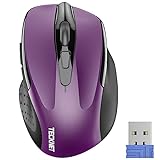
TECKNET’s 2.4 GHz mouse is the budget-tier pick for people who want a contoured, right-hand ergonomic shape rather than a flat symmetrical shell, with a DPI range up to 2,600 and a purple finish that makes it easy to spot in a bag full of black peripherals. It suits desk workers with medium to large hands who want more support than a slim travel mouse gives, without spending mid-range money.
Key specs
- Connection: 2.4 GHz via USB nano receiver
- Sensor: optical, adjustable up to 2,600 DPI via an on-mouse DPI button
- Buttons: left, right, clickable wheel and additional side buttons depending on the revision
- Power: replaceable battery cells, several months per set in typical use
- Shape: contoured ergonomic shell with a raised palm area, right-handed layout
- Compatibility: standard HID device, no software needed
The 2,600 DPI ceiling is higher than anything else in the budget tier here, and although most users will never need it, it does give useful headroom on a 4K or ultrawide display where a lower-DPI mouse feels sluggish. The contoured shell is the bigger draw: a raised palm section and a shaped thumb rest reduce the amount of grip force needed to hold the mouse, which is the main cause of hand fatigue during long sessions. On a budget mouse, that ergonomic shaping is worth more than any sensor figure.
Pros
- Ergonomic contoured shell provides more palm support than flat budget mice
- DPI adjustable up to 2,600 without software
- Higher DPI ceiling helps on large or high-resolution displays
- Distinctive colour makes it easy to identify among other peripherals
- Low cost and no setup required
Cons
- Right-handed ergonomic shape excludes left-handed users
- Build quality and sensor consistency are budget-class; expect some unit-to-unit variation
- Battery documentation is thinner than on the major-brand options
- No onboard memory, so any software-side settings do not travel
- Not a competitive gaming mouse despite the DPI headline
Compared with the Guiheng 1200 DPI mouse, the TECKNET wins on ergonomics and DPI range, while the Guiheng counters with six buttons for users who want extra shortcuts. Compared with the Acer 1600 DPI, the TECKNET is the more comfortable mouse for a full working day, while the Acer is the slimmer and more portable one. If your mouse lives on a desk and your hand aches by the afternoon, the TECKNET’s shape is the reason to choose it; if it lives in a bag, choose the Acer or the VssoPlor instead.
7. Logitech M240 Silent Bluetooth – Best for Silent Bluetooth Travel

The M240 is the Bluetooth-only option in this roundup, and it solves a specific 2026 problem: modern ultrabooks increasingly ship with two USB-C ports and no USB-A


