
Figuring out how much is a gaming pc sounds simple until you realize the answer depends entirely on what you want to play and how you want it to look doing it. A machine that handles competitive shooters at 144fps costs a fraction of one that pushes ray-traced open-world titles at 4K, yet both categories carry the same label. The real problem for buyers in 2026 is identifying which tier actually matches their game library and monitor resolution, rather than overpaying for performance they will never load into memory or underspending and discovering the hardware bottlenecks within months.
What separates a worthwhile system from a poor value usually comes down to three things: whether the GPU generation is current enough to receive driver updates for years, whether the RAM and storage are balanced with the processor rather than padded to inflate a spec sheet, and whether the cooling solution sustains boost clocks under sustained load. Owner feedback across these eight systems consistently highlights thermal design and upgrade headroom as the difference between a desktop you keep and one you sell after a single upgrade cycle.
As an Amazon Associate we earn from qualifying purchases at no extra cost to you. Product prices and availability are accurate as of the date shown and are subject to change.




Top 3 picks at a glance
Quick Picks
| Product | Best for | Price |
|---|---|---|
| Horizon Autherium Dragon RGB I9 RTX | High-end 1440p-4K gaming | $2899.99 |
| Skytech Shadow 5 | 1440p gaming with solid build quality | $1499.99 |
| Skytech Chronos 3 | Best value at the mid-range tier | $1249.99 |
| SKYESEV Gaming Desktop | Entry-level 1080p gaming | $959.99 |
| Skytech Azure 3 | Modern platform with strong cooling | $1379.99 |
| MRSDY USB Gaming Microphone | Streaming or team communication | $19.99 |
| Skytech Storm | Tight-budget prebuilt with essentials | $1099.99 |
| Building a Budget Gaming PC (guide) | DIY builders avoiding a prebuilt | $3.99 |
How We Picked
We evaluated these systems on published specifications, listed prices, and aggregated owner feedback. The criteria that matter most in this category are GPU generation relative to price, balance between RAM and storage (a high-end chip with 16GB of slow DDR4 is a compromise), thermal and power-supply adequacy for sustained loads, and upgrade headroom. A prebuilt that leaves no room to swap in a better GPU later loses value faster than its sticker price suggests.
The 8 Best How Much Is A Gaming Pc in 2026
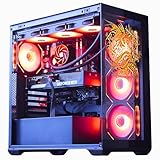
Horizon Autherium Dragon RGB I9 RTX
This is the answer for buyers who want no compromises and are willing to pay accordingly. The Core i9 reaching 5.4GHz paired with an overclocked RTX 5070, 64GB of RAM, and a 5TB storage configuration means you will not run into a hardware ceiling in any current or near-future title. The 360mm AIO keeps thermals in check under long sessions, and WiFi at 2.4GB/s supports high-bandwidth streaming and cloud gaming without latency.
- 64GB RAM and 5TB storage eliminate the upgrade question entirely
- 360mm AIO sustains the i9 boost clocks quietly under load
- Price puts it in custom-build territory where DIY enthusiasts get similar specs cheaper
Skip it if your monitor tops out at 1080p or you play primarily esports titles that barely stress an RTX 5060 Ti.
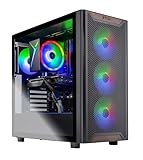
Skytech Gaming PC Shadow 5
The Shadow 5 sits in the upper mid-range and earns its $250 premium over the Chronos 3 through its Ryzen 7 platform, which carries better multi-threaded performance and longer socket support. The RTX 5060 Ti 8GB handles 1440p titles with settings dialed high, and 16GB DDR5 keeps frame times smooth in memory-heavy open-world games. Build quality reports from owners consistently praise cable management and airflow layout.
- Modern Ryzen 7 with strong single and multi-core performance
- 1TB SSD fills most game libraries without a second drive
- Only 16GB RAM, which is already the minimum for some newer releases
Skip it if budget is the priority and you can accept a one-tier-lower GPU for meaningful savings.
Skytech Gaming PC Chronos 3
Among mid-range options, the Chronos 3 is the standout value play. Identical GPU and storage configuration to the Shadow 5, same 16GB RAM, same Ryzen 7 architecture, yet it lands $250 below its sibling. Owner feedback highlights that the chassis is slightly less refined and the included fans are noisier under load, but performance-per-dollar is excellent.
- Same core specs as the pricier Shadow 5 at a lower cost
- Good thermal headroom for the components installed
- Stock cooling is adequate but not quiet under sustained gaming
Skip it if you need a silent build for a shared room or office environment.
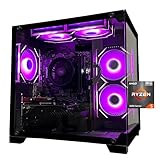
SKYESEV Gaming Desktop
At $959.99, this system is the cheapest path to a working RTX 3050 desktop from a lesser-known brand. The Ryzen 5 5600 is a proven six-core, and 32GB of DDR4 is unusually generous for this price bracket, giving multitaskers and streamers headroom without an immediate upgrade. The 6GB GPU is the limiting factor for newer AAA titles at higher resolutions.
- 32GB RAM at under $1000 is rare and useful for heavy workloads
- Proven Ryzen 5 platform with no known compatibility issues
- RTX 3050 struggles with 1440p in demanding titles
Skip it if you plan to play graphically intensive games at 1440p or above.
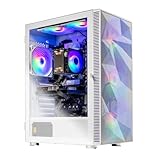
Skytech Gaming Azure 3
The Azure 3 uses the newest AMD platform in this list with a Ryzen 7 9700X and RTX 5060, paired with a 360 ARGB AIO and an 850W Gold ATX 3.0 PSU. That power supply choice is notable because it means upgrading to a higher-tier GPU later requires no PSU swap. The 16GB DDR5 6000 configuration is current and balanced for the GPU tier.
- 850W Gold PSU provides genuine upgrade headroom for a future GPU
- Newest Ryzen 7 9700X with strong efficiency and boost clocks
- 1TB SSD is fine now but fills quickly with modern game sizes
Skip it if the RTX 5060 performance ceiling bothers you and you would rather spend less on a current-generation mid-range card.
MRSDY USB Gaming Microphone
Not a PC, but a necessary companion for anyone building or buying one for streaming, Discord calls, or content creation. At $19.99, it offers noise reduction, a physical mute button, gain control, and RGB lighting that matches a themed build. Sound quality is adequate for voice communication and casual streaming, not for professional podcasting or music production.
- USB plug-and-play with no separate audio interface required
- Physical mute and gain control are practical for team communication
- Budget-grade capsule cannot match dedicated XLR setups for audio production
Skip it if you already own a quality XLR microphone or need broadcast-grade audio.
Skytech Gaming Storm
The Storm is Skytech’s entry-level prebuilt at $1099.99, pairing a Ryzen 5 5500 with an RTX 3050, 16GB DDR4, and a 1TB NVMe SSD. It is a straightforward 1080p machine that handles popular esports and older AAA titles comfortably. The 650W Gold PSU is adequate for the installed hardware but limits future GPU upgrades without a replacement.
- 1TB NVMe SSD at this price point keeps install times short
- Reliable Skytech build quality with straightforward warranty support
- Wi-Fi 5 is dated and a bottleneck on modern high-bandwidth routers
Skip it if you are more than $100 away from the Chronos 3, which offers a meaningful GPU upgrade.
Building a Budget Gaming PC Guide
For buyers who want to spend less than $900 and learn the process simultaneously, this short guide walks through component selection, compatibility checks, and assembly without overselling expensive parts. It is not a substitute for forum research, but it gives beginners a structured starting point so they avoid common mistakes like mismatched RAM speeds or insufficient PSU wattage.
- Low cost with actionable step-by-step guidance for first-time builders
- Helps you understand why prebuilt pricing carries a premium
- Too general for anyone targeting a specific performance tier or resolution
Skip it if you already know how to build and are simply comparing prebuilts.
Buying Guide
GPU Generation Is the Single Most Important Factor
When you ask how much is a gaming pc, the honest answer tracks almost entirely to the graphics card tier. An RTX 3050-based system runs roughly $400-$700 less than an RTX 5060 Ti system, and the performance gap is proportional. Prioritize the newest GPU generation your budget allows, because driver support, ray-tracing features, and DLSS versions are tied to the card, not the rest of the build.
RAM and Storage Should Match the GPU Tier
A mid-range GPU with 16GB DDR4 creates a bottleneck in modern titles that increasingly demand more memory. If you spend on a current-gen card, ensure the system carries at least 16GB and ideally 32GB. Storage matters less for frame rates but 1TB NVMe has become the practical minimum given game install sizes that regularly exceed 100GB each.
Cooling and Power Supply Define Upgrade Potential
A 360mm AIO or a high-quality dual-tower air cooler keeps the CPU at boost clocks through long sessions without thermal throttling. Equally important is the PSU wattage and efficiency rating. An 850W Gold unit, as found in the Azure 3, supports a future GPU swap without opening the case again. A 650W unit limits you to same-tier upgrades.
Our Verdict
Our top pick is the Skytech Chronos 3 at $1249.99. It delivers the best balance of current-generation GPU, modern CPU platform, and fair cooling at a price that leaves meaningful headroom for a RAM upgrade or monitor purchase. For the absolute budget-conscious buyer, the SKYESEV Gaming Desktop at $959.99 is the cheapest entry that still includes a dedicated GPU and generous RAM. However, if you need a silent build for a bedroom or shared office and want upgrade-ready power delivery, the Skytech Azure 3 wins on thermal and PSU design despite its slightly higher price.
FAQ
How much is a gaming pc for 1080p gaming?
Prebuilt systems with an RTX 3050 or equivalent GPU start around $960-$1100 and handle 1080p titles at medium-high settings with stable frame rates. You do not need to spend significantly more unless you want 144Hz refresh rates in demanding AAA titles or plan to play at 1440p.
Is 16GB RAM still enough for a gaming pc?
It is the minimum in 2026 and works for most single-task gaming, but a growing number of open-world titles exceed 16GB with background applications running. If the price difference is under $80, a 32GB configuration is the safer long-term choice and eliminates a near-future upgrade.
Should I buy a prebuilt or build my own?
Prebuilts carry a premium of roughly 10-20% over equivalent DIY builds, but they include assembly, Windows licensing, and a single-point warranty. Building yourself saves money and teaches you the components, but it requires compatible parts selection and troubleshooting skills that not every buyer wants to develop.
How much is a gaming pc with ray tracing support?
Any RTX 5060 Ti or above includes hardware ray tracing cores, meaning prebuilt systems starting around $1250 give you full RT capability. The RTX 3050 includes RT cores as well but its performance at even 1080p with ray tracing enabled is marginal, so the practical threshold is the 5060 tier and above.


