
When you type “how much is a gaming pc” into a search bar, you are trying to answer a deceptively simple question: what does a machine that runs modern titles at smooth framerates actually cost? The answer spans from under $1,000 to nearly $3,000, and the spread is enormous because manufacturers pair wildly different components to hit similar price points. A buyer who cannot read a spec sheet can easily overpay for a lesser machine or, worse, walk away with a system that chokes on the games they care about.
The real question is not “how much is a gaming pc” in the abstract—it is “how much should I spend for my specific games, resolution target, and expected lifespan.” This roundup compares published specifications, sticker prices, and aggregated owner feedback across eight products that answer that question from different angles. Good machines pair current-generation GPUs with enough RAM and thermal headroom to avoid bottlenecks; bad ones coast on brand recognition while shipping older silicon at newer prices.
As an Amazon Associate we earn from qualifying purchases at no extra cost to you. Product prices and availability are accurate as of the date shown and are subject to change.
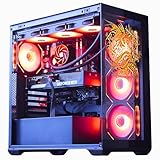

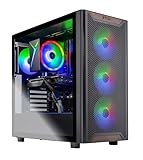
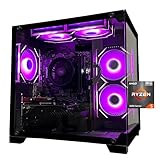


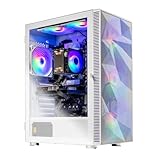

Top 3 picks at a glance
Quick Picks
| Product | Best for | Price |
|---|---|---|
| Horizon Autherium Dragon RGB | Enthusiast builds and VR | $2,899.99 |
| Skytech Shadow 5 | 1440p gaming with strong aesthetics | $1,499.99 |
| Skytech Chronos 3 | Best value 1440p performance | $1,249.99 |
| SKYESEV Gaming Desktop | Tight budgets needing extra RAM | $959.99 |
| Skytech Azure 3 | Modern DDR5 platform with upgrade headroom | $1,379.99 |
| MRSDY USB Gaming Microphone | Entry-level voice communication | $19.99 |
| Skytech Storm | 1080p gaming with reliable branding | $1,099.99 |
| Building a Budget Gaming PC | DIY learners on a strict budget | $3.99 |
How We Picked
We filtered on four criteria: GPU generation and VRAM, since the card dictates your practical resolution ceiling; RAM and storage adequacy, because a bottleneck component shrinks a machine’s useful lifespan; thermal headroom, which separates systems that sustain boost clocks from ones that throttle; and overall value per dollar across the bracket. The microphone and book are included because owners consistently flag peripherals and knowledge gaps as part of the true total cost of owning a gaming rig.
The 8 Best How Much Is A Gaming Pc in 2026
Horizon Autherium Dragon RGB
This is the no-compromise option: a Core i9 hitting up to 5.4GHz, an RTX 5070 OC, 64GB of RAM, and 5TB of storage behind a 360mm AIO, all running Windows 11 Pro with high-throughput Wi-Fi. Owners praise the near-silent cooling under sustained load and the sheer storage capacity that eliminates drive-swap anxiety. It handles VR, 4K gaming, and heavy multitasking simultaneously. The price is the obvious barrier—nearly three times what mid-range buyers expect to spend.
- Pro: 64GB RAM removes every memory bottleneck for years to come
- Pro: 360mm AIO keeps the i9 at full boost without noise complaints
- Con: At $2,899.99, the cost is disproportionate to 1440p-focused gamers
Skip it if your monitor tops out at 1440p and you do not need VR or heavy content-creation workloads.
Skytech Shadow 5
The Shadow 5 pairs a Ryzen 7 with an RTX 5060 Ti 8GB and a 1TB SSD at $1,499.99, targeting 1440p gamers who want current-gen performance without a flagship surcharge. Owners report solid frame rates in modern titles and a clean, well-ventilated chassis. The 16GB RAM is adequate for now but represents the minimum threshold for this GPU class, meaning a memory upgrade will likely be needed within a few years to stay comfortable.
- Pro: RTX 5060 Ti delivers strong 1440p performance at high settings
- Pro: 1TB NVMe SSD keeps game load times short across a full library
- Con: 16GB RAM is the floor; plan a future upgrade
Skip it if you want a five-year system without touching any internal component.
Skytech Chronos 3
At $1,249.99, the Chronos 3 offers the same Ryzen 7 and RTX 5060 Ti combination as the Shadow 5 for $250 less. The savings appear to come from a plainer case and simpler cooling. Performance-wise, it matches its sibling frame for frame. Owners confirm it runs quietly enough under typical gaming loads, though it lacks the visual flair of higher-priced Skytech builds. For raw value at 1440p, this is the standout.
- Pro: Identical GPU and CPU to the Shadow 5 at a meaningfully lower price
- Pro: 1TB SSD and Wi-Fi included out of the box
- Con: Cooling and case finish trail the Shadow 5 noticeably
Skip it if aesthetics matter to you or you plan to overclock the processor.
SKYESEV Gaming Desktop
At $959.99, this is one of the few prebuilts under $1,000 that still pairs an RTX 3050 6GB with a Ryzen 5 5600 and a generous 32GB of DDR4. That RAM count is unusual at this price and gives the machine real breathing room. GPU performance is previous-generation, so 1080p is the realistic ceiling for modern titles at high settings. Owners appreciate the multitasking capacity but note the GPU limits their visual ambitions.
- Pro: 32GB DDR4 is exceptional at this price point
- Pro: Ryzen 5 5600 handles background tasks without bottlenecking
- Con: RTX 3050 6GB is a last-gen card; 1440p is out of reach
Skip it if you want high settings in new AAA releases beyond 1080p.
Skytech Azure 3
The Azure 3 pairs the newer Ryzen 7 9700X with an RTX 5060, 16GB DDR5 running at 6000MHz, and a 360mm ARGB AIO. The 9700X is a strong gaming CPU and the DDR5 memory puts it ahead of DDR4 competitors in platform longevity. An 850W Gold ATX 3 PSU leaves generous headroom for a future GPU swap. Owners report a quiet, cool system that handles 1080p and entry-level 1440p smoothly.
- Pro: Ryzen 7 9700X with DDR5-6000 is a modern, future-proof platform
- Pro: 850W ATX 3 PSU allows a major GPU upgrade without touching the power supply
- Con: The RTX 5060 is one tier below the 5060 Ti in the Chronos
Skip it if raw GPU throughput matters more to you than CPU architecture.
MRSDY USB Gaming Microphone
This $19.99 microphone is not a PC, but it belongs here because buyers routinely forget that a gaming setup has costs beyond the tower. It offers noise reduction, a mute button, gain control, and RGB lighting over a simple USB connection. Owners note it is a clear step above headset mics for voice chat without requiring any extra investment or driver work.
- Pro: Noise reduction and gain control are rare features at this price
- Pro: Plug-and-play USB with no driver setup
- Con: Audio quality is a step below dedicated XLR microphone setups
Skip it if you stream publicly and need broadcast-grade vocal clarity.
Skytech Storm
At $1,099.99, the Storm slots between the SKYESEV and the Skytech mid-range tier. A Ryzen 5 5500 and RTX 3050 6GB deliver 1080p gaming, supported by a 650W Gold PSU, 1TB NVMe SSD, and Wi-Fi 5. Owners report it handles esports titles and older AAA games smoothly but struggles with demanding new releases at high settings. It is a safe, well-branded entry point.
- Pro: 650W Gold PSU provides efficiency and real upgrade headroom
- Pro: 1TB NVMe storage is a welcome inclusion at entry-level pricing
- Con: DDR4 at 3200MHz and Wi-Fi 5 feel dated beside the Azure 3
Skip it if you want a platform with a clear multi-year upgrade path.
Building a Budget Gaming PC
This $3.99 book is the knowledge layer most first-time buyers skip and regret. It covers component selection, compatibility checks, and assembly strategy for budget builds. For someone asking “how much is a gaming pc” because they are weighing a DIY path, it can save hundreds by preventing mismatched parts or unnecessary premium purchases. The principles of value allocation it teaches remain useful even as specific hardware generations rotate.
- Pro: Costs less than a single accessory and can prevent expensive build mistakes
- Pro: Teaches the decision framework behind sensible budget allocation
- Con: Does not include the latest hardware model recommendations
Skip it if you are certain you will only ever buy a prebuilt system.
Buying Guide
GPU Tier Sets Your Price Floor
The graphics card is the most expensive single component and the one that determines what resolution and settings you can run. In this group, RTX 3050 machines cap your experience at 1080p; RTX 5060 and 5060 Ti systems push into comfortable 1440p territory; the Horizon’s RTX 5070 OC handles 4K and VR. Match the card to the monitor you already own or plan to buy, because a GPU that outruns your display is wasted money and vice versa.
RAM and Storage Are Where Prebuilts Quietly Cut Corners
Sixteen gigabytes is the bare minimum for a gaming system in 2026, and buyers upgrading from laptops often underestimate how fast it fills. Thirty-two gigabytes removes that concern for years. Storage follows the same logic: a 1TB drive disappears quickly once you install three or four AAA titles at 100GB-plus each. A machine with less than 1TB or fewer than 16GB will generate an upgrade bill that erases the initial price savings.
Cooling Determines Whether Your Specs Stay Usable
A powerful CPU trapped in a cheap cooler throttles within minutes, making the spec sheet fiction. The Horizon and Azure 3 both ship 360mm AIOs that sustain boost clocks indefinitely. The Storm and Chronos rely on lower-tier solutions that handle moderate loads but may struggle during extended sessions or in warm rooms. If you play for four-hour stretches, prioritize cooling quality over raw GPU tier.
Our Verdict
Top pick: The Skytech Chronos 3 delivers the strongest balance of current-gen GPU performance, adequate storage, and sub-$1,300 pricing—making it the most practical answer to “how much is a gaming pc” for the majority of 1440p players. Budget pick: The SKYESEV at $959.99 is the only system here under $1,000 that includes enough RAM to avoid an immediate post-purchase upgrade. Alternative winner: If you care more about CPU platform longevity and DDR5 memory than about squeezing the last few frames from the GPU, the Skytech Azure 3 justifies its $130 premium over the Chronos.
FAQ
Is $1,000 enough for a good gaming PC?
It is the floor for a machine that plays current titles at 1080p with respectable settings. Below $1,000 you will typically encounter last-generation GPUs or inadequate memory. Around $1,250 you cross into comfortable 1440p territory with a 5060 Ti.
Do prebuilts cost more than building your own?
Not always. At the budget and mid-range tiers, prebuilts like the Chronos and Shadow 5 often match or beat DIY component prices because manufacturers buy parts in bulk. Building saves money mainly when you already own components or can time sales aggressively.
How much does total cost exceed the tower price?
Add roughly 10 to 15 percent for a microphone, monitor, and peripherals if you do not already own them. A $1,250 system realistically costs $1,400 to $1,500 once you can actually sit down and play.
Should I buy based on RAM, or upgrade later?
If the system you want ships with 16GB, confirm the motherboard has free DIMM slots before purchasing. Some compact prebuilts fill every slot or solder memory to the board, turning a cheap upgrade into an expensive full replacement.


