
GPU pricing works through a layered system starting with a manufacturer’s suggested retail price (MSRP) that typically applies only to reference or Founders Edition cards, followed by board partner pricing (from companies like ASUS, MSI and Gigabyte) that varies based on cooler design and factory overclocks, then actual street pricing set by individual retailers responding to supply, demand and their own promotional calendars, which is why the number quoted at a GPU’s launch announcement rarely matches what you’ll actually pay months later.
This guide breaks down each layer of GPU pricing, what actually drives prices up or down after launch, and the specific signals worth watching if you’re timing a purchase around a genuine price drop rather than a fake “sale” price inflated just before a discount. Deals editor Rachel Osei, who tracked retail pricing and inventory data for a consumer-electronics price aggregator before covering gaming deals, built the pricing patterns in this guide from a price-history database covering multiple retailers and years of sale cycles rather than anecdotal impressions of what “usually” happens.
As an Amazon Associate we earn from qualifying purchases at no extra cost to you. Product prices and availability are accurate as of the date shown and are subject to change.



Top 3 picks at a glance
MSRP Versus Street Price: Why They Rarely Match
MSRP, the manufacturer’s suggested retail price, is set by NVIDIA, AMD or Intel at a GPU’s announcement and typically applies specifically to that manufacturer’s own reference design card, sometimes called a “Founders Edition” (NVIDIA) or reference model, which is often the only version actually sold at that exact price, and frequently in limited quantities directly through the manufacturer’s own store rather than widely available through third-party retailers.
Street price, the price you actually see listed at retailers like Amazon, Newegg or Best Buy, reflects real supply and demand conditions and can run anywhere from roughly at MSRP to 20-40%+ above it during periods of high demand or constrained supply, particularly in the weeks immediately following a launch when initial stock is limited relative to demand from enthusiasts wanting the newest hardware immediately. This gap between MSRP and street price is the single most common source of buyer frustration around GPU pricing, since marketing materials prominently feature the MSRP number while actual availability at that price can be limited or nonexistent.
The gap tends to narrow over time as supply catches up with initial launch demand, typically settling closer to MSRP, or in some cases dropping below it, within 3-6 months of release, assuming no unusual supply constraints (component shortages, mining demand spikes in previous years, or unusually high organic demand for a specific model) are affecting that specific GPU generation; tracking this narrowing gap over time is one of the more reliable ways to judge whether current pricing represents reasonable value or inflated launch-window pricing.
Board Partner Pricing: Why The Same GPU Chip Has Many Prices
NVIDIA and AMD sell the actual GPU chip (and reference board designs) to board partner companies including ASUS, MSI, Gigabyte, Zotac, XFX, Sapphire and others, who then design their own cooler, printed circuit board, factory clock speeds and included features around that same underlying chip, meaning a single GPU model (for example one specific chip and memory configuration) can appear on the market as a dozen or more distinctly priced products from different partners.
Entry-level board partner cards, often using a simpler dual-fan cooler and reference or near-reference clock speeds, typically price closest to MSRP, while premium variants with larger triple-fan coolers, higher factory overclocks, RGB lighting, and sometimes longer warranty periods can command a meaningful premium, commonly 10-25% above the entry-level variant of the identical underlying chip, for what is often only a modest, single-digit-percentage real-world performance difference from the factory overclock.
This means the “best price” for a given GPU chip isn’t a single number but a range, and buyers focused purely on gaming performance rather than cooler aesthetics, RGB lighting or a marginal factory overclock generally get the best value from a mid-tier board partner card rather than either the cheapest bare-bones variant (which can sometimes have a genuinely weaker cooler leading to more aggressive thermal throttling, covered in more detail in our gaming hardware coverage) or the most expensive flagship variant of the same chip, where the price premium usually outpaces the actual performance gain.
What Actually Drives Prices Down Over Time
Supply catching up with initial demand is the most consistent driver of price normalization after launch; GPU manufacturing and distribution take time to scale up production to meet demand for a newly released architecture, and prices typically ease as more units reach retailers and the initial rush of early adopters is satisfied, a pattern that has held across most GPU generations in the price-history data tracked for this guide, generally playing out over a 3-6 month window post-launch.
Competitive response from the rival manufacturer (NVIDIA versus AMD, and increasingly Intel’s discrete GPU lineup) also pushes prices down, since a competing product launching at a lower price or better value at a similar performance tier puts direct pressure on the incumbent to adjust pricing, either through official price cuts or through retailer-level promotional pricing and rebates that achieve a similar effect without a formal MSRP change.
The approach of a next-generation replacement is the single strongest predictor of a meaningful price drop on an existing GPU, since retailers and board partners actively want to clear existing inventory before a newer generation makes the current lineup less desirable; this end-of-generation clearance window, typically in the few months immediately before a new architecture’s announced or rumored launch, often produces the best pricing available on a still-current, fully capable GPU generation. Table 1 summarizes the typical pricing trajectory across a GPU generation’s lifecycle.
| Lifecycle Stage | Typical Price Vs MSRP | Timing |
|---|---|---|
| Launch window | MSRP to +20-40% | First 4-8 weeks |
| Supply normalization | MSRP to -5% | 3-6 months post-launch |
| Mid-cycle stability | -5% to -15% | 6-18 months post-launch |
| End-of-generation clearance | -15% to -30%+ | Just before next-gen launch |
Seasonal Sale Events And How They Fit The Pricing Cycle
Major sale events, including Black Friday, Cyber Monday, Prime Day and back-to-school promotions, layer on top of the broader lifecycle pricing trends covered above rather than existing independently, meaning a GPU already in its mid-cycle stability or end-of-generation clearance window will typically show the deepest seasonal discounts, while a GPU still in its launch window rarely drops significantly even during a major sale event, since retailers have less pricing flexibility on newly released, high-demand hardware.
Not every “sale” price represents a genuine discount from typical recent pricing; some retailers set an artificially inflated reference or “was” price shortly before a sale event specifically to make the sale discount look larger than it actually is compared to the GPU’s genuine recent street price, a practice that price-tracking tools with historical data are specifically useful for catching, since they show the actual price trend over weeks or months rather than just the retailer’s own claimed discount percentage.
Our best Black Friday gaming PC deals and best Prime Day gaming deals coverage tracks actual historical pricing for popular GPU models specifically to separate genuine seasonal discounts from inflated reference pricing, and cross-referencing a specific deal against that kind of historical data before buying is the most reliable way to confirm a sale event price is actually better than what the same card sold for a few weeks prior.
Currency, Tariffs And Component Costs: External Pricing Pressures
GPU pricing is denominated in the manufacturer’s home currency for wholesale transactions but sold in local currency at retail, meaning currency exchange rate fluctuations between major manufacturing regions and the US dollar can shift retail pricing over time independent of anything related to the GPU’s actual demand or supply situation, an effect that’s usually gradual and modest but can occasionally cause a more noticeable pricing shift during periods of significant currency volatility.
Tariffs and trade policy changes affecting semiconductor components or finished electronics imports can directly and sometimes suddenly affect GPU pricing, since a meaningful share of GPU manufacturing and assembly occurs in regions subject to these policies; when tariff changes are announced or take effect, retailers and board partners sometimes adjust pricing on existing inventory even before genuinely new, tariff-affected stock arrives, which is why watching general trade policy news relevant to electronics imports is occasionally useful context for anticipating a price shift not explained by normal supply-and-demand dynamics.
Memory chip pricing (DRAM and GDDR specifically) is a significant component cost within a GPU’s bill of materials, and broader memory market pricing cycles, which move somewhat independently of the GPU market itself based on overall memory chip supply and fab capacity, can influence GPU manufacturing costs and therefore pricing floors, particularly for higher-VRAM-capacity card variants where memory represents a larger share of total component cost.
Reading Price History To Spot A Genuine Deal
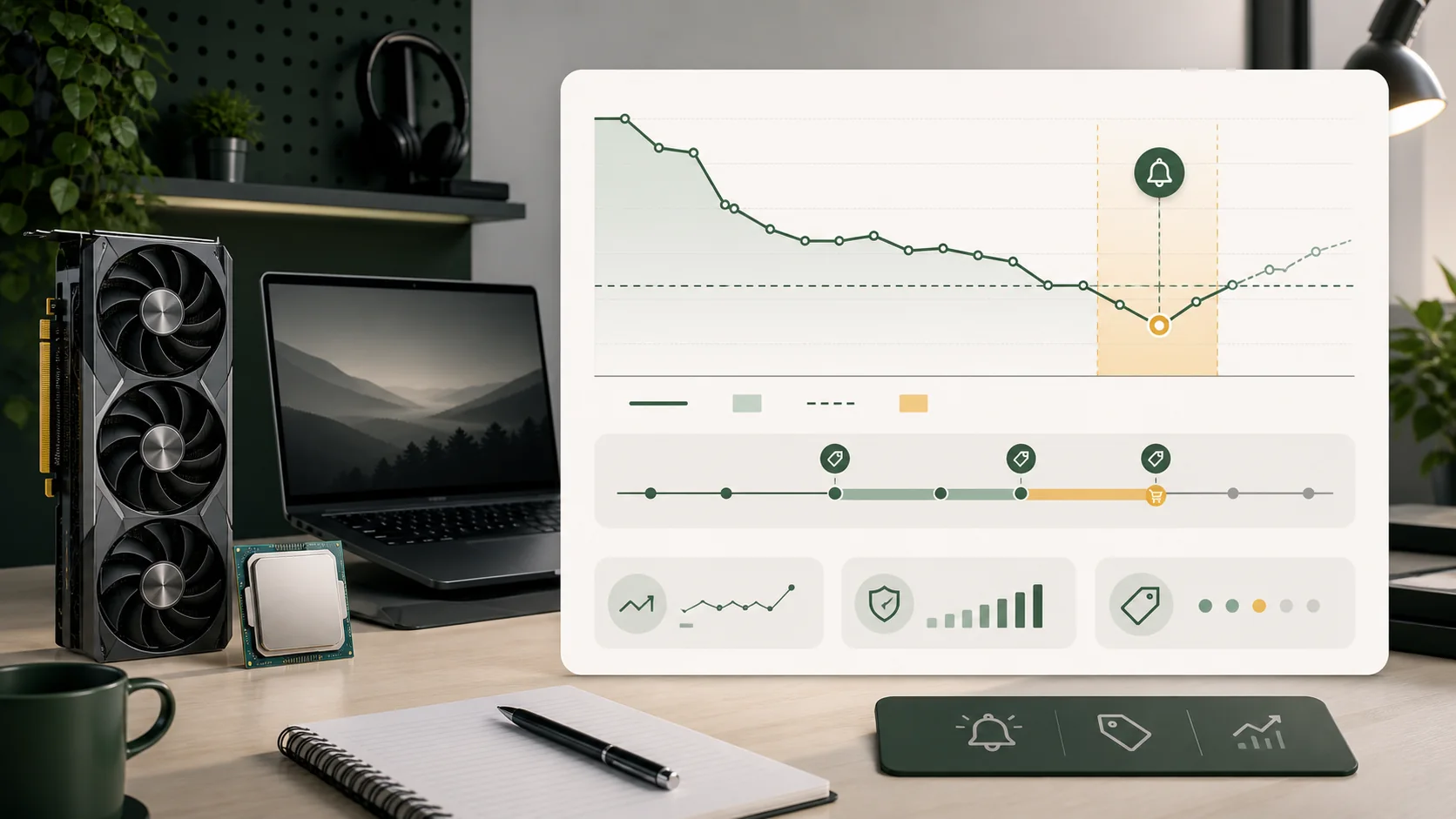
A genuine price drop shows a clear downward trend over multiple weeks or months in a price-tracking tool’s historical chart, not just a single-day dip that reverts shortly after, and comparing a current listed price against the lowest price that specific model has actually reached in the recent past (rather than just its launch MSRP or its highest recent price) gives a much more accurate sense of whether a current price is genuinely good or simply average for that card.
Price-tracking browser extensions and dedicated tracking sites maintain historical pricing data across major retailers specifically for this purpose, and checking a GPU’s price history before purchasing, particularly around advertised sale events, takes only a minute or two but reliably catches the inflated “was” price tactic covered earlier, as well as confirming whether a currently advertised price genuinely represents the lowest that model has been available for recently.
Cross-referencing pricing across multiple retailers simultaneously, rather than relying on a single storefront, also matters, since identical GPU models frequently show meaningfully different pricing between retailers at any given moment based on each retailer’s own inventory position and promotional calendar; our best GPU deals coverage aggregates current pricing across major retailers specifically to make this cross-referencing faster than checking each site individually.
Budget Versus Flagship GPU Pricing Dynamics
Budget and mid-range GPUs generally show more stable, less volatile pricing over their lifecycle compared to flagship models, since demand for budget cards is more consistently driven by steady replacement-cycle buyers and new PC builders rather than the launch-window enthusiast rush that drives flagship pricing volatility; this makes budget GPU pricing somewhat more predictable and less prone to the dramatic launch-window premiums seen on flagship cards.
Flagship GPU pricing shows the most dramatic launch-window premiums and the most significant eventual discounts, since limited initial production of the most complex, highest-margin chips combined with strong enthusiast demand creates the steepest early scarcity pricing, which correspondingly means flagship cards often show the largest percentage price drops by the time a next-generation replacement approaches, making patient buyers of flagship-tier performance the biggest beneficiaries of end-of-generation timing.
Our best budget GPU deals and best GPU deals coverage tracks both tiers separately specifically because the pricing patterns and optimal buying windows differ meaningfully between them; a strategy of waiting for end-of-generation clearance pricing works especially well for flagship tier shopping, while budget tier buyers often find reasonably good pricing available consistently without needing to time a purchase around a specific lifecycle window as precisely.
How Refurbished And Open-Box Pricing Fits The Picture
Refurbished and open-box GPU listings typically price 10-25% below new retail pricing for the same model, reflecting the lack of full manufacturer packaging, a shorter or third-party warranty in many cases, and the simple fact that the unit has been previously owned or returned, even when functionally identical to new; this represents a separate, generally more stable pricing tier that doesn’t follow the same launch-window volatility as new GPU pricing, since it’s driven by used-market supply and demand rather than manufacturer production and distribution timing.
The specific discount available on refurbished stock tends to widen as a GPU generation ages and used-market supply grows from upgraders selling their previous cards, which means refurbished pricing can sometimes offer meaningfully better relative value than waiting for new-unit end-of-generation clearance pricing, particularly for buyers comfortable with a shorter warranty window in exchange for a larger immediate discount; our best refurbished gaming PC deals coverage details which retailers and marketplaces offer the most reliable refurbished GPU warranty terms worth trusting.
Buyers considering refurbished or open-box GPU pricing should weigh the discount against warranty length specifically, since a significantly shorter warranty (commonly 90 days versus a full 2-3 year manufacturer warranty on new stock) shifts more risk onto the buyer if a defect surfaces after that window closes, a tradeoff worth factoring into whether the discount genuinely represents better value for your specific risk tolerance and how long you intend to keep the card.
Troubleshooting: Making Sense Of Confusing Or Inconsistent GPU Prices
If a GPU’s price seems unusually high compared to its MSRP or historical average with no apparent sale event or supply news explaining it, check whether that specific model is a premium board-partner variant (larger cooler, factory overclock, extended warranty) rather than the base configuration you might be comparing it against, since board partner variance, covered earlier, is the single most common source of this kind of apparent pricing confusion.
If a price seems suspiciously low compared to every other listing for the same model, verify the retailer is authorized and the listing isn’t for a different, lower-spec variant with a similar-sounding name, a used or damaged unit not clearly marked as such, or a pricing error that retailers sometimes cancel and refund rather than honor; checking recent buyer reviews specifically on that listing, not just the general product page, often reveals whether other buyers have successfully received the genuine item at that price.
If you’re trying to decide whether to buy now or wait based on pricing trends, check a price-tracking tool’s historical chart for that specific model, consider where the current GPU generation sits in its overall lifecycle (recent launch versus approaching a next-generation replacement), and check current supply commentary from retailers or tech news coverage, since a combination of a downward historical trend, mid-to-late lifecycle timing, and no reported supply constraints together suggest current pricing is reasonably close to what you’re likely to find waiting further, absent a specific upcoming sale event you’re specifically targeting.
Frequently asked questions
Why do GPUs never sell at MSRP?
MSRP typically applies only to a manufacturer’s own reference or Founders Edition card, while board partner models (ASUS, MSI, Gigabyte and others) set their own prices reflecting their specific cooler design, factory overclock and warranty terms, which is why most retail listings run above the MSRP quoted in launch announcements.
Do GPU prices actually drop after launch, or is that a myth?
Prices do drop after launch in most cases, typically 5-15% within the first 3-6 months as initial demand is satisfied and retailers compete for sales, though the exact timing and size of the drop depends heavily on demand relative to available supply for that specific model.
Is it worth buying a GPU during a launch window or waiting?
Waiting 2-3 months after launch generally gets a better price and more model availability, since launch-window pricing is often inflated by limited initial supply, while an established GPU with mature supply and driver optimization at a settled price is usually the better value unless a specific card is genuinely sold out everywhere.
Why do the same GPU model’s prices vary so much between retailers?
Retailer pricing varies based on their own inventory costs, promotional cycles, and how much stock they’re carrying of a specific model, which is why checking a price-tracking tool across multiple retailers rather than a single site is the most reliable way to identify a genuinely good price versus typical routine variation.
Does a GPU’s price ever go back up after it drops?
Yes, this happens most often near the end of a GPU generation’s production life as supply tightens before discontinuation, during periods of component shortage, or when a currency or tariff change affects import costs, so a lower price isn’t guaranteed to be permanent even after it’s been reached once.


