Cutting the cable on a tight budget used to mean accepting a laggy connection or a sensor that spun out during fast flicks. That trade-off has mostly disappeared at the entry level, so the real decision now is narrower: do you want replaceable batteries or a rechargeable cell, a small ambidextrous shell or a sculpted right-handed one, and how many buttons does your game actually need?


This roundup is for first-time wireless buyers, laptop gamers who travel, and anyone replacing a worn-out wired mouse without moving into premium territory. Every pick below was chosen from its Amazon product name and listed specifications, and each one is a dedicated wireless gaming mouse rather than an office model with gaming styling.
Our Top Picks
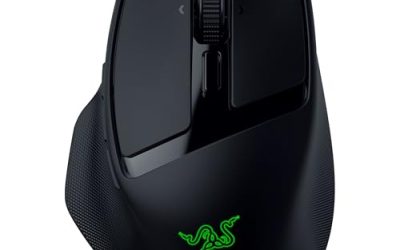
 Razer Basilisk V3 X HyperSpeed Customizable Wireless GamingStandard5.12 x 2.96 x 1.67 inches0.2 poundsCheck on Amazon
Top 3 picks at a glance
Quick Picks
As an Amazon Associate we earn from qualifying purchases.
| Product | Best for | Key spec from title |
|---|---|---|
| Logitech G305 LIGHTSPEED | All-round starter wireless mouse | HERO sensor up to 12,000 DPI |
| Corsair Harpoon RGB Wireless | Players who want Bluetooth as a backup | 10,000 DPI optical sensor |
| SteelSeries Rival 3 Wireless | Anyone who hates charging or swapping cells often | 400+ hour battery life |
| Razer Basilisk V3 X HyperSpeed | Palm-grip players who use extra buttons | 18K optical sensor, 9 programmable controls |
How to Choose
Decide how the mouse connects before anything else
Every mouse here uses a 2.4 GHz USB receiver for gaming, and that receiver is the connection that matters for response: the G305 and the Harpoon both quote a 1 ms or sub-1 ms report rate over their proprietary links. Bluetooth, offered by the Harpoon, Rival 3 Wireless and Basilisk V3 X, is a second channel for a laptop or tablet, not the mode to play ranked matches in. If your PC has few free USB ports, note that the receiver occupies one permanently, and none of these mice can fall back to a cable-free connection on a desktop without either the dongle or Bluetooth support.
Match the battery style to your habits
Two different philosophies sit in this lineup. The G305 runs up to 250 hours on a single AA cell, the Basilisk V3 X stretches to 285 hours on HyperSpeed and far longer over Bluetooth on one AA, and the Rival 3 Wireless claims more than 400 hours from its AAA cells, even running on just one of them. The Harpoon instead uses a built-in rechargeable battery rated up to 60 hours in Bluetooth mode, topped up over USB. Replaceable cells suit players who keep spares in a drawer; a rechargeable mouse suits anyone who would rather plug in overnight once in a while.
Read sensor numbers for range, not bragging rights
The headline figures span 10,000 DPI on the Harpoon to 18,000 CPI on the Rival 3 Wireless and the Basilisk V3 X, with the G305’s HERO sensor covering 200 to 12,000 DPI. In practice, most players settle somewhere in the lower half of any of these ranges, so the ceiling rarely decides a match. What matters more is clean tracking at your chosen setting: the Rival 3’s TrueMove Air is rated at 400 IPS and 40G, and the G305 quotes over 400 IPS, both comfortably beyond what fast swipes in a shooter demand. Treat the big number as headroom, then check the tracking speed.
Fit the shape and button count to your grip
The G305 uses a compact, symmetrical shell that suits claw and fingertip grips and either hand on the desk, though its side buttons sit on the left only. The Rival 3 Wireless is an ergonomic right-handed shape, also aimed at claw and fingertip players, at 120.6 mm long. The Basilisk V3 X is the largest and most sculpted here, built for a palm grip, and it carries nine programmable controls against six on each rival. The Harpoon splits the difference with a contoured right-handed body and rubber side grips. Measure your current mouse before ordering; a few millimetres changes how a shell feels.
The 4 Best Options
Logitech G305 LIGHTSPEED
The G305 is the default recommendation in this price band because it makes so few mistakes: a proven HERO sensor, a 1 ms LIGHTSPEED connection, six programmable buttons and a receiver that stores inside the shell when you travel. At 99 grams with its AA battery fitted it is light enough for low-sensitivity arm aiming, and the symmetrical shape flatters claw and fingertip grips. Players who want one mouse that simply works everywhere, and who would rather swap a battery a few times a year than think about charging, should start here.
Specs
- Sensor: HERO optical, 200 to 12,000 DPI
- Tracking speed: over 400 IPS
- Connection: LIGHTSPEED 2.4 GHz wireless via USB receiver, 1 ms report rate
- Battery: 1 AA (included), up to 250 hours of continuous gameplay
- Buttons: 6 programmable, with on-board memory
- Weight: 99 g
- Compatibility: PC and Mac
Best for: First-time wireless buyers who want the safest all-round pick.
Watch out for: There is no Bluetooth and no wired fallback, so a lost receiver means a mouse that cannot connect until it is replaced.
ASIN: B07CMS5Q6P
Corsair Harpoon RGB Wireless
Corsair’s Harpoon is the flexible one in this group. Its Slipstream link promises sub-1 ms response for gaming, yet the same mouse can pair over Bluetooth with a laptop or plug in over USB and keep playing while its internal battery charges. The contoured shell and rubber side panels give palm and relaxed claw grips something to hold onto, and iCUE handles DPI steps, lighting and battery monitoring in one place. Choose it if your mouse splits its life between a gaming desktop and a second machine, and you want one device covering both without carrying a spare.
Specs
- Sensor: Optical, up to 10,000 DPI
- Connection: Slipstream 2.4 GHz wireless (sub-1 ms), Bluetooth, or USB wired
- Battery: Built-in rechargeable lithium polymer, up to 60 hours in Bluetooth mode
- Buttons: 6 programmable
- Switches: Omron, rated for more than 50 million clicks
- Weight: 99 g
- Extras: RGB backlighting, iCUE software support, USB charging and data cable and wireless transceiver in the box
Best for: Players who move between a gaming PC and a laptop and want Bluetooth plus a wired fallback.
Watch out for: The 60-hour figure applies to Bluetooth mode, so expect to charge more often when gaming on the Slipstream connection.
ASIN: B07KQWR72Z
SteelSeries Rival 3 Wireless
Battery anxiety is the Rival 3 Wireless’s whole target. Its Quantum 2.0 dual wireless system pairs a 2.4 GHz dongle for play with Bluetooth 5.0 for everything else, and the listing rates it beyond 400 hours in its high-efficiency mode. Unusually, it runs on two AAA cells but keeps working on one, dropping the weight from 106 g to 95 g if you prefer a lighter mouse. The TrueMove Air sensor reaches 18,000 CPI with 400 IPS tracking, and the dongle tucks inside the body for travel. Pick it for a laptop bag or a desk where charging cables are unwelcome.
Specs
- Sensor: TrueMove Air optical, up to 18,000 CPI, 400 IPS, 40G
- Connection: 2.4 GHz wireless via micro-dongle, Bluetooth 5.0
- Battery: 2 AAA (included), 400+ hours in high-efficiency mode; can run on a single AAA
- Buttons: 6
- Switches: SteelSeries mechanical, rated for 60 million clicks
- Weight: 106 g with two AAA batteries, 95 g with one
- Shape: Ergonomic right-handed, claw and fingertip grip styles
Best for: Travel and laptop gaming, and anyone who wants the longest gap between battery changes.
Watch out for: The longest battery figures come from the high-efficiency mode, and the right-handed shell will not suit left-handed players.
ASIN: B08GB2PF71
Razer Basilisk V3 X HyperSpeed
Where the other three mice keep things minimal, the Basilisk V3 X adds controls: nine programmable inputs on a wide, sculpted right-handed body with a thumb rest, aimed squarely at palm-grip players who bind abilities, pings or macros to the mouse. Its 5G Advanced optical sensor tops out at 18,000 DPI, HyperSpeed wireless handles gaming duty, and Bluetooth takes over for work, stretching a single AA cell to as much as 535 hours in that mode against 285 hours on HyperSpeed. It is the heaviest and largest mouse here, which palm grippers in slower-paced games will read as stability rather than bulk.
Specs
- Sensor: Razer 5G Advanced optical, up to 18,000 DPI
- Connection: HyperSpeed 2.4 GHz wireless and Bluetooth
- Battery: 1 AA (included), up to 285 hours on HyperSpeed, up to 535 hours on Bluetooth
- Controls: 9 programmable
- Switches: Razer Mechanical Mouse Switches Gen-2
- Lighting: Razer Chroma RGB
- Dimensions: 5.12 x 2.96 x 1.67 inches
- Weight: 3.88 ounces
Best for: Palm-grip players of MOBA, MMO and strategy titles who actually use extra buttons.
Watch out for: The size and weight count against it for fast, low-sensitivity FPS play, and the shape is right-handed only.
ASIN: B0BXBC26X8
Which One Fits Your Situation
You play competitive shooters on a budget
Start with the G305. Its HERO sensor tracks past 400 IPS, the LIGHTSPEED link reports at 1 ms, and at 99 grams it stays easy to flick and stop precisely. The Rival 3 Wireless is the alternative if you also need Bluetooth, accepting a slightly heavier shell with both AAA cells fitted, or a lighter one with a single cell.
Your mouse travels with a laptop
The Rival 3 Wireless was built for this: the dongle stores inside the mouse, Bluetooth covers hotel-room work, and the battery life is measured in weeks of play rather than days. The G305 also stores its receiver internally and is a touch smaller, so it is the fallback if you prefer Logitech’s shape and software.
You play MMOs and MOBAs with lots of keybinds
Take the Basilisk V3 X HyperSpeed. Nine programmable controls give your thumb and fingers real work to do, the palm-filling shape stays comfortable through long sessions, and the battery lasts for months of evening play on HyperSpeed. The Harpoon’s six buttons and iCUE macros are the compromise if the Razer’s shell is too large for your hand.
One mouse has to cover gaming and office work
The Harpoon RGB Wireless handles the split most gracefully, moving between Slipstream for games, Bluetooth for a work laptop and a cable when the battery runs low mid-session. The Rival 3 Wireless runs it close on the strength of its battery life, but it cannot be used wired, so a flat battery ends play until you find fresh cells.
Common Mistakes
- Buying by the biggest DPI number, then playing at a fraction of it; tracking quality at your actual setting matters more than the ceiling.
- Playing competitive games over Bluetooth because it paired first, instead of switching to the 2.4 GHz receiver the mouse shipped with.
- Ignoring hand size and grip style, then blaming aim when a shell that is too large or too small is the real problem.
- Choosing a rechargeable mouse but never building a charging habit, or choosing a battery mouse and keeping no spare cells in the house.
- Leaving the receiver plugged into the back of a tower under a desk, where the signal path is worst, instead of using a front port or a short extension.
Frequently Asked Questions
Is a budget wireless mouse responsive enough for FPS games?
Yes, provided you use the 2.4 GHz receiver rather than Bluetooth. The G305 quotes a 1 ms report rate over LIGHTSPEED and the Harpoon promises sub-1 ms over Slipstream, figures in the same territory as wired mice. Bluetooth modes are meant for convenience and battery saving, not for ranked play.
How long do the batteries in these mice really last?
The listings rate the G305 at up to 250 hours on one AA, the Rival 3 Wireless beyond 400 hours from its AAA cells in high-efficiency mode, and the Basilisk V3 X at up to 285 hours on HyperSpeed. The rechargeable Harpoon is rated up to 60 hours in Bluetooth mode. Lighting and polling settings shorten all of these figures.
Can I use one of these mice with a console or a Mac?
The Rival 3 Wireless lists Windows, Mac, Xbox, PlayStation 4, PlayStation 5 and Linux compatibility, and the Harpoon lists PC, Mac, PS5, PS4 and Xbox support. The G305 is listed for PC and Mac. Console support varies by game, so check the title you play before relying on it.
Should I pick replaceable batteries or a rechargeable mouse?
Replaceable cells, as in the G305, Rival 3 Wireless and Basilisk V3 X, mean a flat battery is a thirty-second swap and the mouse never tethers you to a cable. A rechargeable model like the Harpoon removes battery purchases and can be used wired while charging, but its runtime between charges is far shorter.
Related guides
More from Amazon
Programs that pair well with the guide above. Offers and eligibility are set by Amazon and may change.
Free shipping on eligible items, Prime Video and more. Eligible new members can start with a free trial.
Start a Prime free trialAd-free music streaming. Eligible new subscribers can start with a free trial.
Try Music Unlimited freeA Prime membership for ages 18-24 with a trial period. Eligibility is set by Amazon.
See Prime for Young AdultsAudiobooks and podcasts to listen to on the go. Eligible new members can start with a free trial.
Try Audible freeAs an Amazon Associate we earn from qualifying purchases.