Most people shopping for a managed Ethernet switch are not trying to build a data center. They have a home office, a few cameras, a gaming console, a NAS, and a router that cannot keep them apart, and they want to carve the network into pieces: one VLAN for guests, one for cameras, priority for video calls. A managed switch gives you that control, which an unmanaged box cannot. The decision this keyword implies is how much management you actually need, and whether you also need to feed power to cameras and access points over the same cable.
This guide is for home-lab beginners, small-office owners, and gamers who want traffic rules without paying for enterprise gear. It covers seven switches from five to eight ports, including two models that supply Power over Ethernet. Most are “Easy Smart” web-managed designs, which sit between a plain unmanaged switch and a full command-line unit. An unmanaged NETGEAR model that appeared in the source list was dropped because it does not match the keyword, and sibling variants were trimmed to keep each entry distinct.
Our Top Picks
 NETGEAR 5-Port Gigabit Ethernet Easy Smart Managed Network5-Port3.7 x 3.9 x 1.1 inches0.55 poundsCheck on Amazon
 NETGEAR 8 Port PoE Gigabit Ethernet Easy Smart8 Port, PoE+ @ 62W6.2 x 4 x 1.1 inches2.4 poundsCheck on Amazon
 NETGEAR 5-Port Gigabit Ethernet Unmanaged Network Switch5 Port6.2 x 4 x 1.1 inches0.55 poundsCheck on Amazon
Top 3 picks at a glance
Quick Picks
As an Amazon Associate we earn from qualifying purchases at no extra cost to you.




| Product | Best for | Key spec from the title |
|---|---|---|
| NETGEAR GS305E | Small desks needing a few VLANs | 5-port gigabit Easy Smart, silent |
| TP-Link 8 Port Easy Smart | Home offices with many devices | 8 ports, QoS, VLAN, IGMP |
| TP-Link TL-SG105E | Compact desktop setups | 5-port, metal case, lifetime replacement |
| NETGEAR GS308EP | Cameras and access points | 8 x PoE+ ports at 62W |
| D-Link 8-Port Smart Managed | Feature-hungry small networks | L2, VLANs, QoS, IGMP snooping, LAG |
| STEAMEMO 8-Port PoE+ | Larger PoE camera loads | 120W built-in power, 2 uplinks |
| Goalake 5 Port Managed | Light-duty small offices | 5-port, VLAN and QoS |
How to Choose
Decide how much management you need
“Easy Smart” switches use a browser interface for VLANs, QoS, and port mirroring, and that covers nearly every home scenario. Fully managed Layer 2 switches add features such as link aggregation and detailed protocol controls. If you only want to isolate guest Wi-Fi from your office gear, you do not need the deep end of the feature list. Check that the listing names the specific features you want rather than the general word “managed”. Ignore throughput marketing on small gigabit switches, since every port on these models is limited to the same speed, and focus on VLAN count, QoS options, and whether the settings page runs in an ordinary browser.
Choose port count with room to grow
Count wired devices now: router uplink, PC, console, NAS, printer, cameras, access points. Then add two or three spare ports. Five ports fill up faster than expected, and eight give breathing room without much more cost. Remember that one port becomes the uplink to your router, so a five-port switch gives four usable device ports. If a second switch might join later, an eight-port unit or a model with extra uplinks keeps the upgrade path open without rewiring the room.
Work out the PoE budget if cameras are involved
PoE models list total power in watts, such as 62W, 63W, or 120W built-in. Add up the devices you will power: cameras and access points typically draw modest amounts each, but the total must stay below the switch budget. A unit with eight PoE+ ports but a 62W budget cannot run eight hungry devices at once. If you have no PoE devices, skip the premium and buy a non-PoE model. PoE models also run warmer and may need ventilation, so avoid burying one in a closed cabinet.
Check build quality and mounting
Metal cases with shielded ports dissipate heat and resist static, and fanless designs stay silent in a bedroom office. Desktop and wall-mount options matter in tight spaces. Budget models cut corners on warranty coverage, firmware support, and the quality of the power brick, so look for lifetime or multi-year replacement terms where the listing offers them.
The 7 Best Options
NETGEAR GS305E
A five-port gigabit Easy Smart managed switch with desktop or wall mounting and silent operation, according to the title. It is a modest step up from an unmanaged splitter, giving enough control to separate a few devices on their own VLANs.
- Strength: silent operation suits a desk or bedroom setup.
- Strength: desktop and wall-mount flexibility helps in tight spaces.
- Trade-off: five ports leave only four for devices once the router uplink is used.
Skip it if you already own more than four wired devices or need PoE for cameras. A typical fit is a studio apartment where a router, a gaming PC, a console, and a printer share one tidy cable run, and a guest VLAN is the only advanced feature anyone wants.
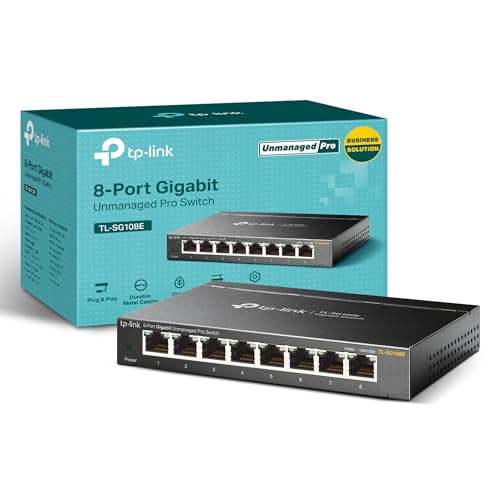
TP-Link 8 Port Easy Smart
An eight-port gigabit switch with plug-and-play setup, metal housing, shielded ports, and support for QoS, VLAN, and IGMP. It handles a busy home office, with room for a PC, console, NAS, and access point at once.
- Strength: eight ports give room for a growing network.
- Strength: QoS and VLAN support let you prioritize calls and isolate devices.
- Trade-off: no PoE is listed, so cameras need their own power supplies.
Skip it if you want to power cameras or access points over the same cable. For a work-from-home desk, the metal shell and shielded ports are reassuring, and the eight-port count means you can leave a spare jack for a laptop dock without unplugging anything.
TP-Link TL-SG105E
The compact five-port option, built for desktops, with a sturdy metal case, shielded ports, and a limited lifetime replacement promise. It is plug and play, so a basic setup needs no configuration at all.
- Strength: the lifetime replacement coverage is a strong confidence signal at this size.
- Strength: it works as an unmanaged switch out of the box and grows into VLANs later.
- Trade-off: five ports can fill up quickly.
Skip it if your network already has more than four devices. It makes the most sense as a first managed switch for someone who is curious about VLANs but not ready to commit to a larger box, since the interface is easy to ignore until needed.
NETGEAR GS308EP
An eight-port Easy Smart managed switch where all eight ports deliver PoE+, with a combined 62W budget. The title calls it an Essentials model for desktop or wall-mount use.
- Strength: PoE+ on every port suits a mix of cameras and access points.
- Strength: the 62W total is clearly stated, so you can plan loads.
- Trade-off: 62W is shared, so a full set of power-hungry devices may exceed it.
Skip it if you only have standard devices that need no PoE. Before ordering, add up the wattage listed for each camera or access point you plan to connect, and leave a margin so the switch never runs at its limit.
D-Link 8-Port Smart Managed
An eight-port gigabit Layer 2 switch listing VLANs, QoS, IGMP snooping, and LAG, in a sturdy, fanless metal body with shielded ports. It offers one of the longest feature lists in the group.
- Strength: link aggregation support is rare at this size and helps with NAS throughput.
- Strength: fanless and metal, so it runs silently.
- Trade-off: the larger feature set means a longer learning curve.
Skip it if you want a pure plug-and-play device without any settings. Anyone who plans to bond two ports to a NAS, or who streams media across several rooms, will appreciate the options, but they come with menus that deserve an evening of reading.
STEAMEMO 8-Port PoE+
A managed switch with eight PoE ports plus two uplinks and 120W of built-in power, supporting VLAN and QoS in a fanless metal case. It is the high-capacity PoE option in this list.
- Strength: 120W of built-in power handles a bigger group of cameras.
- Strength: the two uplink ports offer flexibility for connecting to other switches.
- Trade-off: the title does not mention a warranty term, so confirm coverage before buying.
Skip it if you want a name-brand ecosystem with long-term firmware updates. A shop with a dozen cameras, or a workshop with a camera at every door, is the audience, because the combined power budget is what sets this unit apart.
Goalake 5 Port Managed
A five-port gigabit Easy Smart switch with VLAN and QoS support, desktop or wall mount, aimed at small offices and home networks.
- Strength: managed features in a small footprint.
- Strength: wall-mount option helps with tidy cable runs.
- Trade-off: another five-port design, with the same port-count limit.
Skip it if you need PoE or plan to expand soon. It is a light-duty choice for a reception desk or a spare-room office, where the goal is to keep a phone system and a guest laptop on separate segments.
Which One Fits Your Situation
You run four security cameras
Choose the NETGEAR GS308EP for its PoE+ ports, or the STEAMEMO if the camera load is larger. Put the cameras on their own VLAN so a compromised device cannot reach your laptops, and set the recorder to a static address.
You work from home and want call priority
The TP-Link 8 Port Easy Smart gives QoS and VLAN control with enough ports for a full desk. Mark your video-call device as high priority, and a large download on the console will stop stuttering the meeting.
You want advanced options on a budget
The D-Link 8-Port includes LAG and IGMP snooping, useful for a NAS and media streaming. IGMP snooping keeps multicast video from flooding every port, which can help in a house with several streaming boxes.
You have a tiny desk
The TP-Link TL-SG105E or NETGEAR GS305E fit easily and cover basic VLAN needs. Either one can sit behind a monitor or on a shelf, and both leave the wall socket free for the router.
Common Mistakes
- Paying for PoE when no devices need it, then running a loud, warm switch for nothing.
- Forgetting that the uplink uses one port.
- Exceeding the PoE power budget with too many devices.
- Confusing “smart” with unmanaged and skipping the VLAN setup.
- Leaving the default settings and admin credentials in place in 2026.
Related guides
- Gaming Chair Cushions And Lumbar Supports
- Travel Backpack With Laptop Compartment
- Business Laptops With Long Battery Life
Frequently Asked Questions
What is the difference between managed and unmanaged?
A managed switch lets you configure VLANs, QoS, and monitoring. An unmanaged switch just passes traffic. The managed models here use a web page for setup, so no command-line skills are required.
Do I need a managed switch at home?
Only if you want to separate devices or prioritize traffic. Otherwise an unmanaged switch is simpler. Smart-home gadgets, cameras, and guest laptops are the usual reasons people step up.
What is PoE+?
PoE+ delivers more power over Ethernet than basic PoE, enough for cameras and access points. It runs power and data through one cable, which removes the need for an outlet near each device.
Can I mix managed and unmanaged switches?
Yes. Connect them by Ethernet, and VLAN rules apply only to the managed unit’s ports. Keep the managed switch closest to the router so its rules cover the traffic you care about most.
Related guides
More from Amazon
Programs that pair well with the guide above. Offers and eligibility are set by Amazon and may change.
Free shipping on eligible items, Prime Video and more. Eligible new members can start with a free trial.
Start a Prime free trialAd-free music streaming. Eligible new subscribers can start with a free trial.
Try Music Unlimited freeA Prime membership for ages 18-24 with a trial period. Eligibility is set by Amazon.
See Prime for Young AdultsAudiobooks and podcasts to listen to on the go. Eligible new members can start with a free trial.
Try Audible freeAs an Amazon Associate we earn from qualifying purchases.